Create your very own Auto Publish News/Blog Site and Earn Passive Income in Just 4 Easy Steps
This blog post was last updated on October 9, 2025.
There are many good reasons to find an email marketing strategy that works for your business.
Email marketing campaigns are one of the most cost-effective marketing efforts you can undertake for your brand. Email marketing campaigns not only help you reach a large portion of your target audience with a simple click. They are also an essential tool for increasing brand awareness, attracting prospects, staying top of mind with current and potential customers, and providing your audience with an exceptional digital experience.
Do you need even more convincing? Here are some impressive statistics about what getting started with email marketing can do for your business:
It’s no wonder why marketers around the world invest so much time and resources into email marketing and why it has become a mainstay of effective public relations.
Plus, With increasing privacy restrictions and algorithm uncertainty on social platforms, your email list is more important than ever.
However, the email game has evolved. Email tools are smarter (hello, AI), deliverability rules are stricter, and analytics are more comprehensive. With Benchmark Email, you don’t just get a tool – you unlock features designed for this new era.
Before we get into how, here’s what works today:
- Permission-first lists (not a quick purchase)
- Clear, relevant content
- Strong delivery hygiene
- Iterative performance measurement
- Compliance and data protection awareness
Now let’s map these basics through the lens of Benchmark Email.
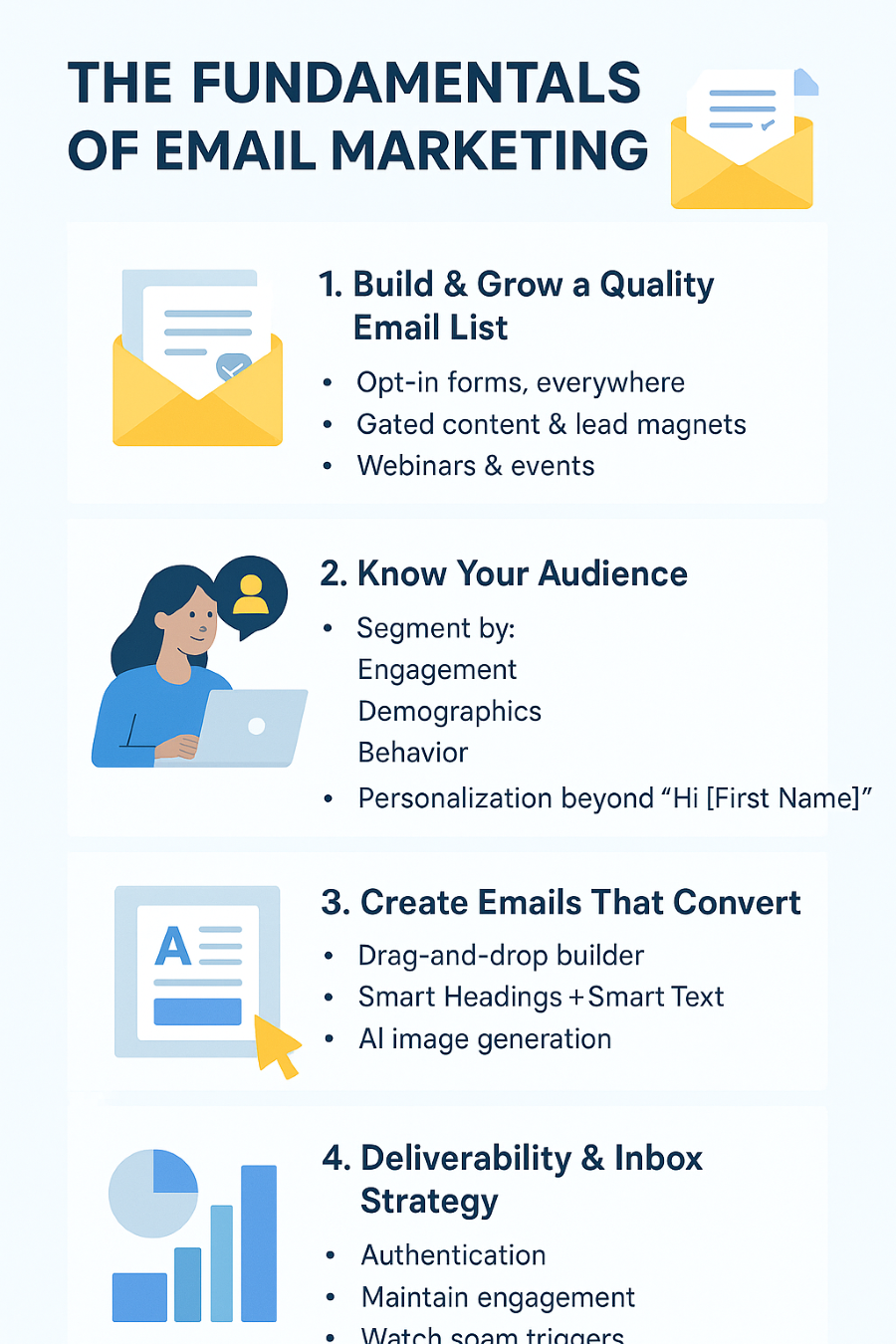
1. Build and Grow a Quality Email List (The Right Way)
Without a solid list, even the best email won’t reach the interested eyes.
Best Practices:
- Opt-in forms everywhere: Place them on your homepage, blog posts, footers, social bios, and pop-ups. But nothing intrusive – Benchmark supports embedding signup forms with smart design standards.
- Gated content and lead magnets: Offer e-books, checklists, or guides in exchange for an email. However, add explicit consent for future emails (not just the protected asset).
- Webinars and events: Great for lead acquisition – but follow up with a sequenced email series (see below).
- Double opt-in/confirmation emails: Adds a layer of quality control and reduces the risk of incorrect addresses.
What to avoid:
- Never buy lists. They often result in spam complaints, poor engagement, and jeopardize your sender’s reputation.
- Avoid asking too many questions when signing up. Only ask for the bare minimum (e.g. email, maybe name). You can collect preferences later.
Benchmark tip: Use tags and segmentation early. For example, track which form a contact came from or what their area of interest is – this will help you send more relevant content later.
Free resource
The Complete Guide to Email Marketing
DOWNLOAD NOW
2. Know your audience (segment and personalize)
Today’s inbox is overflowing. The way to stand out is not volume, but relevance.
Segment by:
- Engagement (opens, clicks)
- Demographic data (location, role)
- Behavior (past purchases, content downloads)
- Likes (topics they like, frequency)
Personalization via “Hello [First Name]”:
Our Smart Text tools allow you to dynamically adapt language to your audience. For example:
- Use conditional copy snippets (if a contact is from X region, show regional content).
- Use a tone adjustment (formal or casual) depending on the segment.
Always aim for “this feels meant to them” rather than “mass email”.
3. Create Emails That Convert (Using Benchmark Email Tools)
The core structure is timeless: subject line, preheader, header image or logo, text content, CTA, footer. But how you build and polish it is where our software shines.
Drag and Drop Builder:
Skip the HTML chaos. Benchmark Email gives you modular blocks (text, image, button, separator, social) so you can put your email together like a LEGO building.
Smart Headings + Smart Text:
- Subject lines and section headings: Use Smart Headings to automatically generate dozens of options. Choose those that spark curiosity or urgency while remaining on-brand.
- Refine your copy: Paste your draft into Smart Text. Would you like it shorter? More convincing? Friendlier? One click transforms it.
AI image generation (if included):
Do you need images and don’t have any? Our built-in image tool (if available on your plan) can help you quickly create custom images tailored to your message.
Mobile-first mindset:
Always preview on mobile devices. Many templates adjust automatically, but complex blocks (side-by-side images, multi-column layouts) should be tested to ensure readability.
Call to Action (CTA) Best Practices:
- A clear primary CTA (e.g. “Shop Now”, “Download”)
- Place above the fold And at the bottom
- Use color contrast – make it stand out
- Copying anchor text is important – prefer “claim your space” to the vague “click here”
4. Deliverability and inbox strategy
Your email can be great – but if it doesn’t arrive in your inbox, it’s a wasted effort. These are updated best practices for 2025:
Authentication is non-negotiable:
- Set up SPF, DKIM, and DMARC for your sending domain.
- Use a consistent “From” address (name + domain) instead of free platforms (e.g. Gmail).

Free resource
Email Deliverability 101: Understanding the Basics of Reaching the Inbox
DOWNLOAD NOW
Maintain commitment:
- Clean up your list regularly. Suppress or re-enable unopened actions.
- Use re-engagement campaigns (e.g. “We missed you. Would you like to stay in touch?”)
- Avoid sudden spikes in sending volume – increase it gradually as your list grows.
Watch spam triggers:
- Excessive capitalization or punctuation (!!!)
- Misleading subject lines
- Too many external links in the first paragraphs
- Heavy HTML with little text (“image only” emails)
Manage bounces and complaints:
- Automatically suppress hard bounces
- Monitor spam complaint rates – if they spike, stop and check
- Add a clear and simple unsubscribe link
Insights into inbox variation and deliverability:
- Test with major inbox providers (Gmail, Outlook, Apple Mail)
- Use Benchmark’s deliverability dashboards to detect anomalies (e.g., rejections of certain domains, user complaints).
- Use seed lists (internal test addresses across domains) to monitor actual placement
5. Measure success with updated analytics
Key figures guide your decisions – but which ones are important now?
Key metrics to keep an eye on:
- Open rate: Still significant, but increasingly influenced by privacy settings (e.g. image blocking, opening Apple Mail’s proxy). Use this metric with caution.
- Click rate / click-to-open rate (CTOR): Much stronger signal of interest.
- Conversion/Target Rate: This is your money metric (purchase, signup, download).
- Unsubscribe and spam complaint rates: Signals for list health and content relevance.
- Commitment over time: Track trends per campaign and per segment.
- Deliverability and inbox placement metrics: Watch how many reach the inbox compared to spam or promotions.
Benchmark Email Advantage:
- You can link email performance to behavior (e.g. whether a contact clicked and then went to the website).
- Advanced segmentation allows you to compare variants (A/B subject lines, layout changes).
- Export trends and share dashboards with stakeholders.
About the tip: Don’t just look back. Use data to predict What your following email should do: which subject lines attract attention, which offers convert, which segments need more nurturing.
6. Compliance, data protection and regulation (2025 edition)
You can’t ignore it – but you don’t have to be afraid either.
Important rules and trends:
- GDPR/CCPA/other regional laws: Always record your consent clearly. Make it easy to unsubscribe or manage preferences.
- Privacy updates and email tracking: With Apple Mail’s mail privacy and similar features, open rate signals are blurred. This is why click and conversion metrics are now even more important.
- Data minimalism: Only collect what you need. If you ask for additional fields, explain why (e.g. “Your industry helps us customize your content”).
- Retention and deletion policies: Decide how long you want to keep inactive contacts and when you want to remove them or re-opt them.
- Transparent footers and identity: Provide your company address, contact information and an opt-out option.
- Integrations and data exchange with third parties: If you send emails through integrations, make sure those systems are compatible (e.g. your CRM, e-commerce).
7. Plan, iterate and scale
Just start. Then build.
- Campaign calendar: Decide on your broadcast frequency (weekly, bi-weekly, etc.) and topics in advance.
- Use A/B testing: Test subject lines, CTAs, layouts or timings. Let Benchmark Email’s analysis tell you what wins.
- Iterate based on data: Don’t reinvent every time – reuse what works and discard what doesn’t.
- Prepare for Growth: As you scale, you’ll want automation, advanced integrations, and collaboration. Benchmark Email is designed to grow with you.
Final Thoughts – From Basics to Moving Forward
The basics of email marketing – good list building, relevant content, deliverability hygiene, measurement and compliance – are still important. What has changed is How we make them.
With Benchmark Email you get modern tools (drag-and-drop editing, AI-powered smart text and smart headings, comprehensive analytics, built-in deliverability infrastructure) that make implementing these fundamentals faster, smarter and more scalable.
Author Biography:

by Natalie Slyman
Content Marketing Manager | Content marketing, inbound funnels, social media, email nurturing | Natalie Slyman is an experienced content marketing manager at Benchmark Email with a strong B2B background and a knack for creating pillar content that boosts SEO and brand authority. She regularly shares actionable insights—from remote work strategies to AI-powered content workflows—in blog posts and webinars tailored to busy marketers.
Create your very own Auto Publish News/Blog Site and Earn Passive Income in Just 4 Easy Steps