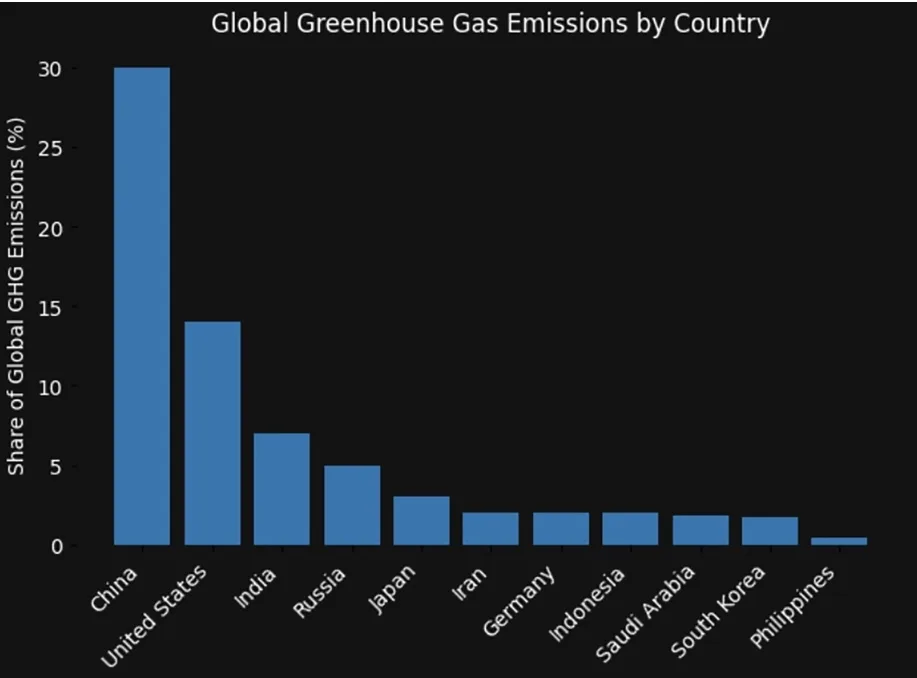
The Philippines sits on the heart of an ethical paradox within the international local weather debate. Producing barely lower than 1% of world emissions, the nation is amongst these most uncovered to local weather dangers, but least able to influencing the planet’s temperature trajectory. Demanding fast net-zero sacrifices from a creating financial system could fulfill international optics, nevertheless it does little to change local weather outcomes, whereas imposing actual prices on households, companies, and competitiveness. True local weather justice, on this context, will not be measured by symbolic targets, however by whether or not vitality coverage protects improvement, retains electrical energy reasonably priced, and avoids turning energy right into a privilege for the few.
The extra sturdy path ahead is disciplined pragmatism. The Philippines should pursue renewables aggressively, with out destabilizing the grid or pricing progress out of attain. An all-of-the-above vitality technique that preserves dependable baseload energy, whereas scaling clear applied sciences, will not be ideological compromise; it’s financial necessity. Growth itself is the nation’s strongest local weather protection, enabling resilience, adaptation, and long-term decarbonization.
The selection will not be between local weather duty and progress. For the Philippines, the one local weather technique that endures is one which retains the lights on, the payments manageable, and the financial system transferring ahead.
Each storm season brings the identical ethical chorus: the Philippines should speed up towards web zero to guard itself from local weather disaster. It’s a noble intuition. It’s also, by itself, a deceptive one. Web zero is an try to stability the quantity of greenhouse gases (GHGs) launched into the environment and the quantity eliminated.
The uncomfortable arithmetic is unavoidable. The Philippines accounts for roughly 0.46% of GHG emissions. Even when the nation miraculously achieved web zero in a single day, the trajectory of world warming would stay largely unchanged, pushed by the far bigger carbon footprints of business economies. Local weather change wouldn’t pause. Storms wouldn’t politely weaken at our borders. The planet would proceed warming as a result of international issues don’t reply to unilateral sacrifice by marginal emitters.
This actuality doesn’t absolve the Philippines of duty, nevertheless it does demand honesty. Local weather change is a collective-action drawback, and pretending in any other case dangers turning ethical urgency into financial self-harm. When a creating nation bears heavy prices for outcomes it can’t meaningfully affect, the consequence will not be local weather justice however a misplaced advantage.
That distinction issues as a result of the prices usually are not summary. They arrive month-to-month, printed on electrical energy payments, absorbed by households whose pockets are already stretched skinny. They seem in manufacturing facility margins, in meals costs, and within the quiet erosion of competitiveness that determines whether or not jobs are created or misplaced. An vitality transition that costs energy past the attain of strange Filipinos is not only politically fragile — it’s socially regressive.
That is the place the dialog should shift from symbolism to substance.

Is net-zero goal doable?
I get it that local weather justice for the Philippines begins not with emissions targets, however with improvement. Historical past provides no counterexample: no nation has lifted tens of millions out of poverty with out considerable, dependable, and reasonably priced vitality. Electrical energy will not be a luxurious add-on to progress; it’s its precondition. Clinics can’t refrigerate vaccines on intermittent energy. Faculties can’t train successfully by rolling brownouts. Manufacturing can’t scale on unstable grids.
For a rustic nonetheless climbing the event ladder, asking the poorest households to shoulder larger energy prices within the title of world emissions discount — when their contribution to the issue is negligible — is an ethical misallocation. Justice, on this context, means refusing to make electrical energy a privilege solely of the prosperous.
That ethical boundary leads naturally to a tougher, extra pragmatic conclusion: vitality coverage should be judged by outcomes, not intentions.
The Philippines wants renewables. Photo voltaic, wind, and different clear applied sciences are important to long-term sustainability, diversification, and resilience. However they don’t seem to be but substitutes for dispatchable baseload energy. Their variability is a technical constraint, not an ideological one. Till storage turns into low-cost and scalable, the grid requires agency capability — from coal, gasoline, and different standard sources — to stay secure and reasonably priced.
An vitality technique that treats this actuality as heresy somewhat than physics will not be progressive; it’s reckless. Brownouts usually are not local weather options. Neither are energy charges that render native manufacturing uncompetitive and quietly export jobs to nations with cheaper electrical energy and dirtier grids.
Because of this probably the most defensible transition technique will not be technological purity, however expertise agnosticism. An all-of-the-above vitality combine will not be a betrayal of local weather objectives: it’s the solely strategy to sequence the transition with out breaking the financial system within the course of. The target is to not delay renewables, however to combine them with out destabilizing the system they rely upon.

Attaining low-cost energy
Affordability, due to this fact, should be the true north. Not as a result of carbon doesn’t matter, however as a result of prices do. Electrical energy costs ripple by the financial system, shaping inflation, funding selections, and employment. When energy turns into costly, every thing else follows. A local weather coverage that ignores this actuality is not going to survive voter scrutiny, investor self-discipline, or fundamental arithmetic.
The irony is that improvement itself is among the simplest types of local weather adaptation. Wealthier societies construct stronger infrastructure, implement higher requirements, and get better sooner from disasters. They put money into resilience as a result of they will afford to. A poorer Philippines, constrained by excessive vitality prices and stalled progress, is extra — not much less — weak to local weather shocks.
That is the sequencing drawback many local weather debates refuse to confront. The query will not be whether or not the Philippines ought to decarbonize. It ought to, and it’ll. The true query is whether or not it might probably accomplish that with out undermining the very financial base that makes adaptation and resilience attainable.
The reply lies in disciplined pragmatism. Construct renewables aggressively the place they’re cost-effective. Strengthen the grid. Enhance market design. Encourage competitors. Deploy storage when it makes financial sense, not when it makes headlines. And use standard vitality because the bridge it was all the time meant to be — not as a everlasting crutch, however as insurance coverage in opposition to fragility.
In a world of absolutes, this strategy could sound insufficiently heroic. However in the actual world — the place households pay payments, factories compete, and governments face elections — it’s the solely technique that lasts.
The Philippines can’t save the planet by itself. However it might probably refuse to impoverish itself chasing the phantasm that it might probably. Local weather duty, for a creating nation, will not be about symbolic sacrifice. It’s about constructing an financial system sturdy sufficient to endure — and good sufficient to transition with out collapse. – Rappler.com

https://weblog.passive-income4u.com/create-your-very-own-auto-publish-news-blog-site-and-earn-passive-income-in-just-4-easy-steps/
https://www.rappler.com/voices/thought-leaders/vantage-point-truth-net-zero-emissions/