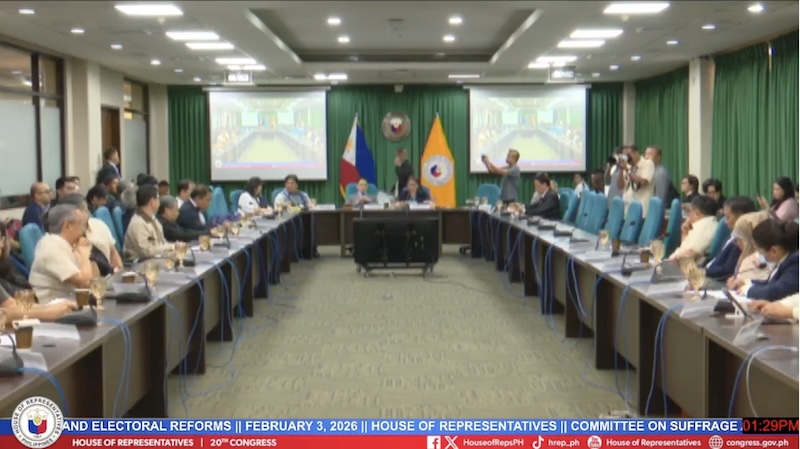
DAVAO CITY (MindaNews / 03 February) – The Home Committee on Suffrage and Electoral Reforms accepted at 3:59 p.m. on Tuesday a substitute invoice setting the date of the 1st Bangsamoro Parliamentary Elections to the second Monday of September and each three years thereafter.
The primary elected Members of Parliament will assume their posts on December 1, 2026.
The second Monday of September 2026 is on September 14 or 11 months after the scheduled October 13, 2025 elections that didn’t push by way of as a result of the Supreme Courtroom on September 30 declared as unconstitutional the 2 districting legal guidelines – Bangsamoro Autonomy Acts 58 and 77.
The substitute invoice amended Part 1 of Home Invoice 7236 filed by Lanao del Sur Representatives Zia Alonto Adiong and Yasser Alonto Balindong on January 21 which set the date of the election to September 28, 2026 and the following election to be held and synchronized with the nationwide and native elections in 2028, and each three years thereafter.
The modification paves the best way for the desynchronization of the Bangsamoro Parliamentary Elections from the Nationwide and Native Elections, however nonetheless sustaining the three-year time period mandated by the 1987 Structure and RA 11054 or the Natural Regulation for the Bangsamoro Autonomous Area in Muslim Mindanao (BARMM).
Adiong, chair of the Home Committee on Suffrage and Electoral Reforms, requested chair George Garcia of the Fee on Elections (Comelec) throughout the listening to livestreamed from the Home of Representatives in Quezon Metropolis, if the BARMM polls might be desynchronized from the nationwide and native polls.
“Last item I wish to see is one other group submitting one other petition once more earlier than the Supreme Courtroom,” Adiong stated, including this could once more delay the holding of elections.
Beneath Adiong’s and Balindong’s unique invoice, the primary elected Members of Parliament would maintain workplace just for 19 months as a substitute of three years as the following election is to be synchronized throughout the nationwide and native elections in Might 2028.
Adiong acknowledged the truncated time period would doubtless be questioned within the Supreme Courtroom.
He stated the BARMM has a distinct set-up from the nationwide authorities. The product of a peace settlement, the BARMM is the lone area within the nation with a parliamentary set-up beneath a Presidential system.
“Can that be a foundation to deal with the regional parliamentary election not a neighborhood election, not a nationwide election however a parliamentary election,” Adiong requested Garcia. He additionally requested if that might be a superb foundation for desynchronizing it from the nationwide and native elections. He stated desynchronizing would even be “in compliance with political autonomy, the true essence of a political autonomy.”
Garcia, an election lawyer earlier than he was appointed within the Comelec, replied that if Congress passes a regulation fixing the time period of three years and saying the following election is in 2029, this could be “tantamount to exception of the final rule,” so RA 7166 handed in 1991 which synchronized the conduct of nationwide and native elections is the final regulation and “this now, (beneath) the authorship of Zia (Adiong) is the exception being a particular regulation.”
Requested to touch upon desynchronized election, lawyer Ona Caritos, Govt Director of the Authorized Community for Truthful Elections (LENTE), advised the Committee that the BARMM polls, if separate from nationwide and native elections, will likely be given extra focus and “violence is decreased or minimized.”
The substitute invoice additionally deleted the whole Part 5 on the conduct of sectoral assemblies. Part 5 offers that Comelec might, when warranted by the election timeline, amongst others, authorize the reopening of the submitting of Manifestations of Intent of duly registered Parliamentary Sectoral Organizations.
Parliamentary Invoice 419 which amended some provisions of the Bangsamoro Electoral Code, revised the way of election for sectoral polls throughout the first Bangsamoro election – from sectoral assemblies to representatives elected straight by voters, aside from the Non-Moro Indigenous Peoples’ whose two representatives will proceed to be chosen by way of sectoral meeting. The opposite sectoral representatives – ladies, youth, settlers, Ulama and conventional leaders – will likely be straight elected.
Voters within the BARMM are to elect 80 Members of Parliament – 40 representing political events, 32 single district representatives, and eight sectoral representatives. (Carolyn O. Arguillas / Mindanews)
https://weblog.passive-income4u.com/create-your-very-own-auto-publish-news-blog-site-and-earn-passive-income-in-just-4-easy-steps/
https://mindanews.com/top-stories/2026/02/1st-barmm-polls-on-sept-14-2026-next-election-in-2029/