MANILA, Philippines – Within the Philippines, micro, small, and medium enterprises (MSMEs) make up nearly all registered corporations and make use of most staff. However if you take a look at the place formal credit score truly goes, they hardly obtain what they should develop.
Relying on the dataset and 12 months you cite, they account for about 99.5% to 99.6% of institutions, roughly round two-thirds of employment, and round 40% of output.
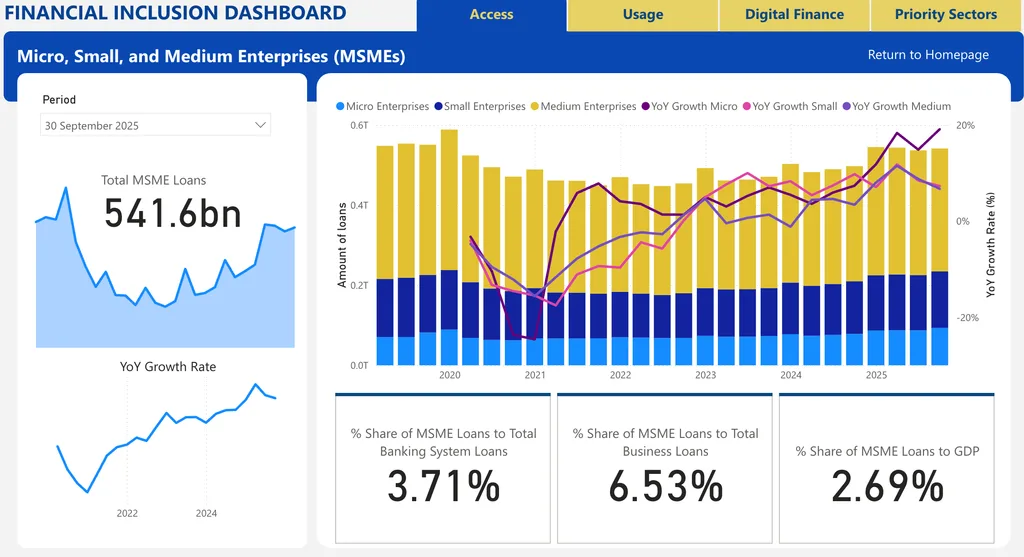
The Bangko Sentral ng Pilipinas’ (BSP) financial inclusion dashboard has repeatedly proven how small MSME lending is as a slice of the banking system, hovering across the low single digits in recent times. As of the most recent knowledge (Q3 2025), whole MSME loans have reached P541 billion, which sounds substantial however actually solely makes up 6.53% of all enterprise loans. That’s a pitifully small proportion for the sector that by far employs the most individuals and drives an enormous a part of the nationwide financial system.
The quantity seems to be much more sobering if you maintain it up in opposition to the previous benchmark many reviews nonetheless use: the Magna Carta for MSMEs credit score allocation that after required banks to put aside 8% of their mortgage portfolio for micro and small enterprises and a couple of% for medium-sized corporations. By end-September 2025, loans to micro and small enterprises have been nonetheless solely round 1.9%.
That hole is why fintech conferences preserve harping on digital rails, embedded finance, open finance, and higher knowledge that may lastly make small-business lending work. At Money20/20 Philippines, for instance, Maya Financial institution president Angelo Madrid not too long ago argued that digital banking helps monetary inclusion for MSMEs, however provided that the nation additionally fixes the fundamentals like enterprise registration, documentation, and digitized data throughout authorities and finance.
“Digital banking performs an necessary position, nevertheless it works finest when supported by the best nationwide infrastructure — easier processes, streamlined necessities and digitized techniques that make it simpler for companies to function and develop,” Madrid mentioned on the convention. “Bettering entry to finance isn’t nearly new merchandise. It’s about making the general expertise easier and extra intuitive — from onboarding and verification to disbursement and each day use.”
It reads like a company feel-good line as a result of it’s. However it additionally factors to actual issues.
Why MSMEs wrestle to get credit score
MSMEs typically must clear two huge hurdles: identification and proof. The primary sits beneath know-your-customer, the place lenders want to verify who the proprietor is, whether or not the enterprise is reputable and correctly registered, and whether or not the individual signing in the present day will nonetheless be traceable and accountable months from now. Sounds easy sufficient, however in observe it could actually imply coughing up a number of IDs that some could not have and getting by way of loads of paperwork.
The second hurdle is more durable. Banks need data that present how the enterprise truly earns and spends, paperwork like gross sales histories, financial institution statements, invoices, tax filings, and something that helps reply the essential query of reimbursement capability.
Many MSMEs do have these indicators, however not in a type banks can simply confirm or standardize, like monetary statements. That’s precisely the place many micro and small corporations hit a wall, as a result of they might have regular money circulate however no titled belongings they’ll pledge.
That is additionally a price drawback. A P50,000 working capital mortgage can require practically the identical onboarding work as a mortgage that’s 100 occasions bigger. In spite of everything, each would require verification, checks, documentation, monitoring, and collections – with arguably much more effort wanted for MSMEs which have much less standardized accounting practices. For a standard financial institution, small loans will be costly to course of relative to the curiosity they earn.
That’s the reason so many MSMEs finance development by way of household, suppliers, or casual and predatory lending. It is usually why digital retains getting pitched because the repair as a result of digitized exercise can extra simply generate the form of proof lenders want at a decrease value.
How fintechs can use digital indicators for credit score assessments
A concrete native instance is Maya. Maya’s public messaging round MSMEs has leaned on embedded credit score, that means financing supplied contained in the instruments retailers already use for funds and cash administration, like their Maya app.
In its 2024 annual report, Maya Financial institution described “Maya Advance” as working capital loans delivered by way of the Maya Enterprise app, positioned as fast and collateral-free for micro-merchants and unbiased sellers.
Credit score selections are knowledgeable by the service provider’s transaction footprint on the platform, akin to gross sales exercise, money inflows, and utilization of instruments like QR funds. Disbursement and reimbursement are saved throughout the similar app, with funds launched shortly and with out the borrower needing to step right into a financial institution department.
In fact, that form of pace also can cover threat. When lending turns into simpler to entry, it turns into simpler to overuse, particularly for small corporations which can be already juggling skinny margins. If the lender’s fashions misinterpret a seasonal slowdown, or if the service provider’s gross sales fall due to elements exterior the enterprise, the identical frictionless system that disburses shortly additionally has to gather shortly.
This doesn’t appear to be an excessive amount of of an issue for Maya. The financial institution doesn’t publish delinquency figures particularly for MSME loans, however BSP data for the third quarter of 2025 reveals its gross non-performing mortgage (NPL) ratio at 5.77%. By itself, that’s not an uncommon degree for a lender doing quite a lot of small-ticket, unsecured, cash-flow-based credit score, the place NPLs are inclined to run larger than in collateral-heavy portfolios.
The larger level is {that a} single fintech’s mortgage volumes don’t remedy the MSME financing hole. However they do present how collateral-first lending will be improved by way of cash-flow visibility, utilizing ongoing knowledge generated by a enterprise’s on a regular basis transactions on digital platforms. – Rappler.com

Lance Spencer Yu is a former enterprise journalist for Rappler. He later labored as a personal capital analyst at MSCI, working instantly with sovereign wealth funds, pension funds, and household places of work throughout the Asia-Pacific area. He now serves as an funding and technique analyst at Dedale, producing in-depth, actionable analysis for personal fairness funds and institutional buyers.
Finterest is Rappler’s sequence that demystifies the world of cash and provides sensible recommendation on managing your private funds.
https://weblog.passive-income4u.com/create-your-very-own-auto-publish-news-blog-site-and-earn-passive-income-in-just-4-easy-steps/
https://www.rappler.com/enterprise/finterest-msmes-get-few-loans-can-digital-banks-close-gap/