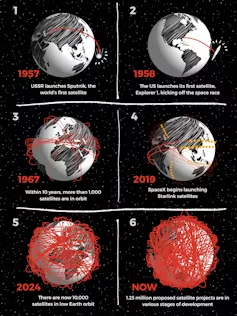
On January 30 2026, SpaceX filed an software with the US Federal Communications Fee for a megaconstellation of up to one million satellites to energy data centers in space.
The proposal envisions satellites working between 500 and a pair of,000 kilometers in low Earth orbit. A number of the orbits are designed for near-constant publicity to daylight. The general public can currently submit comments on this proposal.
SpaceX’s submitting is simply the most recent amongst exponentially rising satellite megaconstellation proposals. Such satellites function with a single function and have quick substitute life cycles of about 5 years.
As of February 2026, roughly 14,000 active satellites are in orbit. A further 1.23 million proposed satellite projects are in varied phases of improvement.
The approval course of for these satellites focuses nearly solely on the restricted technical data corporations should undergo regulators.
Cultural, non secular, and most environmental impacts aren’t taken into consideration – however they need to be.
The night time sky will drastically change
At this scale of progress, the night time sky will change completely and globally for generations to come.
Satellites in low Earth orbit replicate daylight for about two hours after sundown and earlier than dawn. Regardless of engineering efforts to make them less brighttruck-sized satellites from many megaconstellations seem like shifting factors within the night time sky. Projections present future satellites will significantly increase this light pollution.
In 2021, astronomers estimated that in lower than a decade, 1 in each 15 factors of sunshine within the night time sky would be a moving satellite. That estimate solely included the 65,000 megaconstellation satellites proposed on the time.
As soon as deployed at a scale of hundreds of thousands, the impacts on the night time sky might not be simply reversed.
Whereas the typical satellite tv for pc solely lasts about 5 years, corporations design these megaconstellations for almost steady substitute and growth. This locks in a steady, industrialised presence within the night time sky.
All that is inflicting a space-based “shifting baseline syndrome”, the place every new technology accepts a progressively extra degraded night time sky. Criss-crossing satellites grow to be the brand new regular.
And for the primary time in human historical past, this shifting baseline means children in the present day gained’t develop up with the identical night time sky each earlier technology of humanity had entry to.

Houston, we’ve a ‘mega’ downside
Issues over the sheer quantity of proposed satellites come from many sides.
Scientific issues embrace bright reflections and radio emissions from satellites that can disrupt astronomy.
Trade specialists additionally be aware visitors administration and logistical issues. There’s at the moment no type of unified space traffic management in the identical method that exists in aviation, for instance.
Megaconstellations additionally improve the danger of Kessler syndrome, a runaway chain reaction of collisions. There are already 50,000 pieces of debris in orbit which can be ten centimetres or bigger. If satellites stopped all collision avoidance manoeuvres, the most recent knowledge exhibits we will count on a major collision in 3.8 days.
Main cultural issues abound, too. Satellite tv for pc gentle air pollution will negatively impression Indigenous uses of the night sky for longstanding oral traditionsnavigation, looking, and non secular traditions.
Launching so many satellites makes use of up huge quantities of fossil fuels, damaging the ozone layer. After the satellites have served their function, the end-of-life plan is to burn them up within the ambiance. This poses one other environmental concern – depositing vast quantities of metals into the stratosphereinflicting ozone depletion and different probably dangerous chemical reactions.
All this feeds into authorized issues. Underneath international space lawinternational locations – not corporations – are chargeable for hurt brought on by their house objects.
House legal professionals are more and more attempting to grasp if worldwide house regulation can really maintain corporations or personal people accountable. That is particularly essential as the risk of damage, death or permanent environmental damage grows.
We will not ignore the gaps in regulation
At present, the primary laws regarding satellite tv for pc proposals are technical, comparable to deciding which radio frequencies they may use. At nationwide ranges, regulators deal with launch security, lessening environmental impacts on Earth, and legal responsibility if one thing goes unsuitable.
What these laws don’t seize is how a whole bunch of hundreds of vivid satellites change the night time sky for scientific examine, navigation, Indigenous instructing and ceremony, and cultural continuity.
These will not be conventional “environmental” harms, nor are they technical engineering issues. They’re cultural impacts that fall right into a regulatory blind spot.
This is the reason the world wants a Darkish Skies Impression Evaluation, as proposed by house legal professionals Gregory Radisic and Natalie Gillespie.
It’s a scientific option to establish, doc, and meaningfully think about all of the impacts of a proposed satellite tv for pc constellation earlier than it goes forward.
How would such an evaluation work?
First, proof have to be gathered from all stakeholders. Astronomers (each novice {and professional}), atmospheric scientists, environmental researchers, cultural students, affected communities, and trade all carry their views.
Second, it’s important to mannequin any cumulative results of the satellites. Assessments ought to analyse how constellations will change night sky visibility and skyglow, orbital congestionand the danger of casualties on the ground.
Third, it is going to outline clear standards for when unobstructed sky visibility is essential for science, navigation, schooling, cultural follow, and shared human heritage.
Fourth, it should embrace mitigation pathways comparable to brightness discount, orbital design adjustments, and deployment changes to minimize hurt. This could embrace incentives for utilizing as few satellites as attainable for a given undertaking.
Lastly, the findings have to be clear, independently reviewable, and instantly tied to licensing and coverage selections.
It’s not a veto software
A Darkish Skies Impression Evaluation doesn’t forestall house improvement. It clarifies trade-offs and improves resolution making.
It will possibly result in design selections that cut back brightness and visible interference, orbital configurations that reduce cultural impression, earlier and extra significant session, and cultural issues the place hurt can’t be averted.
Most significantly, it ensures that communities affected by satellite tv for pc constellations aren’t discovering out about them after approval has already been granted and vivid lights crawl throughout their skies.
The query just isn’t whether or not the night time sky will change – it’s already altering. Now could be the time for governments and worldwide establishments to design truthful processes earlier than these adjustments grow to be everlasting.
Gregory RadisicFellow on the Centre for House, Our on-line world and Knowledge Regulation; Senior Educating Fellow, College of Regulation, Bond University and Samantha LawlerAffiliate Professor, Astronomy, University of Regina. This text is republished from The Conversation below a Artistic Commons license. Learn the original article.
https://weblog.passive-income4u.com/create-your-very-own-auto-publish-news-blog-site-and-earn-passive-income-in-just-4-easy-steps/
https://interaksyon.philstar.com/trends-spotlights/2026/02/23/309574/too-many-satellites-earths-orbit-is-on-track-for-a-catastrophe-but-we-can-stop-it/