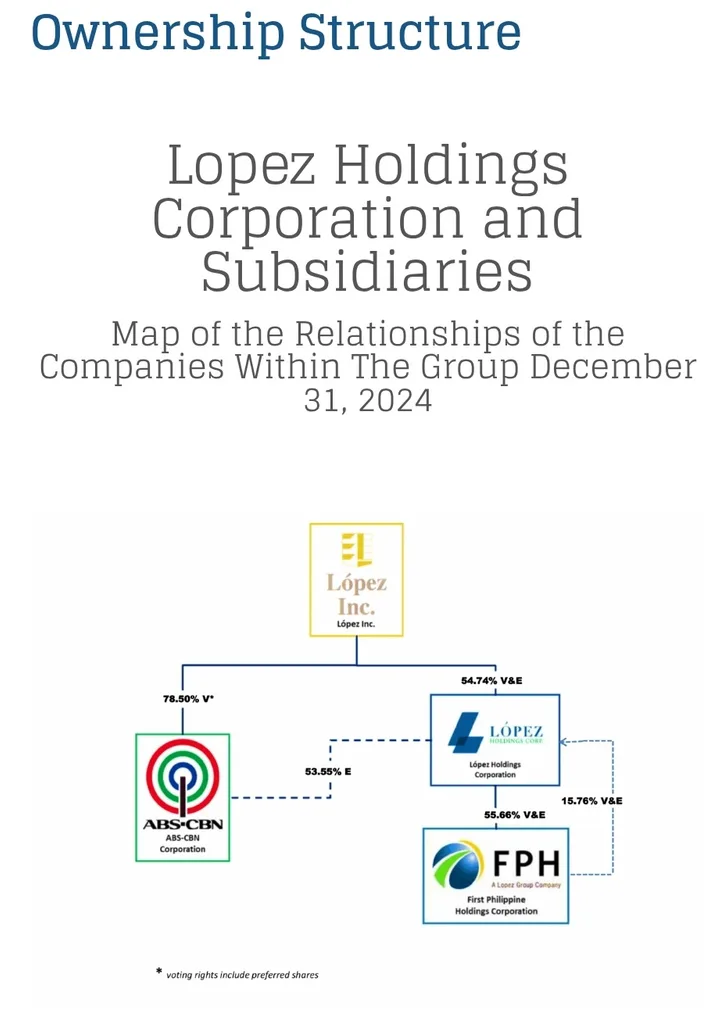
First of two components
On paper, the Lopezes ought to have performed it secure after Martial Regulation: they’d already discovered {that a} hostile president can erase an empire with a stroke of a pen. But now, almost 4 many years after they recovered ABS-CBN Company and energy large Manila Electrical Firm (Meralco) throughout the Cory Aquino administration, the clan is once more at warfare with itself, this time, over a proposed P2-billion money infusion into ABS-CBN, pushed by Eugenio “Gabby” Lopez III and opposed by his cousin, Federico “Piki” Lopez.
The struggle is taking part in out in courtroom and at Lopez Inc., the non-public holding firm of the group. On one aspect are Gabby (Eugenio Lopez III) and cousins who argue that household capital have to be used to shore up the community their fathers rebuilt after the late dictator Marcos, even when meaning subsidizing a politically battered and financially weakened broadcaster. On the opposite is Piki (Federico Lopez), who now sits atop the household’s energy and renewables empire and insists that any contemporary cash should include strict phrases and clear safeguards, not what he derides as a “bailout” for a selected few.
That is the primary of a two-part collection that zooms out from that cousins’ warfare to have a look at the Lopez story in vast shot. It attracts on my a few years as a enterprise journalist who has watched, lined, and written about this very colourful household for many years — from the company rehabilitation of Bayan Telecommunications (Bayantel), Maynilad Water Companies and SkyCable, to the Meralco wars and, now, to the bitter struggle over what stays of ABS-CBN.
(Editor’s word: The ABS-Board of Administrators, specifically Martin Lopez, Carlo Katigbak, Rafael Lopez, plus impartial administrators Honorio Poblador IV, Emmanuel De Dios, and Randolf David, issued a statement on March 28, Saturday, on information experiences in regards to the Lopez household dispute. They mentioned ABS-CBN just isn’t a celebration to the reported authorized dispute among the many cousins, and denied allegations of “unresolved audit findings.”)
Earlier than diving into Bayantel and steadiness sheets, it helps to recollect who sat the place throughout generations.
Within the Lopez empire’s post-EDSA rehabilitation, Eugenio “Geny” Lopez Jr. was the builder and public face of ABS-CBN and the telecom push. Contained in the Lopez group, he was merely “Kapitan,” the boss whose presence within the newsroom and the corridors outlined what the community stood for. His youthful brother Oscar M. Lopez chaired Benpres Holdings Company (the outdated holding firm now generally known as Lopez Holdings Company) and First Philippine Holdings Company (FPH), and would later turn into the household’s de facto disaster supervisor. Manuel “Manolo” Lopez, the youngest, turned the steward of Meralco and the outdated “crown jewels” of distribution.
Their youngsters are the protagonists right now.
Gabby is a son of Geny whose line is intricately linked with ABS-CBN and the household’s media affect. Piki is a son of Oscar, whose line is now anchored in FPH and First Gen Company, with their portfolio of fuel crops, geothermal fields, and industrial parks.
Geny’s period arrange the daring expansions. Oscar’s period was about cleansing up the entrepreneurial adventures that went unsuitable. Manolo presided over the painful sacrifice of Meralco when money and political strain left the household cornered.
Right this moment, the third era is combating over who ought to pay to rescue the newest bet-gone-wrong — i.e. ABS-CBN within the Duterte aftermath — and below whose guidelines.
This primary piece focuses on the enterprise aspect of that story: how the group dealt with bets that went unsuitable in Bayantel, in First Gen, and now in ABS-CBN, and what “self-discipline” actually seemed like when the payments got here due. The second will comply with the presidents and present how politics retains deciding which asset — and which department — pays the worth.
The Benpres decade
Within the late Nineteen Eighties and early Nineteen Nineties, Benpres Holdings Company was the Lopez household’s large tent. It sat above ABS-CBN and Meralco. It additionally turned the launchpad for a wave of “nation-building” ventures opened up after the regime of Marcos Sr., particularly throughout President Fidel V. Ramos period of financial liberalization, deregulation, and privatization push.
In hindsight, the best way Benpres did it seems to be like a case examine in overreach. On the telecom aspect, they established Bayan Telecommunications (Bayantel), one of many many new telco gamers poised to compete with PLDT, which monopolized cellphone companies then. That meant constructing their very own community — placing up traces and switches — and financing it with a mixture of financial institution loans and greenback bonds.
On the water aspect, Benpres took 60% of Maynilad Water Companies Inc., the non-public operator of the west zone of Metro Manila’s water system, alongside French companion Ondeo (then Suez). In pay TV, they constructed SkyCable/Sky Imaginative and prescient into the nation’s largest cable operator on the time. In banking, they held a big stake in Philippine Industrial Worldwide Financial institution (PCI Financial institution) with John Gokongwei’s JG Summit, a place Geny would promote in 1999 as the primary spherical of retrenchment. In infrastructure, they’d a stake within the toll highway operator of the North Luzon Expressway (NLEX).
The logic was easy sufficient. In the event you already know learn how to navigate regulators and public opinion by means of Meralco, which powers hundreds of thousands of properties, and ABS-CBN, which entertains and informs, then why not lengthen that to each “primary service” Filipinos depend on — water from Maynilad, cellphone traces from Bayantel, cable from SkyCable, and tollways by means of NLEX.
The issue was how all this was financed, and on what scale.
When the numbers stopped working
Within the mid-Nineteen Nineties, Bayantel — below Bayan Telecommunications Holdings and finally Benpres — raised about US$200 million of 13.5% senior notes, on high of syndicated financial institution loans, to fund its community rollout.
Consider senior notes as large IOUs bought to international traders: you get money now, promise to pay curiosity yearly, and repay the principal on the finish. Bayantel additionally signed omnibus and mortgage belief agreements that pledged most of its receivables and challenge money flows as collateral. In plain phrases, if Bayantel stumbled, virtually all the things it earned or owned was already spoken for by collectors.
On the similar time, Benpres Holdings itself was issuing long-term business paper — IOUs bought to native traders — and taking up financial institution loans, whereas guaranteeing components of its working corporations’ money owed.
So take word: Bayantel’s rollout, Maynilad’s concession, SkyCable’s enlargement and different initiatives had been all leaning on the identical central “pockets” as ABS-CBN and Meralco.
So long as the unique assumptions held, this construction seemed intelligent. When Bayantel borrowed at 13.5%, inner fashions assumed an change price close to P25 to the greenback and robust take-up of its half-million rolled-out traces.
However after the 1997 Asian monetary disaster, the peso slid to round P53 to a greenback. So by 2000, every greenback of debt price greater than twice as many pesos to service. By July 2000, after solely two curiosity funds, Bayantel stopped paying coupons on its notes — successfully defaulting — though it was incomes on the working degree. EBITDA was constructive, however the curiosity invoice was just too large.
In 2001, Bayantel started formal talks to restructure roughly P25 billion in obligations below an “casual standstill,” paying solely diminished curiosity whereas it tried to agree new phrases. Benpres itself was negotiating standstill agreements, which is a well mannered means of claiming it was asking its collectors: “please don’t gather but whereas we determine this out.” By 2003, Bayantel’s complete indebtedness had climbed to roughly US$674 million (round P35.9 billion); that July, the bondholders pushed it into court-supervised rehabilitation. (READ: Globe hikes Bayantel stake, buys out Lopez group)
Maynilad and SkyCable adopted into their very own types of misery.
Maynilad couldn’t reconcile the capital it wanted to repair leaky pipes with tariffs that had been politically acceptable. It filed for rehabilitation in 2003 with a P5-billion-plus capital deficit on its books. SkyCable and Residence Cable, in the meantime, needed to signal a P2.5-billion restructuring cope with banks in 2004, giving them seven years to repay about P1.1-plus billion of SkyCable’s share of the loans — one other signal {that a} Nineteen Nineties guess was not producing sufficient money to satisfy its authentic schedule.
On high of that, the Development Bank of the Philippines (DBP) later disclosed it had sold non-performing loans to Bayantel, Maynilad, SkyCable and Benpres right into a “unhealthy asset” car. Translation: these accounts had been past what a state financial institution needed to hold by itself books.
By then, it was apparent that the Nineteen Nineties push into telecoms, water, cable and different “nation-building” companies had left Benpres over-leveraged, with these regulated utilities and platforms below pressure on the similar time. The loans and ensures that when seemed like good monetary engineering now compelled the holding firm into years of debt exercises and reputational harm, establishing the painful wave of asset gross sales — PCI Financial institution, NLEX, Maynilad, SkyCable restructurings, and finally Meralco — that may comply with.
How Benpres tried to dig itself out
As soon as the mud settled, the holding firm’s decisions had been unglamorous and painful: promote what you may, restructure what you may’t, and shrink till the steadiness sheet can breathe once more. That meant unwinding items of the very enlargement that had outlined the post-EDSA Lopez comeback story.
The banking story went first. PCI Financial institution, as soon as a core Lopez–Gokongwei three way partnership, turned chip on the desk because the Philippines’ banking panorama consolidated. PCI was bought down in 1999, successfully ending the household’s direct function in large business banking.
Toll roads adopted. The NLEX enterprise was bought into the orbit of Metro Pacific Investments Company (MPIC). Within the language of the time, this was framed as “monetizing a mature infrastructure asset” to pay down long-term business papers and financial institution loans. In easier phrases, the household gave up a dependable future stream of toll earnings so they might cease worrying about giant chunks of debt coming due.
Maynilad was messier. The west-zone concession went into rehabilitation; its contract with MWSS needed to be renegotiated, new traders (MPIC and others) finally got here in, and the Lopezes ceded management. Economically, they wrote off a lot of their funding. Politically, they bore the blame for price hikes and repair points whilst they misplaced the asset. (READ: Public interest, private hands: How Manila Water, Maynilad got the deal)
All through this era, Benpres — later renamed Lopez Holdings Company — sat throughout the desk from its lenders. It purchased again bonds at a reduction the place it might, requested for longer reimbursement phrases the place it couldn’t, and chipped away on the mountain of obligations that Bayantel, Maynilad and SkyCable had helped create.
This was not the glamorous aspect of enterprise. It was monetary triage: deciding which limbs to amputate to maintain the affected person alive.
It additionally had an unintended aspect impact. As belongings like PCI Financial institution, NLEX, and Maynilad had been bought or surrendered, the inner weight of the group shifted. The extra Benpres shrank round its remaining holdings, the extra central one cluster turned: the facility and vitality companies housed below First Philippine Holdings Company and its subsidiary First Gen Company.
From Benpres overreach to First Gen self-discipline
By the mid-2000s, the Lopez story had quietly break up into two tracks.
On one observe was the Benpres world of telecoms, water, cable and toll roads, being reduce to measurement. On the opposite observe was a power-focused platform anchored in First Philippine Holdings Company (FPH) and First Gen Company (First Gen), the place the household was making a special form of high-risk guess below Oscar and son Piki Lopez.
This second arm constructed pure gas-fired crops just like the 1,000-megawatt Santa Rita and 500-megawatt San Lorenzo services in Batangas by means of First Fuel Energy Company and allied corporations. These bought electrical energy to Meralco below long-term energy buy agreements (PPAs) — the 20-plus-year contracts the place Meralco basically agreed to purchase a set quantity of capability or vitality over a few years.
These PPAs had been creatures of the early-Nineteen Nineties energy disaster, when brownouts had been every day actuality and the federal government didn’t have the cash to construct all of the wanted crops. To entice non-public traders, authorities supplied lengthy contracts with “take-or-pay” clauses so banks would lend. So long as the plant was accessible, Meralco (or the Nationwide Energy Company) needed to pay for a minimal degree of capability whether or not or not precise demand matched it. For banks, that made the initiatives financeable.
For First Fuel and First Gen, it meant that when Santa Rita and San Lorenzo had been operating, their income streams had been rather more predictable than Bayantel’s or Maynilad’s. Not like Bayantel’s gamble on getting sufficient paying cellphone subscribers, or Maynilad’s dependence on politically delicate tariff will increase, these fuel crops had clearer cash-flow visibility: “take-or-pay” provisions meant Meralco would pay for the capability even in lean years, and gas prices for Malampaya fuel might largely be handed by means of to customers below regulatory guidelines.
The trade-off was reputational: critics like Winston Garcia would later accuse Meralco of locking itself into shopping for from “family” — Lopez-owned turbines — on assured phrases, even when the precise numbers confirmed these contracts had been cheaper than many options. The financing was nonetheless heavy on debt — these had been large, capital-intensive initiatives — however it was traditional challenge finance: loans tied to the money flows of a selected plant, with banks comforted by the long-term PPAs, somewhat than a single holding firm rolling the cube on many sectors without delay.
By 2007, this energy arm seemed, on the floor, just like the extra disciplined aspect of the household. First Gen had Santa Rita and San Lorenzo buzzing alongside on long-term contracts with Meralco, and a decent 112-megawatt hydro asset within the Pantabangan-Masiway advanced.
The following transfer, nevertheless, would present that this arm may very well be simply as daring — and simply as fallible — as Benpres had been with Bayantel.
Betting the home on geothermal
That subsequent transfer was Vitality Improvement Company (EDC).
In 2007, a Lopez-led consortium referred to as Crimson Vulcan Holdings gained the federal government public sale for 60% of PNOC-EDC, the nation’s dominant geothermal developer and the core of what would turn into one of many world’s largest geothermal portfolios.
Geothermal faucets underground warmth by means of steam fields and wells, so it’s an indigenous supply of energy that the Philippines already has, and crops can run virtually nonstop, not like photo voltaic and wind. The group, managed by First Gen and partnered with overseas traders, paid round P58-plus billion for the stake — roughly $1.2–1.3 billion on the time, at a wealthy premium to EDC’s IPO worth. It was a traditional Lopez play: pay as much as safe management of a strategic, regulated asset that match the “nation-building” story.
On paper, the technique made sense.
Geothermal was baseload, “inexperienced,” globally enticing, and in EDC’s case it relied on steam fields contained in the Philippines somewhat than imported coal or oil. EDC already had working fields with extra megawatts within the pipeline, and placing it below First Gen’s umbrella would give the Oscar–Piki aspect a portfolio that spanned fuel, hydro and geothermal — precisely the combo that now underpins their “clear vitality” narrative. In 2008, Federico “Piki” Lopez, already president and CEO of First Gen, would name EDC a “very sturdy asset” that they meant to “take to the subsequent degree.”
The financing carried the danger. To fund the acquisition, First Gen used a mixture of fairness and short-term “bridge” loans, together with virtually P29 billion in financing organized by a syndicate led by Banco de Oro, Improvement Financial institution of the Philippines (DBP), and Land Financial institution. A bridge mortgage is meant to be momentary: a giant, short-term credit score line to shut a deal rapidly, with the plan to refinance it later with longer-term loans or bonds. First Gen was betting that when the EDC mud settled, it might roll these bridge loans into cheaper, longer-dated financing.
Then the 2008 global financial crisis hit.
By June 2008, the numbers had turned from bold to alarming. First Gen knowledge reported it had about $820 million in present liabilities (money owed due inside a 12 months) and $1.6 billion in long-term debt, in opposition to roughly $1.2 billion in fairness. The important thing downside: over $410 million of short-term loans taken for the EDC acquisition had been coming due in November 2008.
On the similar time, each EDC’s and First Gen’s share costs had fallen sharply. EDC, purchased at round P9–9.25 per share, was buying and selling under P5. First Gen inventory was down about 75% year-to-date by October 2008, making it one of many worst performers within the Philippine Inventory Alternate index. Traders had been asking a easy query: had the Lopezes overpaid for EDC and borrowed an excessive amount of, too quick, in addition?
Beneath the headlines, this was a traditional refinancing disaster.
First Gen was essentially sound in working phrases — its crops had been operating — however the timing and construction of its EDC debt meant it immediately had an enormous lump of loans to refinance simply as international credit score markets had been freezing. Worldwide banks had been pulling again from emerging-market publicity, not including to it. For a corporation that had turn into the flagship of Oscar–Piki’s “new Lopez” id, the stakes had been existential.
The Oscar–Piki arm now seemed like Benpres had a decade earlier: extremely leveraged, with a giant, ill-timed guess sitting on quick maturities. The distinction lay in how they responded.
Taking the drugs
First, First Gen bought a superb asset to boost money. It agreed to promote a controlling 60% stake in First Gen Hydro Energy Company, which owns the Pantabangan-Masiway hydro advanced, to EDC at a revenue versus the roughly $129 million it had paid for the hydro asset in 2006. The money proceeds — on the order of $100 million — had been earmarked to pay down First Gen’s short-term acquisition debt, to not fund new enlargement.
This will seem like shifting cash from one Lopez pocket to a different: a hydro plant shifting from First Gen to EDC. In apply, what mattered to lenders was the place the money landed. The cash went into First Gen’s coffers and was used to shrink the near-term loans sitting in First Gen’s identify, whereas EDC — a separate listed firm with its personal steadiness sheet — took on the asset and its funding. For bankers gazing a number of hundred million {dollars} of EDC-related loans coming due, that was an actual enchancment.
Second, First Gen renegotiated the EDC acquisition loans. Administration sat down with banks to stretch out roughly P13.8 billion of short-term bridge services into multi-year loans. In plain language, they requested to transform an enormous invoice due “very quickly” right into a collection of smaller funds unfold over extra years — swapping a cliff for a staircase.
Third, it lined up a brand new refinancing bundle. First Gen organized about $500 million of alternative financing from a mixture of overseas and native banks to take out the maturing bridge loans, utilizing the mix of the hydro sale and its broader plant portfolio as consolation for lenders. As an alternative of going through a single, scary deadline, it now had a extra standard long-term debt profile.

In layman’s phrases, the Oscar–Piki aspect realized they’d maxed out a really giant bank card to purchase EDC simply earlier than a world disaster. To keep away from default, they bought a prized automotive (the hydro asset) to a sibling with extra cash (EDC), then satisfied the banks to transform the credit-card invoice right into a longer-term automotive mortgage.
Not like Bayantel and Maynilad, First Gen didn’t find yourself in court-supervised rehabilitation. There have been no state-bank write-offs, no petitions to place it below receivership. As an alternative, there was a visual willingness to promote belongings, settle for that some investments had been mis-timed, and do the unglamorous work of renegotiating debt.
Doubtless for Piki’s camp right now, this episode is Exhibit A: when our aspect miscalculated, we took our medication.
Promoting the outdated to save lots of the brand new
The First Gen repair didn’t occur in isolation. Whereas Piki and his crew had been scrambling to refinance EDC-related loans, Oscar and the broader Benpres/FPH construction had been deciding which legacy belongings to placed on the altar to make the entire group’s leverage extra bearable.
Infrastructure went first. In 2008, FPH bought its toll highway enterprise, together with its stake in Manila North Tollways Company (NLEX), to Metro Pacific Investments. The headline rationale was to “monetize a mature asset” and use the proceeds to pay down long-term business papers and financial institution loans. Extra bluntly: they bought a future earnings stream so they might cease worrying about right now’s debt.
Then got here Meralco. In March 2009, FPH agreed to promote 20% of Meralco to PLDT’s Piltel at P90 per share, elevating round P20 billion in money. In its inventory change disclosure, FPH mentioned the sale was a part of a technique to “pare down money owed”. It adopted a bruising, year-long boardroom warfare I lined intimately — state pension fund GSIS chief Winston Garcia making an attempt to wrest management within the identify of decrease energy charges and “good governance,” the Lopez camp defying an SEC cease-and-desist order on the ground of a 12-hour shareholders’ assembly, and, lastly, San Miguel swooping in to purchase the federal government block after the courts had been dragged in.
Economically, that Meralco verify did two issues without delay. It retired a piece of Benpres/FPH-level debt that had been weighing on all the things from Bayantel to First Gen, and it freed the Oscar–Piki aspect to give attention to being a generator and challenge developer somewhat than a politically uncovered distributor.
Politically, it acknowledged a tough actuality that Oscar would later say out loud: a “very important and influential” regulated enterprise like Meralco “inevitably requires authorities assist.” And when that assist is lacking, the enterprise mannequin weakens. The sale was not nearly admitting that the Lopezes now not had that assist, but in addition about cleansing up the numbers.
Contained in the household, the ache was actual.
Meralco was Manolo’s turf and the image of the pre-martial regulation empire. In my 2008–2009 protection of how the Lopezes misplaced management of Meralco, the sting was palpable when Manolo and his allies insisted they’d poured many years of capital and managerial effort into the utility, solely to be painted as villains in a political and company drama they now not managed. Oscar later described the sale as “a enterprise determination” hashed out over months of board dialogue. Each will be true.
For right now’s cousins’ warfare, that is the road that issues: when the group wanted money and de-leveraging, it was Meralco, an asset anchored in Manolo’s department, that was bought, and the proceeds flowed right into a capital construction that supported each media and energy.
ABS-CBN earlier than and after the franchise axe
For many of the 2000s and 2010s, ABS-CBN’s numbers seemed nothing like Bayantel’s or First Gen’s EDC squeeze. The community was large and capital-hungry, however it was profitable. Mid-2010s financials present stable revenues from promoting, content material gross sales and cable, and billions in web earnings. It carried company debt however there have been no rehabilitation petitions, no standstills, no headlines about default.
That modified abruptly in 2020, when a hostile Home of Representatives, in the midst of the COVID-19 pandemic, denied ABS-CBN’s application for a brand new broadcast franchise. Free-to-air operations stopped, promoting tied to Channel 2’s attain collapsed, the corporate scrambled into cable, digital and partnerships.
Subsequent reporting reveals that complete debt peaked at about P21 billion across the time of the shutdown and was step by step diminished to round P16 billion by 2024, with a plan to deliver it additional all the way down to P13 billion by means of property gross sales and different measures.
This isn’t a Bayantel-style spiral — there is no such thing as a court-ordered rehabilitation — however it’s a severe, slow-burn deleveraging for an organization whose predominant money cow was taken away by politics. That’s the reason the P2-billion ask seems like, relying on which cousin you ask, both paying a political invoice the household knowingly ran up, or pouring contemporary capital right into a enterprise mannequin whose predominant pipe has been lower by forces they don’t management.
The essential distinction from the sooner episodes is causality.
Bayantel and Maynilad crashed as a result of the enterprise mannequin and capital construction didn’t survive a forex shock and regulatory limits. First Gen’s EDC scare was triggered by a world credit score disaster colliding with short-term acquisition loans. ABS-CBN’s physique blow got here from politics: the state closed its predominant distribution pipe.
For Gabby’s department, that doubtless issues. Of their view, ABS-CBN just isn’t a reckless enlargement gone unsuitable. It’s the invoice for greater than three many years of editorial decisions, from the Lopezes’ return to the community after Marcos in 1986 by means of the 2020 franchise non-renewal, and into right now’s cousins’ warfare over what comes subsequent.
Doubtless for Piki, the origin of the harm doesn’t change the maths: ABS-CBN is now a distressed media enterprise in a hostile political setting, and any new cash injected into it carries actual threat.
The ₱2-billion query
Which brings the story again to Lopez Inc. and the proposed P2-billion infusion into ABS-CBN that has despatched cousins to courtroom.
In response to experiences on the present feud, Gabby Lopez, his brother, and a bloc of different third era cousins need Lopez Inc. to inject round P2 billion of household capital into ABS-CBN to assist its post-franchise enterprise mannequin and stabilize its funds. Piki Lopez has opposed the plan as initially drawn up, questioning each the construction and the beneficiaries. In his camp’s telling, greater than half of the proposed funds would find yourself within the fingers of a slim group of executives and insiders through share purchases and debt repayments, somewhat than being tightly ring-fenced for a transparent, value-creating turnaround plan.

I say this with some pores and skin within the recreation. I labored at ABS-CBN from 2007 to 2011, throughout a interval when the community’s journalism was usually at odds with highly effective individuals. In these years, I noticed up shut that the Lopezes didn’t inform us to tug punches when protection was uncomfortable for presidency or for his or her different companies. They allowed robust reporting, even when it clearly made life tougher of their boardrooms. I’ve a excessive respect for them for that, and nothing on this collection is supposed to decrease it.
However strip away the emotion and the argument is acquainted. Gabby is successfully saying: ABS-CBN has been the lightning rod for our politics; the household ought to fund a severe try and maintain it alive. Piki is saying: when our aspect over-reached with Bayantel and EDC, we took the ache by means of asset gross sales and onerous renegotiations. Why ought to ABS-CBN be handled in another way?
The remainder of this collection will dig into the politics that lurk beneath that query. As a result of when you deliver Ferdinand Marcos Jr., Gloria Macapagal-Arroyo and Rodrigo Duterte again into the body, it turns into tougher to insist that ABS-CBN is simply one other enterprise case — and tougher for the cousins to faux that the worth of their political stance is another person’s downside. – Rappler.com
Subsequent: Half 2: The Lopezes, presidents, and the price of dissent
Lala Rimando wrote about Philippine enterprise, and managed newsrooms, together with Newsbreak, ABS-CBN, Rappler, and Forbes, for over 25 years. She’s now based mostly in La Union, caring for her mother with dementia, and dealing on the multimedia biography of the late John Gokongwei.

https://weblog.passive-income4u.com/create-your-very-own-auto-publish-news-blog-site-and-earn-passive-income-in-just-4-easy-steps/
https://www.rappler.com/enterprise/debt-discipline-daring-inside-lopez-group-high-risk-bets/