Albert, a 68-year-old retiree, acquired a name midday on August 14, 2025. The decision got here at an ideal time as a result of Albert wanted a cost reference quantity (PRN) from his SSS (social safety service) however he was having a difficult time logging on to his app.
The caller knew his full title, his SSS quantity, and his handle, and provided to help him in downloading a supposed up to date SSS app. The help got here within the type of him clicking a hyperlink supplied over Viber, adopted by a really lengthy set up course of.
In a single-and-a-half hours, his three financial institution accounts and two money wallets — all related to his Android telephone — have been swiped. Multiple million pesos in life financial savings gone. Albert by no means supplied any private element like OTPs (one time passwords) or safety codes.
“My dad was depressed for the primary few months,” Albert’s daughter Jobelle Garcia advised Rappler.
The rip-off is a banking trojan deployed via malware on Android which might management your system from a distant location, and it has been traced to rip-off compounds in Cambodia, in accordance with a first-of-its-kind report by US-based cybersecurity agency InfoBlox, and Vietnamese cyber security non-profit Chong Lua Dao.
“We uncovered an Android banking trojan that’s possible operated from a number of areas, together with the K99 Triumph Metropolis compound in Cambodia,” mentioned the report.
That is the primary time that sturdy proof has been discovered to attach a particular kind of malware to a bodily location of a rip-off compound, and it was made doable by trafficked staff who escaped from the compound and took damning proof with them.
The malware
The crew discovered a “refined malware-as-a-service (MaaS),” which is a high-end malicious software bought to cybercriminals. MaaS suppliers basically construct a top-of-the-line software and make that out there to low-skilled criminals for a payment. To place it merely, it makes it simpler for criminals to commit a classy crime.
This explicit MaaS is “possible attributed to an unknown Chinese language-speaking MaaS administrator servicing a number of rip-off facilities within the Mekong area, the place pressured labor has been reported, and that are used to distribute malware and function scams,” in accordance with the report.
The victims are principally from the Philippines, Thailand, Indonesia and Vietnam, and seeping into Africa and Latin America, the report mentioned.
In contrast to pig-butchering scamsthe place criminals make investments time to nurture a relationship with their victims, and the place victims truly ship their cash, this malware wants only some hours and an unsuspecting sufferer to click on a hyperlink.
Right here’s the way it works.
Social engineering
The crew has a screenrecording of 1 work station inside K99 compound, and it reveals “detailed private and company knowledge used to tell sufferer focusing on,” mentioned the report, referring to knowledge to assist them select and exploit their victims. That knowledge will be purchased in web black markets. That’s known as social engineering, which additionally consists of “tailor-made scripts.”
The legal then makes contact with a sufferer via totally different means, and the objective is for the sufferer to click on a hyperlink to an internet site.
The web site, known as a “lure area,” appears respectable — spoofing principally authorities providers web sites like SSS.
In 2025, which is when Albert was victimized, 400 lure domains have been registered to focus on victims. “This report presents proof indicating that these domains are a part of a coordinated, centrally managed operation designed for scale and resilience,” mentioned the report.
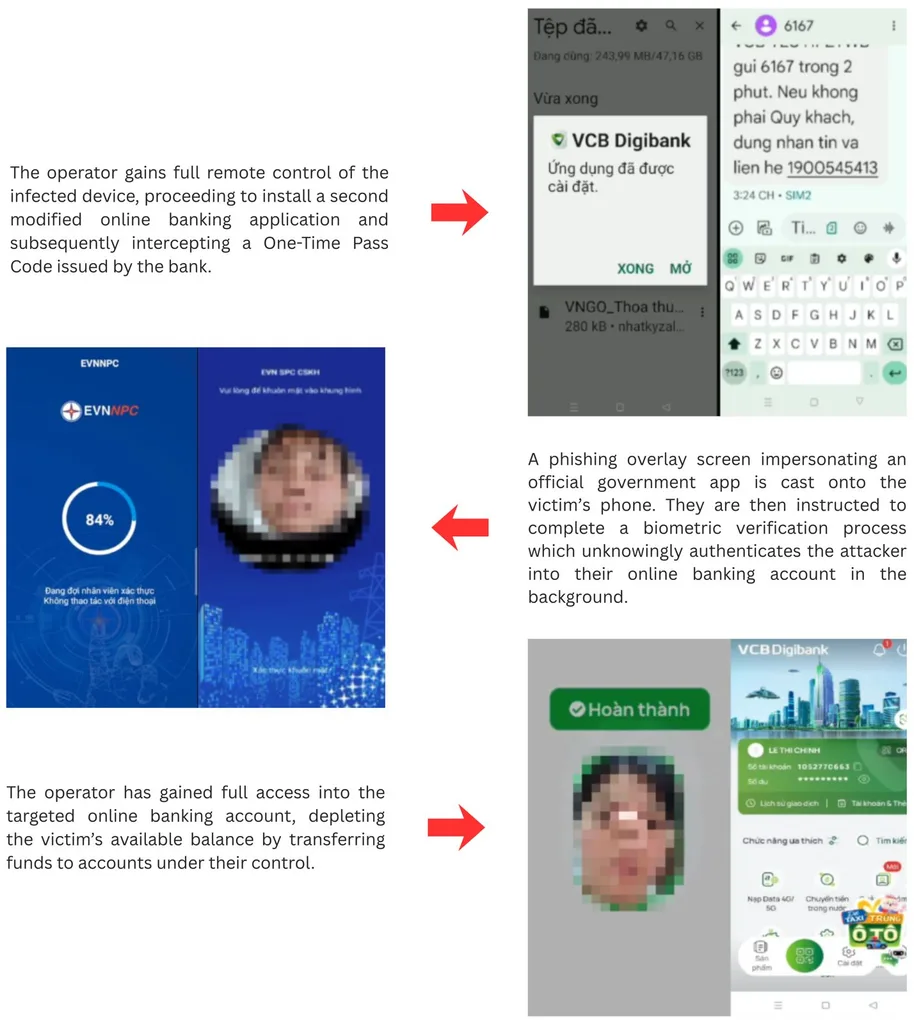
As soon as the sufferer is on the lure web site, they’re requested to put in an app — just like the fake up to date SSS app. As soon as that “app” begins to put in on the Android telephone, the criminals acquire distant entry to your system with out your data.
When that distant entry is secured, the malware can intercept texts and telephone calls, which is how they’ll entry the banks and wipe out the deposits.

Some Filipinos who posted their expertise on Fb have been made to enter biometric knowledge like facial recognition.
“Facial recognition knowledge is then used to authenticate into the sufferer’s on-line banking software with out their data. By intercepting the financial institution’s SMS OTP code, the operator has full entry to the sufferer’s financial institution accounts and might switch funds wherever they need,” mentioned the report.
Albert didn’t do facial recognition, mentioned his daughter.
Albert spoke with Filipino-speaking scammers who guided him on find out how to set up the faux app, and who warned him that it could take lengthy. “Be affected person simply,” the scammer advised Albert, in accordance with his affidavit.
That rendered Albert’s telephone virtually unusable to him, and to his daughter who was attempting to name him. As a result of she couldn’t attain her father by telephone, Jobelle went to his residence and found they might neither flip off the telephone nor take a screenshot.
“We determined to take away the sim card. When the sim card was eliminated, the SSS app set up simply stopped,” mentioned Albert in his affidavit. (We determined to take away the sim card, and that’s the one time the SSS app set up stopped.)
Sadly, like in Albert’s case, biometrics aren’t strictly required to run this rip-off. “Biometrics are non-compulsory for app safety. Not all establishments will use it,” John Wojcik, an InfoBlox senior risk researcher for Asia who labored on the report, advised Rappler.
The Philippines now has a sim registration regulation, the place everybody who owns a sim card should register with the federal government. It was branded as a solution to crack down on cyber crime, however the sim card that Albert’s scammer used was registered to a distinct title.
The facial recognition within the sim card registration was “blurry,” mentioned Jobelle, relaying what the Nationwide Bureau of Investigation (NBI) advised her. What the NBI is aware of at this level is “the decision got here from one other Asian Nation however used a Philippine quantity — may need used VPN,” in accordance with Jobelle.
Different spoofs
It’s extremely doable that Albert’s scammer known as from the Cambodian compound, as a result of Jobelle was capable of pay attention to the URL supplied by the criminals to her father. I then supplied the URL to Wojcik who confirmed it’s certainly among the many domains they tracked.
We’re posting it right here as a warning, together with a number of web sites focusing on Filipinos. These web sites spoof authorities providers like e-gov, and personal providers like Philippine Airways. Be sure to don’t ever click on them. These are just some of probably thousand faux URLs.

Whereas this particular banking trojan runs on Android solely “possible attributable to extra inflexible safety protocols (of Apple app retailer),” in accordance with Wojcik, there’s a chance that there’s additionally malware deployed on iOS or iPhones.
“We’ve recognized a rising variety of MaaS distributors in addition to different service suppliers supporting the rip-off networks within the area. They’re more and more straightforward to search out, typically adverising out within the open on numerous illicit on-line market locations in Southeast Asia, though Android gadgets definitely characterize the working system focused most often inside this cellular malware ecosystem,” mentioned Wojcik.
What this report means
Rip-off compounds all around the world, however extra significantly in Southeast Asiahad been uncovered, raided, and shut through the years. “However connecting particular malware to the infamous compounds has been elusive … till now,” the report mentioned.
“This report consists of particulars of the operation, obtained instantly from individuals who have been held captive within the K99 compound and compelled to take part in cybercrime,” mentioned the report.
This factors to a chance that the scammer these victims have spoken with, both by name or message, may very well be victims of trafficking, too. However they may be prepared scammers.
”Whereas we’re solely capable of speculate at this level, it’s clear that human trafficking and compelled labor has been widespread throughout the rip-off trade for years. Philippine nationals have often been lured by misleading recruitment practices and victimized, significantly within the Mekong area,” Wojcik mentioned.
Via the testimonies and proof obtained from these trafficked into the K99 compound in Cambodia, the crew discovered “direct proof supporting a hyperlink between the domains we’re monitoring to exercise related to the compound.”
Politically-connected
The K99 compound is positioned in Sihanoukville, Cambodia, which is infamous for rip-off facilities. Whereas Cambodia has mentioned it has shut down 200 scam centersthe crew mentioned “current studies from rights teams and different sources recommend that K99 Triumph Metropolis stays lively regardless of the Cambodian authorities’s ongoing crackdown.”
The K99 compound (or extra formally generally known as ‘K99 Triumph Metropolis’) is owned by Cambodia’s K99 group, whose chairman is tycoon Rithy Raksmei (aka Xie Liguang), in accordance with the report. Rithy Raksmei is “an prolonged member of the family of considered one of Cambodia’s wealthiest males, Senator Kok An, who has been recognized in reporting as being needed by Thai authorities in reference to cyber-enabled fraud and cash laundering,” mentioned the report.
A bill launched within the US Congress to “dismantle and shut down transnational legal syndicates perpetuating mass on-line rip-off operations towards Individuals” names each Rithy Raksmei and Kok An as among the many international folks and entities coated by the invoice.
“The focus of actors tied to this space factors to a extremely centralized ecosystem, the place a comparatively small circle of politically related insiders function key facilitators enabling entry, safety, and operational continuity for transnational legal teams,” mentioned the report.

What now?
Jobelle mentioned her father recovered from despair when a senior residents group helped join them to authorities. “Our case continues to be open with CICC (Cybercrime Investigation and Coordinating Middle) as they’re nonetheless monitoring the place the funds went,” Jobelle mentioned.
They have been advised that it could be troublesome to get well the cash if it’s been withdrawn. Thus far, the household has been capable of get well P250,000 from BDO.
“Sure, it is laborious to chase. It wants numerous time, endurance and energy. Sure, the authorities assigned to us are useful. It actually takes some time to progress as a result of there are such a lot of scams now, so additionally they have numerous different folks to cope with. However there’s nonetheless progress and so we’re grateful,” mentioned Jobelle.
(Sure, it’s laborious to run after them. Wants numerous time, endurance and energy. Sure, the authorities assigned to us are useful. Progress simply takes some time as a result of there are such a lot of scams in the present day, so they’re additionally busy. However nonetheless there’s progress, and so we’re grateful.)
The rip-off received’t finish right here, and “it’s possible we’ll see them pivot and spin up extra within the close to future,” mentioned Wojcik.
The malware, in accordance with Wojcik, “has additionally advanced over time, discovering methods to adapt to and circumvent new safety measures. It’s no shock organizations in lots of international locations are struggling to maintain up.”
“Whereas it’s pressing for banks and different monetary establishments to reply shortly to such threats, Asian legal networks are extremely agile, revolutionary, and more and more succesful, quickly integrating the brand new applied sciences made out there to them with a purpose to keep steps forward of efforts to disrupt them,” Wojcik mentioned.
Jobelle mentioned the household has now grow to be “paranoid to reply calls from unknown numbers.”
You ought to be, too. – Rappler.com
https://weblog.passive-income4u.com/create-your-very-own-auto-publish-news-blog-site-and-earn-passive-income-in-just-4-easy-steps/
https://www.rappler.com/newsbreak/in-depth/sss-scam-philippines-traced-cambodia-scam-compound-report/