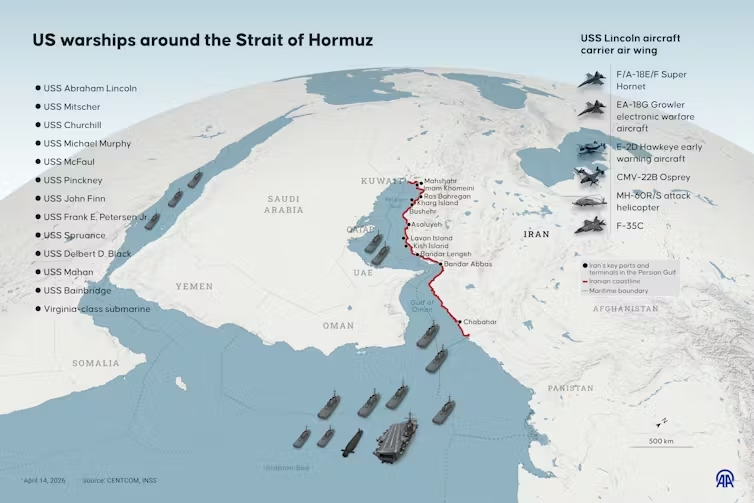
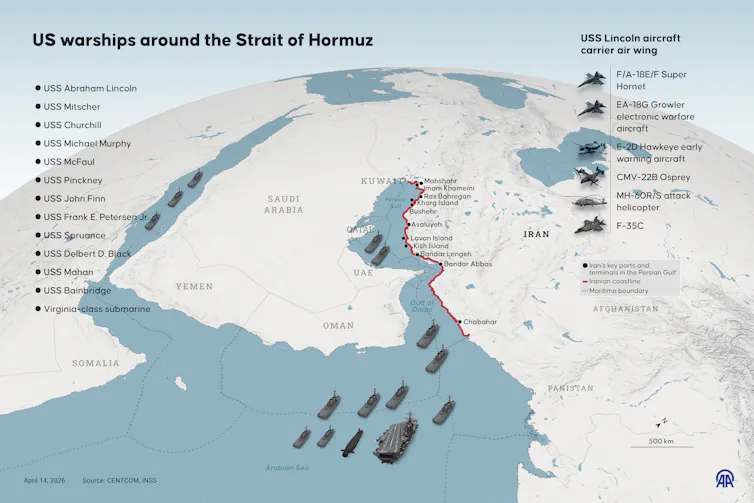
The Strait of Hormuz exists within the eye of the beholder.
Whereas everybody agrees that, geographically talking, it’s a strait – a slim sea passage connecting two locations that ships need to go – its political and authorized standing is reasonably extra sophisticated.
The US and Iran each eye the strait – a choke level by way of which 20% of the world’s oil passes – very in another way. Washington sees the Strait of Hormuz as completely a global waterway, whereas Tehran sees it as a part of it territorial waters.
It follows that Iran’s toll-charging of ships is seen by the U.S. as unlawful. Equally, U.S. President Donald Trump’s blockade of the passage is a “grave violation” of sovereignty to Iran.
As an expert in the law of the seaI do know a part of the issue is that the U.S. and Iran live in two completely different worlds in terms of the worldwide legal guidelines governing the strait. Additional complicating issues, each are in a unique authorized universe than many of the remainder of the world.
The legislation of the ocean
The “legislation of the ocean” is a community of worldwide legal guidelines, customs and agreements that set out the muse for rights of entry and management within the ocean. The framework sits other than the legal guidelines of warfare, that are also relevant to the Persian Gulf situation.
The United Nations Convention on the Law of the Seaor UNCLOS, is a serious plank of the legislation of the ocean. Accomplished in 1982 and in power since 1994, it goals to create a secure set of zones and locations – like worldwide straits – the place everybody agrees on who can do what. It has been ratified by 171 countries and the European Unionhowever not Iran or the US. Iran has signed it however has but to ratify; the U.S. has finished neither.
Which means that the principles which just about every country in the world has consented to can’t function a foundation of settlement over how the U.S. and Iran ought to govern their actions within the strait through the present warfare.
The view from Iran
Each Iran and the U.S. agree that beneath the legislation of the ocean, the Strait of Hormuz is a global strait, however not on what sort of worldwide strait it’s. Furthermore, they disagree on the related legal guidelines that exist, and the way they apply.
For Iran, the Strait of Hormuz is a global strait as set out beneath worldwide legislation predating UNCLOS – notably the Worldwide Court docket of Justice’s ruling within the 1949 Corfu Channel case and the 1958 Territorial Seas Convention.
These older requirements state that overseas ships have a proper of “innocent passage” by way of worldwide straits. Put in different phrases, which means that if a ship is just passing by way of, with out doing anything and with out harming the safety of the coastal international locations, it should be allowed passage.
This offers Iran – and Oman, the strait’s different bordering nation – energy to make and implement some guidelines over passage, corresponding to guidelines for security and the surroundings. Additionally they have broad discretion to resolve if passage is “non-innocent” and subsequently not allowed. However it doesn’t give them the proper to impede harmless passage.
Opposite to the older commonplace, nevertheless, Tehran claims the proper to “droop” passage by way of its half of the strait, citing the waters as its territorial sea. This can be a violation of the 1958 Territorial Seas Conference that Iran depends on for authorized assist, which says that when a territorial sea can also be a global strait, harmless passage can’t be suspended.
The US interpretation
For the U.S., the Strait of Hormuz is a global strait requiring “transit passage,” as per UNCLOS. Though the US will not be a member of UNCLOS, it argues that the settlement’s up to date idea of an “worldwide strait” ought to apply.
Understanding a waterway because the newer kind of “worldwide strait,” which requires transit passage, shifts the steadiness towards a coastal nation’s management and towards free navigation.
Below this commonplace, international locations bordering straits – like Iran and Oman within the case of Hormuz – should additionally permit overflight and submarines beneath the floor. Passage should be allowed as long as it’s “steady and expeditious.”
The U.S. has forcefully asserted this place at sea by way of common “Freedom of Navigation” patrols by way of the Strait of Hormuz and different straits around the globe. The patrols are a visual rejection of claims over the ocean that the U.S. deems unlawful or extreme.
The fundamental U.S. argument is supported by some main authorized students, corresponding to James Kraska, a professor of worldwide maritime legislation on the U.S. Naval Struggle School, who decries the Iranian position as “lawfare” and argues that Iran should abide by the compromises made in UNCLOS.
A ‘persistent objector’
However the U.S. is a world outlier right here, and certainly one of solely a handful of nations – alongside the UK, France, Australia, Thailand and Papua New Guinea – which argue that “transit passage” is required by customized.
Customized, on this sense, is established if a follow at sea is seen as constant and is backed by broad settlement over its legality. If one thing is seen as customary legislation, it applies to everybody. The one solution to forestall a customized from making use of to you is through the “persistent objection rule,” which supplies a rustic an exemption to newly rising requirements if it has proven itself to be constantly towards it.
Authorized students are split on whether transit passage is customary legislation – though legislation of the ocean specialists are likely to say it’s not.
Tehran argues that even when transit passage have been customary worldwide legislation, Iran is a “persistent objector,” and subsequently, the rule doesn’t apply to them.
And it’s true that Iran’s objection has been constant. Each Iran and Oman argued in favor of harmless passage, and towards transit passage, at the UNCLOS negotiations.
Iran reaffirmed its perspective upon signing UNCLOS in 1982. Tehran argues that as a result of transit passage is tied up within the compromises made by UNCLOS, solely international locations that ratify the treaty can declare the proper to transit passage – and neither the U.S. nor Iran has ratified it.
Yasin Demirci/Anadolu via Getty Images
Navigating troubled waters
The complicated army state of affairs and financial disruption are solely a part of the story of the Strait of Hormuz.
What lies beneath is a sophisticated authorized state of affairs. Not solely do the U.S. and Iran disagree concerning the authorized standing of the strait, however the international locations that flag oil tankers – and that are subsequently chargeable for them – should additionally navigate their very own commitments and views beneath the legislation of the ocean.
Each nation desires to keep away from a authorized precedent that’s opposite to its long-term pursuits. However for worldwide legislation to operate – to cut back battle and allow commerce – what is required is an settlement about what guidelines exist, and a shared dedication to abide by them.
Solely that will obtain a secure post-war standing for the Strait of Hormuz. How we get there, nevertheless, requires navigating some very tough waters.
Elizabeth MendenhallAffiliate Professor of Marine Affairs, University of Rhode Island. This text is republished from The Conversation beneath a Inventive Commons license. Learn the original article.
https://weblog.passive-income4u.com/create-your-very-own-auto-publish-news-blog-site-and-earn-passive-income-in-just-4-easy-steps/
https://interaksyon.philstar.com/politics-issues/2026/04/15/312036/strait-of-hormuz-why-the-us-and-iran-are-sailing-in-very-different-legal-waters/