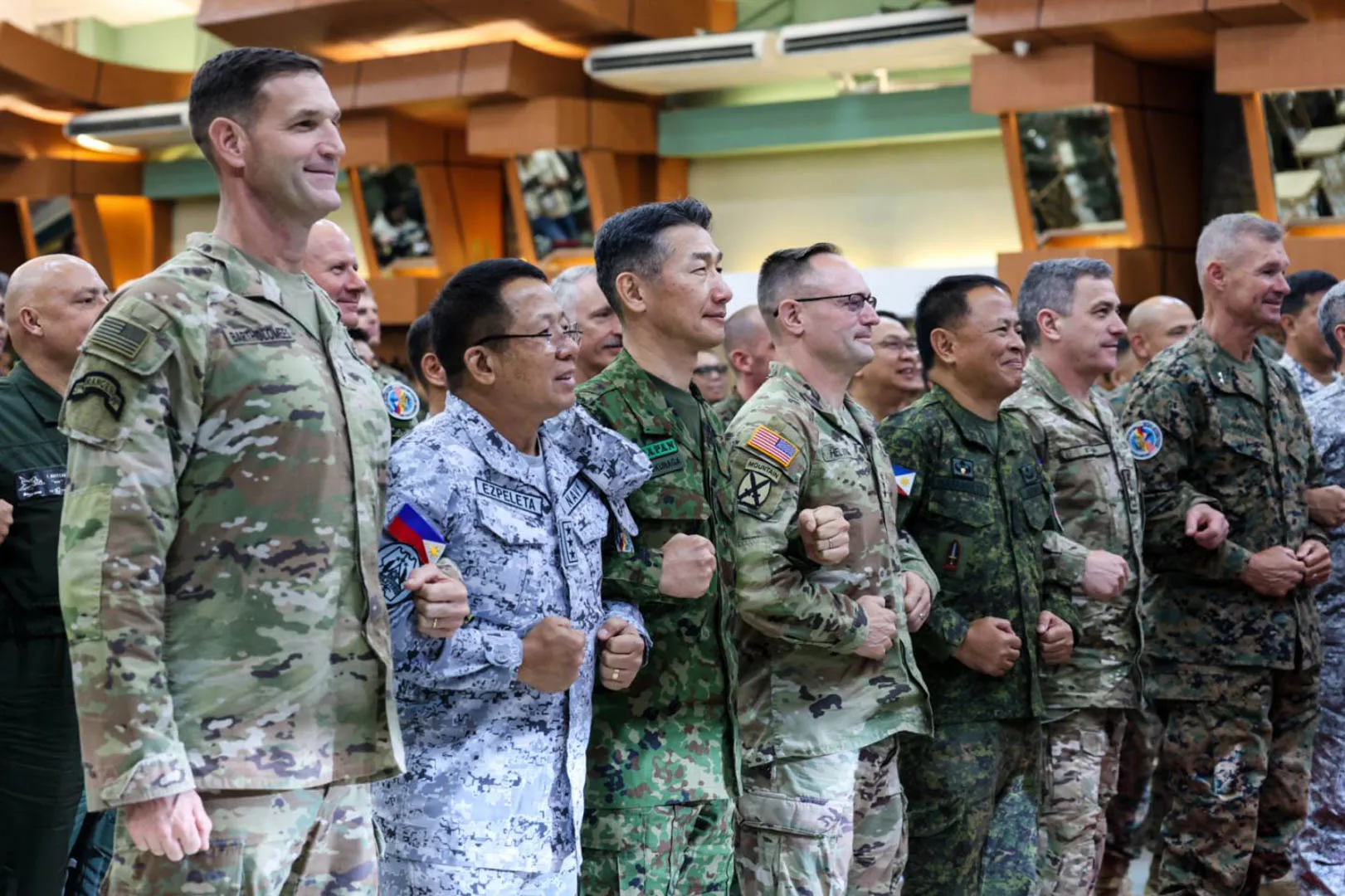
MANILA, Philippines — Even because the state of affairs within the Strait of Hormuz and the larger Middle East vacillates between threats that “an entire civilization will die tonight” and negotiations which are regular and hopeful, some 10,000 troopers from the US navy will likely be coaching within the Philippines for the weeks-long yearly Balikatan wargames.
Regardless of different issues occurring elsewhere on this planet, “Balikatan is proof that the US’ ironclad dedication to the Philippines stays unwavering,” stated Lieutenant Normal Christian Wortman, commanding normal of the First Marine Expeditionary Pressure.
For 3 weeks from April 20 till the second week of Could, some 17,000 troopers and fight troops from seven international locations will likely be coaching all throughout the archipelago in joint wargames between the Armed Forces of the Philippines (AFP) and the US navy.
The yr’s joint workouts are the “biggest” and most complex yet.
For the primary time, too, Balikatan will embrace troops from the Japan Self-Protection Forces — a long-awaited improvement some two years after Manila and Tokyo signed the Reciprocal Entry Settlement (RAA). It’ll be the primary time for Japanese troopers to set foot on Philippine soil since World Battle II, when Japan colonized the Philippine islands.
There are a number of different noteworthy particulars of this yr’s drills.
There are multilateral maritime occasions and maritime strike drills, amongst others below the Northern Luzon Command (NOLCOM) or the AFP unified command answerable for Bajo de Masinloc (Scarborough Shoal) within the West Philippine Sea and the waters between Luzon and Taiwan up north — flashpoints for tensions within the area.
The majority of drills that’ll be accessible for media to cowl, in reality, are occurring up north, once more below NOLCOM.
That’s to not say that the south isn’t getting any motion.
Earlier than Balikatan kicked off, Philippine and American troopers “rehearsed gear and provide offload from maritime prepositioning pressure transport” on the Port of Cagayan de Oro that was ultimately dropped at Luzon.
{That a} flurry of navy coaching actions are set to happen on Philippine soil is nothing new.
However the context of which they’re occurring in 2026 provides a brand new dimension to every maritime exercise, logistical drills, and take a look at of interoperability: the US making an attempt to guarantee its companions within the Indo-Pacific that its pivot to the area remains to be on observe, at the same time as their battle within the Center East appears to be going awry.

The area’s sense of US energy
“We expect the participation displays a rising worldwide consensus of a free, open, and secure Indo-Pacific,” stated Wortman in a press convention on April 20, when requested in regards to the inclusion of Australia, Japan, New Zealand, Canada, and France as collaborating forces.
All 5 nations have visiting forces offers with the Philippines and are additionally shut companions of the US. None of these international locations are from Southeast Asia or Asia, though a number of Asian international locations are a part of Balikatan as observers.
Army officers have taken nice pains to distance the actions within the Philippines from the battle in opposition to Iran, or in any operations within the Gulf — even when they’re questions on whether or not navy actions there have affected deployments right here.
France scaled down its deployment for the reason that US and Israel launched the battle on Iran in late February. From the deployment of the French Mission Jeanne D’Arc 2026, Paris will as an alternative be sending a small group of 15 to twenty personnel for coaching each in Palawan and the Philippine capital.
Main Normal Francisco Lorenzo Jr., Philippine train director for Balikatan 2026, stated the drills are supposed to “showcase our alliance with the US, strengthening our potential and functionality, and pushing for the rules-based worldwide order and to maintain the Indo-Pacific open and free.”
It’s fascinating to notice that solely Lorenzo put emphasis on the “rules-based worldwide order” throughout the hour-long press convention and even throughout the opening ceremony.
In spite of everything, how can American officers talk about worldwide order when their very own president’s actions seem to undermine or threaten that?
A ISEAS–Yusof Ishak Institute survey of thought leaders within the area appears to point a attainable shift in views within the Philippines towards the US.
In its yearly survey, which concluded simply weeks earlier than the battle on Iran, 54.7% of respondents stated they “welcomed” Washington’s regional political and strategic affect, down from the 66% in 2025. “Fear” over the US’ regional political and strategic affect went up — to 45.3% in 2026 from simply 34% in 2025.
The 2026 numbers put us just a bit nearer to the remainder of Southeast Asia. Some 43.2% of respondents from throughout the bloc stated they welcomed US hegemony, whereas 56.8% stated they have been anxious.
It’s nonetheless a substantial hole between the Philippines and the area, admittedly, however earlier surveys (by a unique suppose tank) would point out that Filipinos trusted the US greater than they did themselves.
However maybe essentially the most telling quantity from the survey could be the 51.9% of these surveyed from throughout the area who stated “US management below President (Donald) Trump” was their prime geopolitical concern for the area. It trumps world rip-off operations and even aggressive habits within the South China Sea (which was the highest concern in 2025). Dynamics and prospects within the South China Sea, and a dream of a Free and Open Indo-Pacific, in spite of everything, was as soon as rooted on a secure and predictable US.
A battle’s penalties
There may be a lot to be anxious about over the US and Israel’s battle on Iran — the demise toll throughout the area that’s hit the hundreds, together with civilians, is devastating. There’s the destroy of vital infrastructure within the area, and the disruption of life in components of the area.
Nearer to house is the reminder of simply how weak the Philippines, an archipelagic nation, is to fluctuations within the world oil market. President Ferdinand Marcos has lately introduced dramatic rollbacks in the price of diesel and gasoline, however not earlier than diesel rose to virtually triple its pre-Iran battle costs. It was an already weak transportation sector that absorbed the brunt of the oil worth surge.

In Manila, navy officers are cautious when speaking in regards to the type of vitality necessities an enormous navy train would want. Accomplice nations are bringing their very own provides. The US navy’s spokesperson for Balikatan, Colonel Robert Bunn, stated the US bought gasoline for Balikatan between three to 4 months in the past.
“However the US, whether or not or not it’s by means of vitality use or once we put our autos on the roads throughout Balikatan, are at all times very delicate to the native populace and our impact on the nation of the Philippines. We respect that to a excessive diploma and it’s essential to our alliance,” he added.
The Philippine navy additionally has its personal pre-determined provide for Balikatan, though elsewhere the AFP has tightened its belt too — conferences and conferences are virtually all on-line, save for when it’s a delicate matter, in line with sources.
So even because the Philippines and US up the depth and intricacy of their protection ties and interoperability workouts, Manila must also look, in earnest and with intentionality, at partnerships past its solely treaty ally.
Balikatan 2026 might be the beginning of a protection community that goes past a superpower some have warned is burning too brilliant and to fast for its personal good. – Rappler.com
https://weblog.passive-income4u.com/create-your-very-own-auto-publish-news-blog-site-and-earn-passive-income-in-just-4-easy-steps/
https://www.rappler.com/philippines/view-manila-balikatan-2026-wargames-gulf-war/