DAVAO CITY (MindaNews / 9 Could) — Each March 1, Davao Metropolis celebrates Araw ng Dabaw with parades, live shows, pageants, and festivals that remodel town right into a spectacle of colour and motion. But amid the noise and celebration, few keep in mind that one of many Philippines’ most influential fashionable artists — Ang Kiukok — was additionally born in Davao on the identical day in 1931.
Born to a Chinese language immigrant father and a Filipino mom, Ang Kiukok would develop into one of many nation’s most recognizable fashionable painters; his work of distorted our bodies, strained labor, starvation, and unrest remaining a few of the starkest portraits of the anxieties and violence underlying fashionable Filipino life.
Although initially pursuing structure, Kiukok ultimately shifted in the direction of portray, learning in Manila and coaching below distinguished artists resembling Diosdado Lorenzo and Vicente Manansala. His years on the College of Santo Tomas, alongside along with his participation in scholar artwork competitions, helped form the distinct visible language that might later outline his profession.
Deeply influenced by Cubism and Expressionism, Kiukok developed a method marked by fractured varieties, angular strains, and emotionally charged figures. Relatively than merely imitating western Cubism, nevertheless, he tailored its fragmented views to depict Filipino realities: laborers, fisherfolk, employees, households, and solitary figures caught in rigidity and battle.
His work usually portrayed distorted human our bodies and compressed areas, utilizing vivid reds, stark blacks, and heavy textures to evoke violence, grief, anger, and survival. Critics would later describe his work as a type of “distorted realism” or “expressive cubism,” one which remodeled on a regular basis Filipino life into one thing visceral and confrontational.
Over time, his work grew to become a few of the most recognizable photos in fashionable Philippine artwork, incomes him nationwide and worldwide acclaim. In 2001, he was named Nationwide Artist for Visible Arts, cementing his legacy as one of many nation’s most influential painters.
Right this moment, Could 9, marks 21 years since Kiukok died of most cancers in 2005, abandoning a physique of labor that continues to form and unsettle modern Philippine artwork.
Kiukok’s artwork flourished in periods of political and social unrest, notably throughout Martial Regulation, when a lot of his works centered on themes of oppression, starvation, and alienation. Requested as soon as why he painted in such fractured and sometimes unsettling varieties, Kiukok reportedly replied: “Go searching you. A lot anger, ugliness. And likewise insanity.”
Our bodies in rigidity: Studying Kiukok’s Fishermen
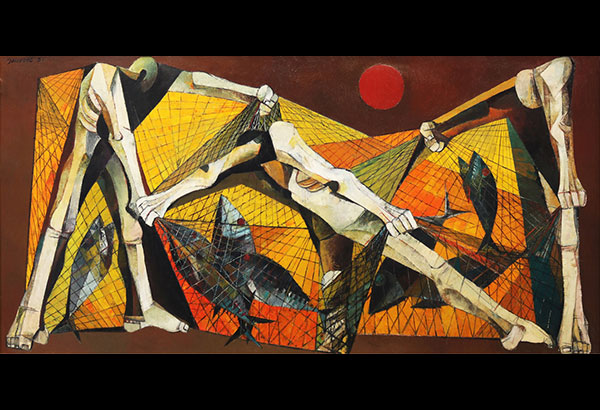
One among Ang Kiukok’s most recognizable works, Fishermen (1981), depicts two fishermen hauling a heavy fishing web beneath a blaring red-orange sky. Fish cling suspended throughout the internet of intersecting strains, whereas the boys’s our bodies seem elongated, fractured, virtually skeletal.
Relatively than portraying the human physique organically, Kiukok renders the fishermen by means of sharp angles and distorted limbs that twist the physique unnaturally, compressing them into the identical inflexible geometry as the web they carry.
On this sense, the portray turns into a portrait of alienation — of our bodies formed, strained, and consumed by the calls for of survival.
Kiukok’s use of expressive cubism and distortion displays a recurring concern all through his work: the strain between human dignity and the forces that cut back folks into devices of labor. The fishermen’s faces are obscured, their individuality erased beneath the overwhelming construction of the composition. What stays are merely our bodies — our bodies made to drag, to hold, to endure, to provide.
Right here there is no such thing as a seen horizon, no open sea. As a substitute, the crimson sky looms over the scene with an virtually suffocating depth, amplifying the exhaustion and pressure embedded into the portray.
In some ways, Fishermen displays the bigger considerations that outlined Kiukok’s artwork in periods of social and political unrest. His work repeatedly returned to employees, fisherfolk, hungry tables, distorted households, screaming figures — photos formed by poverty, violence, and the psychological pressures of on a regular basis life.
Greater than 20 years after his loss of life, Kiukok’s work stay tough to look away from. The anger, the ugliness, the insanity he as soon as painted into kind, all stay painfully acquainted. (Bea Gatmaitan/MindaNews)
https://weblog.passive-income4u.com/create-your-very-own-auto-publish-news-blog-site-and-earn-passive-income-in-just-4-easy-steps/
https://mindanews.com/arts-culture/2026/05/remembering-ang-kiukok-the-davao-born-national-artist-who-painted-rage-into-form/