The Yield Entice Most Earnings Traders Fall Into Earlier than Shopping for a Single Share
There’s a persistent false impression amongst income-focused buyers that dividend yield is a static, dependable quantity. It’s not. For firms working in cyclical commodity markets, yield is a shifting goal, formed by earnings volatility, forex fluctuations, capital allocation selections, and the unpredictable rhythms of worldwide commodity demand. Understanding this dynamic is the start line for any critical evaluation of what number of Rio Tinto shares for $10,000 a 12 months in passive revenue you’ll really need to carry.
Earlier than operating any calculation, it’s price appreciating the structural complexity sitting beneath what seems like a easy arithmetic downside. The variety of shares required adjustments relying on which yield determine you employ, what tax bracket you occupy, whether or not you account for franking credit, and the way you interpret Rio Tinto’s dividend historical past relative to its commodity worth cycle.
When large ASX information breaks, our subscribers know first
Rio Tinto’s Dividend Construction: What the Numbers Truly Present
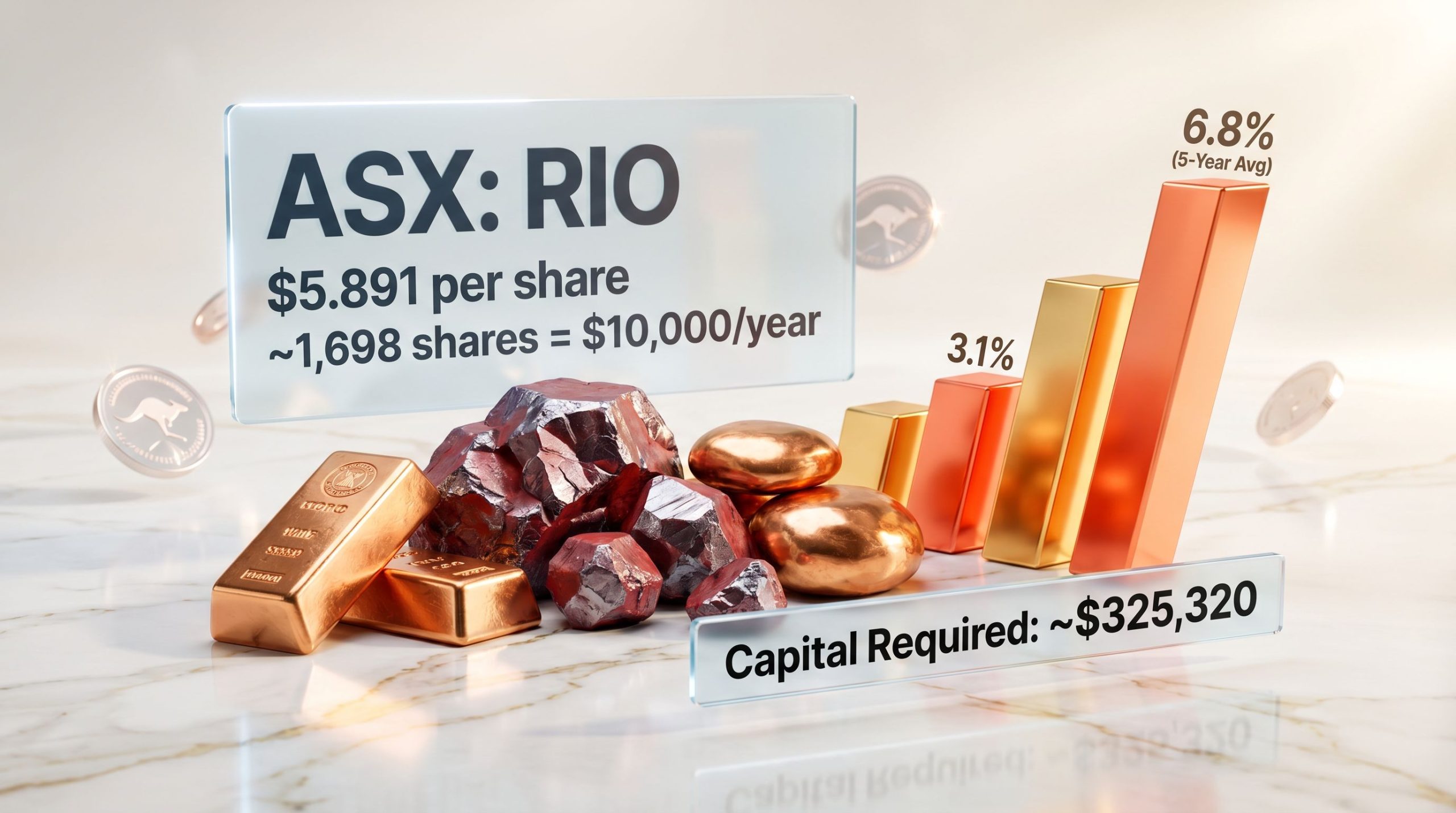
Rio Tinto (ASX: RIO) distributes dividends to shareholders twice per 12 months. The latest cycle produced a totally franked interim dividend of $2.22 per share, paid in September, adopted by a totally franked closing dividend of $3.671 per share, paid in April. Mixed, the full money dividend throughout the total 12 months reached $5.891 per share.
Utilizing Rio Tinto’s closing share worth of roughly $191.59, the trailing money dividend yield sits at roughly 3.1%. That sounds modest by revenue investing requirements, however there’s a crucial layer beneath the headline quantity that almost all informal buyers overlook.
Trailing Yield vs. Forecast Yield: Why Does the Distinction Matter?
A trailing yield seems backward, calculating the return based mostly on dividends already paid divided by the present share worth. A forecast yield seems ahead, incorporating analyst projections about what the corporate may pay in future intervals.
For useful resource sector firms, forecast yields carry significantly extra uncertainty than these for banks or infrastructure companies. The iron ore worth tendencies, copper demand, Pilbara climate circumstances, and Chinese language macroeconomic coverage can all shift dividend outcomes materially inside a single reporting cycle.
Earnings buyers ought to deal with forecast yields on mining firms as directional estimates, not dependable revenue projections. The trailing yield is the one determine that displays cash really distributed to shareholders.
The Hidden Yield Increase: How Franking Credit Change the Actual Return
Rio Tinto’s dividends are totally franked, which carries important implications for Australian resident buyers that transcend the said money return. Full franking means the corporate has already paid 30% company tax on the underlying earnings earlier than distributing dividends. Shareholders obtain an connected franking credit score representing that pay as you go tax, which can be utilized to offset private revenue tax obligations.
For eligible buyers, the grossed-up yield exceeds the headline 3.1% money determine significantly. The sensible impact is determined by the investor’s marginal tax charge:
| Investor Tax Fee | Money Dividend (per share) | Franking Credit score Worth | Efficient End result |
|---|---|---|---|
| 0% (retiree beneath threshold) | $5.891 | Full money refund of credit | Highest whole return |
| 19% marginal charge | $5.891 | Partial tax offset | Sturdy profit |
| 32.5% marginal charge | $5.891 | Average offset | Some profit |
| 45% + Medicare Levy | $5.891 | Reduces legal responsibility solely | Least profit |
For self-managed superannuation fund (SMSF) buyers drawing a retirement pension, the franking credit score refund mechanism can flip Rio Tinto’s modest money yield right into a meaningfully increased efficient return. This is among the extra under-appreciated benefits of totally franked dividend investing throughout the Australian tax framework. In line with Morningstar, producing substantial passive revenue by way of dividend shares requires cautious consideration of those tax-efficiency components.
The Core Calculation: How Many Rio Tinto Shares for $10,000 a 12 months?
The arithmetic is simple upon getting a agency dividend-per-share determine. Utilizing the trailing whole dividend of $5.891:
Shares Required = $10,000 ÷ $5.891 = roughly 1,698 shares
On the present share worth of $191.59, buying 1,698 shares requires a complete capital deployment of roughly $325,320.
That determine deserves some historic context. Rio Tinto’s share worth has climbed greater than 59% over the previous twelve months. As the worth rises with no proportional enhance in dividends, the yield compresses, that means the capital required to generate a set revenue goal expands. Traders who constructed positions in periods of decrease share costs benefited from considerably higher entry yields.
| State of affairs | Shares Required | Reference Share Worth | Complete Capital Required |
|---|---|---|---|
| Present trailing yield (~3.1%) | ~1,698 shares | ~$191.59 | ~$325,320 |
| 5-year common yield (~6.8%) | ~1,471 shares | ~$110.59 (historic) | ~$162,680 |
| Mid-range yield estimate (~3.81%) | ~2,375 shares | ~$110.59 | ~$262,700 |
The distinction between the present yield setting and the five-year common of roughly 6.8% illustrates simply how a lot the capital requirement shifts throughout completely different market cycles. Traders shopping for at cycle peaks face compressed yields and elevated capital prices concurrently. For additional context on passive revenue projections from a $10,000 beginning place, analyst commentary highlights how variable these returns may be 12 months to 12 months.
Why Rio Tinto’s Dividend Is So Troublesome to Predict
Probably the most essential issues an revenue investor can perceive about Rio Tinto is that its dividends are structurally linked to commodity costs, significantly iron ore and, more and more, copper. In contrast to banks or utilities that generate predictable money flows from contracted income streams, Rio Tinto’s earnings are largely a operate of prevailing spot costs on world commodity markets.
Iron Ore: The Dominant Earnings Driver
Iron ore stays the muse of Rio Tinto’s income base. The Pilbara area of Western Australia homes one of many world’s most efficient iron ore mining complexes, and output from this area feeds instantly into Chinese language metal mills. When China metal demand is elevated, iron ore costs rise and Rio Tinto’s earnings increase. When Chinese language demand contracts, the reverse happens.
A decline in iron ore costs beneath roughly US$80 per tonne has traditionally positioned significant downward stress on free money circulation, which feeds instantly into dividend capability. This isn’t a theoretical threat. Iron ore has traded nicely beneath this threshold throughout earlier commodity downturns, and buyers counting on peak-cycle dividends for revenue planning have been upset accordingly.
Copper and the Power Transition Issue
Rio Tinto’s rising copper publicity introduces a second earnings driver with a distinct demand profile. Copper is central to electrification infrastructure, together with electrical autos, grid upgrades, and renewable vitality installations. In contrast to iron ore, which is tied primarily to building and conventional manufacturing, copper demand is more and more linked to decarbonisation capital expenditure globally.
This creates an fascinating dynamic for long-term dividend buyers. If the vitality transition continues accelerating, copper revenues may partially offset intervals of iron ore weak spot. Nonetheless, understanding broader copper market tendencies reveals that provide responses to cost indicators are gradual, including a speculative dimension to copper’s long-term worth trajectory.
Historic Dividend Variability: A Sample Earnings Traders Should Settle for
| Interval | Dividend Development | Main Driver |
|---|---|---|
| FY2021 | Peak payouts | Iron ore super-cycle |
| FY2022 | Sharp decline | Commodity worth correction |
| FY2023-2024 | Partial restoration | Stabilising iron ore, copper progress |
| FY2025 (Trailing) | $5.891 per share | Twin totally franked funds |
The swing from peak cycle payouts in FY2021 to materially decrease distributions in FY2022 was a pointy reminder that useful resource sector dividends can’t be budgeted with the identical confidence as financial institution dividends or infrastructure distributions. This variability is structural, not unintended.
The Focus Threat Drawback
Even when the revenue maths work, concentrating $325,000 in a single inventory creates a threat profile that almost all monetary planning frameworks would classify as inappropriate for income-dependent buyers. Single-stock focus means the investor’s complete passive revenue stream is topic to the fortunes of 1 firm, one commodity complicated, and one geographic working setting.
A well-structured passive revenue portfolio usually spans 10 to fifteen ASX dividend-paying firms throughout a number of sectors. Moreover, a considerate method to portfolio diversification serves two measurable features:
- Earnings smoothing: When sources dividends fall in a commodity downturn, monetary or infrastructure dividends could maintain regular or develop, cushioning whole revenue.
- Capital preservation: Sector-specific drawdowns, equivalent to a sustained iron ore worth decline, don’t devastate your complete portfolio worth.
| Sector | Function in Portfolio |
|---|---|
| Sources (e.g., RIO, BHP) | Excessive yield, cyclical revenue era |
| Main banks | Constant franked dividend historical past |
| Infrastructure and utilities | Defensive, usually inflation-linked revenue |
| Client staples | Recession-resistant money circulation profile |
| Healthcare | Defensive progress element with dividends |
Constructing Towards $10,000 a 12 months With no $325,000 Lump Sum
For many buyers, deploying $325,320 in a single transaction is neither sensible nor advisable. Luckily, the trail to a $10,000 annual revenue goal from Rio Tinto shares doesn’t require it. A structured accumulation method can obtain the identical final result over time:
- Outline your goal and time horizon earlier than buying a single share. Realizing you need 1,698 shares offers the buildup technique a concrete endpoint.
- Apply dollar-cost averaging (DCA) by investing a set quantity frequently, for instance $2,000 monthly, which reduces the danger of shopping for solely at excessive costs.
- Enrol within the Dividend Reinvestment Plan (DRP) to routinely convert money dividends into further shares. This compounds the shareholding with out requiring contemporary capital contributions.
- Monitor payout ratio tendencies at every reporting interval. Rio Tinto’s board determines dividends based mostly on earnings and capital necessities, so monitoring payout ratios gives early indicators about dividend sustainability.
- Evaluation diversification yearly to make sure Rio Tinto stays an appropriately sized place inside a broader revenue portfolio moderately than rising by way of compounding to grow to be an outsized focus threat.
The subsequent main ASX story will hit our subscribers first
Rio Tinto vs. BHP: A Transient Comparative View
Australian revenue buyers often examine Rio Tinto and BHP Group (ASX: BHP) given their comparable market positioning. Each are large-cap, totally franked, twice-yearly dividend payers with iron ore and copper as main income sources. Additionally it is price contemplating the Rio Tinto delisting affect on investor technique, significantly for these constructing long-term revenue positions. The important thing distinctions price noting:
| Metric | Rio Tinto (ASX: RIO) | BHP Group (ASX: BHP) |
|---|---|---|
| Dividend Franking | Totally franked | Totally franked |
| Dividend Frequency | Twice yearly | Twice yearly |
| Main Income Driver | Iron ore + copper | Iron ore + copper + coal |
| Power transition metallic publicity | Excessive (copper, lithium initiatives) | Average |
| Reporting forex | US {dollars} | US {dollars} |
Each firms convert dividends from USD to AUD for ASX shareholders, that means the AUD/USD change charge on the time of conversion influences the ultimate cost acquired. A stronger Australian greenback reduces the AUD equal of every dividend, which is an often-overlooked variable in passive revenue planning for useful resource sector shares.
Macro Forces That May Reshape the Dividend Outlook
A number of macro variables past iron ore and copper costs deserve consideration from buyers concentrating on what number of Rio Tinto shares for $10,000 a 12 months in passive revenue they want:
- Chinese language financial coverage: Stimulus or contraction in China’s property and infrastructure sectors instantly impacts metal demand, iron ore costs, and in the end Rio Tinto’s earnings capability.
- International rate of interest cycles: As central banks regulate financial coverage, the relative attractiveness of dividend-paying equities shifts relative to fastened revenue options. In declining charge environments, high-yield shares usually entice capital inflows, which compresses yields additional by lifting share costs.
- Pilbara operational dangers: Cyclone exercise and flooding within the Pilbara can disrupt shipments and have an effect on quarterly manufacturing volumes. These occasions are unpredictable and might affect annual earnings.
- Massive-scale capital allocation selections: Tasks of the dimensions of the Simandou iron ore growth in Guinea symbolize important capital commitments that would have an effect on free money circulation obtainable for dividends over multi-year intervals.
- Foreign money threat: Rio Tinto reviews in USD. AUD/USD actions create variability in dividend revenue for Australian shareholders that’s completely unbiased of the underlying enterprise efficiency.
Disclaimer: This text accommodates basic monetary info solely and doesn’t represent private monetary recommendation. Dividend yields, share costs, and franking credit score advantages range over time and rely upon particular person circumstances. Previous dividend funds should not indicative of future distributions. Traders ought to search unbiased monetary recommendation tailor-made to their private state of affairs earlier than making funding selections.
Incessantly Requested Questions
How Usually Does Rio Tinto Pay Dividends?
Rio Tinto pays dividends twice per 12 months. The interim dividend is usually paid in September and the ultimate dividend in April. Each have traditionally been totally franked for ASX shareholders.
Are Rio Tinto’s Dividends Assured?
No. The board determines dividend quantities based mostly on earnings, free money circulation, and capital necessities every reporting interval. Commodity worth cycles can produce important variation between years, together with materials reductions from peak ranges.
What Is the Distinction Between a Trailing and Forecast Yield?
A trailing yield makes use of dividends really paid over the previous twelve months divided by the present share worth. A forecast yield makes use of analyst estimates of future distributions. For cyclical miners, forecast yields carry considerably increased uncertainty than trailing figures.
How Do Franking Credit Have an effect on Rio Tinto Dividend Earnings?
Franking credit symbolize company tax already paid by Rio Tinto earlier than distributing earnings. Australian resident buyers can apply these credit towards private tax liabilities, with eligible low-income buyers or SMSF pension accounts doubtlessly receiving a money refund, growing whole revenue above the said money yield.
Does Rio Tinto Supply a Dividend Reinvestment Plan?
Sure. Rio Tinto operates a Dividend Reinvestment Plan that enables eligible shareholders to obtain further shares in lieu of money dividends, supporting the compounding of shareholdings over time.
How Does the AUD/USD Trade Fee Have an effect on My Dividends?
Rio Tinto declares dividends in US {dollars}. When transformed to Australian {dollars} for ASX-listed shareholders, the cost quantity displays the prevailing change charge on the time of conversion. Consequently, a stronger Australian greenback reduces the AUD worth of every cost.
Need To Know Which ASX Mineral Discoveries May Increase Your Funding Portfolio?
Whereas constructing a passive revenue technique round established miners like Rio Tinto gives stability, Discovery Alert’s proprietary Discovery IQ mannequin scans ASX bulletins in actual time to establish important mineral discoveries — the sort which have traditionally generated substantial returns, as showcased on Discovery Alert’s devoted discoveries web page — so start your 14-day free trial right now and place your self forward of the broader market.
https://weblog.passive-income4u.com/create-your-very-own-auto-publish-news-blog-site-and-earn-passive-income-in-just-4-easy-steps/