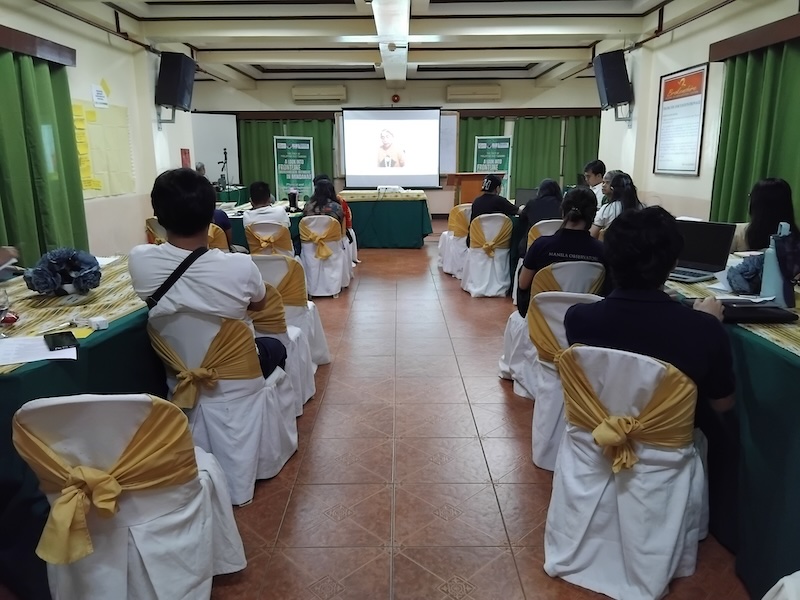
DAVAO CITY (MindaNews / 17 Could 2026) — Environmental defenders, journalists, legal professionals, and human rights advocates gathered at Brokenshire Resort & Conference Heart on Friday, Could 15, for a workshop analyzing how repression in opposition to environmental and indigenous defenders in Mindanao more and more extends from bodily assaults on communities into digital areas marked by human rights abuses and red-tagging.
“The Prey of Philippine Pink-Tagging: A Look into Entrance-line Environmental Defenders in Mindanao – Bodily and Digital Area Repression Resiliency Constructing” introduced collectively useful resource individuals and individuals from activist teams, Lumad communities, authorized organizations, and media establishments to doc experiences of repression, focus on authorized and safety responses, and strengthen assist networks amongst affected communities.
Organizers mentioned the workshop sought to deepen understanding of “red-tagging-driven repression — each bodily and digital — on frontline environmental defenders in Mindanao,” whereas co-creating “concrete, rights-based responses.”
Kat Dalon of Sabokahan recognized indigenous communities defending ancestral lands, girls organizers, environmental advocates opposing mining and plantations, Save Our Colleges campaigners and educators, and human rights defenders amongst these most susceptible to assaults.
Dalon linked these assaults to the growth of mining operations, plantation agriculture, militarization in indigenous communities, and counterinsurgency frameworks related to Government Order No. 70 and the Nationwide Activity Pressure to Finish Native Communist Armed Battle (NTF-ELCAC).
She then additional described how environmental protection and indigenous organizing are more and more handled “as safety threats reasonably than legit democratic motion.”

Tracing an extended historical past of assaults in opposition to Lumad communities, Dalon cited army operations, pressured evacuations, closures of Lumad faculties, and the extrajudicial killings of Lumad leaders and lecturers.
Dalon additional mentioned how repression now extends into on-line areas.
She cited instances involving surveillance by way of Fb and Messenger, on-line harassment, manipulation makes an attempt, and threats delivered by way of digital platforms. Dalon described the rise of “digital insecurity,” warning that on-line intimidation creates worry, self-censorship, and elevated vulnerability amongst defenders.
Journalist and red-tagging survivor Leonardo Vicente “Cong” Corrales emphasised that red-tagging shouldn’t be dismissed as mere political disagreement.
“Pink-tagging just isn’t merely a distinction of opinion … It’s an lively dying menace designed to silence fact by way of the specter of violence,” he mentioned in an explainer through the workshop.
Corrales additionally pointed to the Supreme Court docket’s Deduro v. Vinoya ruling, the place the best court docket categorically declared that state-sponsored labeling, vilification, and guilt by affiliation represent a transparent, authorized foundation for a Writ of Amparo. This acknowledged red-tagging as a legit menace.
Discussions additionally centered on the impression of repression on households and communities.
Presenters and individuals alike described how kinfolk of defenders are generally repeatedly interrogated, pressured, or used as leverage throughout army operations. Communities, they mentioned, expertise worry, psychological stress, pressured displacement, and the erosion of belief.
One workshop session highlighted the experiences of girls environmental defenders, who reported nervousness, restricted motion, threats to livelihood and training, and fixed worry for his or her households’ security.
Workshop individuals additionally mentioned the difficulties of pursuing authorized cures in opposition to red-tagging.
Atty. Angelisa Razo of the Union of Individuals’s Legal professionals in Mindanao (UPLM) mentioned how counterinsurgency frameworks and present legal guidelines are used in opposition to environmental and indigenous defenders. She argued that digital red-tagging ought to be legally acknowledged as “a verifiable precursor” to extra severe bodily assaults, warning that victims might “disappear” or turn out to be targets of extrajudicial killings.

“You need to-transfer That is in legislation digital red-taggingwhich is a verifiable precursor to extra harmful or severe bodily mass assault — you possibly candisappear or you possibly canEJK,” she defined. (Digital red-tagging have to be legally acknowledged as a verifiable precursor to extra harmful or severe bodily assaults in opposition to individuals — one might disappear or turn out to be a sufferer of extrajudicial killing.)
Razo additionally referred to as for stronger authorized protections for defenders, together with proposals to criminalize red-tagging, strengthen protections for ancestral domains, and move a Human Rights Defenders Safety Act.
Kath Cortez of Davao At this time famous that documentation on red-tagging stays minimal, whereas grassroots organizations usually face boundaries in submitting instances. She cited landmark instances involving journalists and activists, together with Atom Araullo, Bulatlat, and Corrales himself.
A participant criticized what he described as a “tradition of impunity,” urging stronger accountability mechanisms and the criminalization of red-tagging as a menace to life, liberty, and safety, whereas calling for stronger alliances.
Members additionally raised issues over the position of state establishments in ancestral land conflicts.
Lumad representatives criticized insurance policies that favored giant firms and improvement initiatives over indigenous communities, significantly in disputes involving mining and ancestral domains.
The workshop concluded with calls to finish harassment and red-tagging in opposition to defenders, demilitarize indigenous communities, strengthen bodily and digital safety mechanisms, shield environmental and indigenous rights, and assist unbiased investigations into assaults on defenders.
Regardless of continued threats, communities stay dedicated to defending ancestral lands, environmental safety, indigenous self-determination, and the proper to training.
“Peace,” one presentation learn, have to be “primarily based on justice, not militarization.” (Bea Gatmaytan / MindaNews)
https://weblog.passive-income4u.com/create-your-very-own-auto-publish-news-blog-site-and-earn-passive-income-in-just-4-easy-steps/
https://mindanews.com/top-stories/2026/05/environmental-defenders-journalists-tackle-physical-and-digital-repression-in-mindanao/