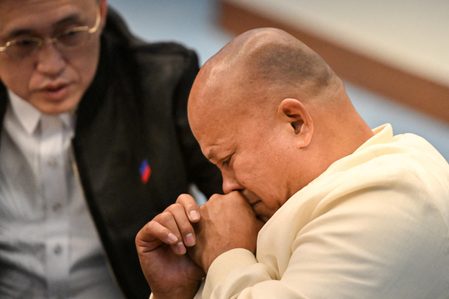
The Supreme Court docket has now denied Senator Ronald dela Rosa’s request for a brief restraining order in opposition to the attainable execution of an Worldwide Legal Court docket (ICC) warrant.
It proves that the Court docket is neither unaware of the urgency nor institutionally incapable of performing with velocity when confronted with politically explosive points. The justices clearly perceive the stakes. They know the nation is standing on the fringe of a constitutional confrontation involving sovereignty, government energy, worldwide regulation, and the legacy of Rodrigo Duterte’s drug warfare.
And but, regardless of this demonstrated capability to behave decisively, the Court docket nonetheless refuses to supply complete constitutional readability on the bigger authorized questions surrounding ICC cooperation.
That’s the place the actual drawback lies.
The problems earlier than the Court docket should not factual labyrinths requiring years of evidentiary hearings. They don’t seem to be prison trials demanding witness credibility determinations. They’re basically questions of regulation.
Larger questions
Can the Philippine authorities cooperate with the ICC regardless of its withdrawal from the Rome Statute?
Does Republic Act No. 9851 nonetheless present a framework for cooperation?
Can Philippine authorities execute requests linked to ICC processes?
What constitutional boundaries exist, if any?
These are authorized questions. Pure authorized questions. Questions the Supreme Court docket exists exactly to resolve.
But what the nation continues to obtain are fragmented procedural actions as a substitute of definitive constitutional steering.
Take, as an example, the habeas corpus petitions filed on behalf of Rodrigo Duterte. Whereas the Supreme Court docket has already acted procedurally, it has not but rendered a last substantive ruling on the deserves. (READ: What are the legal issues in Duterte’s arrest and transfer to The Hague?)
The petitions had been consolidated underneath a number of docket numbers, together with G.R. Nos. 278763, 278768, and 278798. In response to current filings by Duterte’s camp, these consolidated petitions had been filed on March 12, 2025.
The Supreme Court docket beforehand required authorities businesses to reply and later required the submission of memoranda, which means the Court docket has already taken cognizance of the petitions. The events reportedly accomplished their memoranda by late 2025 and early 2026.
Nonetheless, Duterte’s legal professionals not too long ago complained that regardless of the passage of round 14 months, the Court docket has nonetheless not issued a substantive decision. In a “Second Pressing Movement to Resolve,” they argued that the extended delay successfully undermines the very goal of habeas corpus as a “speedy and effectual treatment.”
This delay is now not simple to justify as mere judicial warning. The truth is, the denial of Dela Rosa’s TRO might have unintentionally highlighted the inconsistency even additional. The Court docket acted swiftly on provisional aid for a attainable future arrest, but continues to withhold a last constitutional decision on the legality of Duterte’s give up and the broader ICC cooperation framework.
That distinction is turning into institutionally troublesome to disregard.
The longer the Court docket refuses to talk with readability, the extra it creates the impression that it’s ready not for authorized illumination, however for political climate circumstances to stabilize. That may be a harmful picture for the very best tribunal of the land.

The Supreme Court docket can’t defend itself from scrutiny just by issuing partial procedural actions whereas suspending the central constitutional reckoning.
Courts don’t merely determine circumstances. In moments of nationwide stress, they stop constitutional uncertainty from mutating into political chaos. Delay itself turns into a choice when the results are huge and rapid.
What makes the delay much more obvious is that the related authorized terrain is just not solely unexplored. The Court docket is just not being requested to interpret an alien authorized universe. The petitions revolve round treaty withdrawal, government cooperation, statutory interpretation, jurisdiction, and constitutional construction, areas the Court docket has confronted repeatedly in numerous kinds.
Worry of penalties?
The problems could also be politically explosive, however legally they’re neither mysterious nor incapable of decision.
That is exactly why the delay invitations suspicion.
Folks start to wonder if the Court docket fears the results of its personal ruling greater than the absence of 1. A judiciary that turns into excessively acutely aware of political backlash dangers remodeling itself from an unbiased constitutional organ right into a spectator ready for energy blocs to settle their battle first.
However constitutional courts should not designed to path behind politics. They’re alleged to confront constitutional crises earlier than they metastasize.
The irony is painful. The Court docket usually acts swiftly in circumstances involving electoral deadlines, funds disputes, or inner political quarrels amongst elites. But on a matter touching sovereignty, worldwide accountability, government energy, and the give up of a former president to a world tribunal, the establishment all of a sudden discovers the virtues of warning and prolonged deliberation.
One begins to ask: if not now, then when precisely is judicial urgency acceptable?
The hazard right here extends past Rodrigo Duterte, Ronald Dela Rosa, or the ICC itself. The larger hazard is the normalization of constitutional ambiguity throughout moments of most political consequence.
A Supreme Court docket that delays too lengthy teaches future governments a harmful lesson: that sufficiently controversial constitutional questions can merely be outrun politically whereas the judiciary stays frozen in procedural warning.
In some unspecified time in the future, incremental procedural actions cease wanting like prudence and begin wanting like institutional concern.
The nation doesn’t want theatrical language from the Court docket. It doesn’t want ethical grandstanding. It doesn’t want fastidiously calibrated fragments of motion designed to alleviate rapid stress with out confronting the central constitutional points.
It merely wants a ruling. A transparent one. A well timed one. And above all, one worthy of a tribunal that calls itself supreme. – Rappler.com
Raul F. Borjal is an alumnus of Ateneo de Manila College. He held senior government positions in numerous home and multinational firms, culminating in his retirement as vp and company secretary of a Filipino-owned group of firms.
https://weblog.passive-income4u.com/create-your-very-own-auto-publish-news-blog-site-and-earn-passive-income-in-just-4-easy-steps/
https://www.rappler.com/voices/thought-leaders/opinion-supreme-court-speaks-in-fragments-while-history-demands-clarity/