The Philippine Inventory Alternate has been passing reform after reform for nearly a decade, however the market stays one of many area’s weakest performers. The tougher query, nonetheless, stays unanswered: are new merchandise the answer, or are they merely distractions from deeper issues of confidence, participation, and market relevance?
The Philippine Inventory Alternate (PSE) has unveiled a reform package which goals to treatment the nation’s exchange-traded fund (ETF) framework by decreasing capital necessities, permitting actively managed ETFs, broadening participation, and making it less complicated for funding firms to carry merchandise to market.
Does it sound fashionable? Does it sound just like the form of innovation a struggling inventory market ought to embrace? The difficulty is, this is similar story native and overseas traders have repeatedly heard time and again after almost a decade below Ramon Monzon’s leadership.
Once in a while, there’ll be some form of reprieve. On Monday, world shares rallied as oil costs eased. The PSE’s 300-point surge will little question be celebrated by bulls. The positive aspects, nonetheless, have been pushed not by reforms from the PSE Tower, however by occasions unfolding in Washington and Tehran. The inventory uptick follows information of a possible US-Iran peace breakthrough.
There’s little question that easing geopolitical tensions was what boosted danger urge for food, however a inventory trade is finally judged not by a single day’s rally, however by the way it performs towards its friends over time — a far much less flattering measure of the Monzon period.
Futile reforms
Each few years, one other reform comes alongside. New merchandise. New guidelines. New consultations. New frameworks. New roadmaps. Nonetheless, the scoreboard stays stubbornly unchanged.
The PSE stays dogged by power illiquidity, shrinking relevance, declining overseas participation, and an inventory pipeline that will be thought of anemic anyplace else in Southeast Asia.
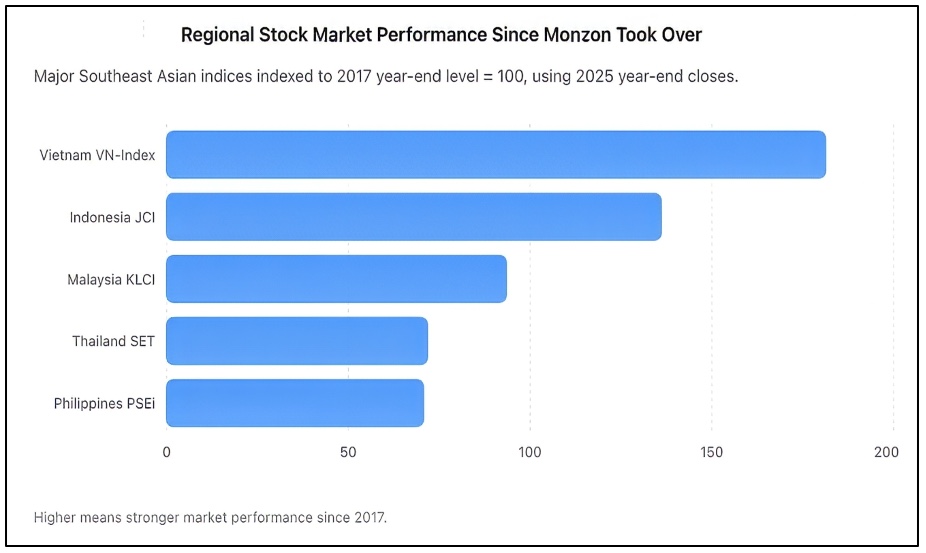
As proven above, from 2017 to 2025, the PSEi fell to 70.7 on an listed foundation, virtually the identical weak end result as Thailand, whereas Vietnam almost doubled and Indonesia rose strongly. The PSEi closed 2025 at 6,052.92, whereas Indonesia’s JCI closed at 8,646.94, Vietnam’s VN-Index at 1,784.49, Thailand’s SET at 1,259.67, and Malaysia’s KLCI at 1,680.11.
Sooner or later, traders should cease being glad with guarantees and begin what they need to get. There was loads of optimism when Monzon stepped into management of the PSE in 2017. The benchmark index had simply breached 8,500. The Philippines was being marketed as certainly one of Asia’s rising development tales. Demographics, consumption, and remittances have been rising, and company earnings have been increasing. The expectation was that with the economic system, the inventory market would naturally deepen. As a substitute, the other occurred.
PSEi struggles
Nearly a decade later, the PSE Index stays effectively under its former highs regardless of years of financial development. Whereas new neighboring markets have attracted capital and drawn traders, the Philippines has steadily misplaced floor.
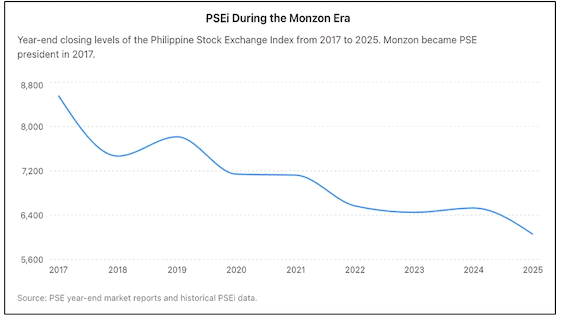
Practically a decade of reforms, but the Philippine inventory market ended 2025 virtually 30% under the place it stood when Ramon Monzon took over the trade, as proven within the chart above.
Bloomberg beforehand described the Philippine market because the worst-performing major stock market over the previous decade, a humiliating distinction for a rustic that spent years selling itself as certainly one of Asia’s most promising funding locations. World situations don’t account for all the deterioration. Each market confronted the pandemic. Every market confronted inflation, geopolitical shocks, and better rates of interest. However many recovered extra rapidly and emerged stronger. The Philippines didn’t. The proof is seen in every single place.

International traders have change into constant web sellers. Every day buying and selling is minimal and tied carefully to a small variety of blue-chip shares. Many listed companies commerce solely sporadically. A number of firms have opted absolutely to delist, realizing that the value of remaining public is solely increased than the payoff. Solely two companies completed initial public offerings in 2025. However that’s not simply disappointing for a nation of greater than 110 million individuals. It’s an indictment of the market’s lack of ability to usher in new issuers.

Monzon’s supporters level to a sequence of latest reforms imposed throughout his tenure. To be truthful, there are various. The trade pursued the acquisition of the fixed-income platform Product Disclosure Assertion (PDS). It promoted Real Estate Investment Trusts (REITs). It pushed sustainability reporting. It modernized buying and selling infrastructure. It advocated securities lending and borrowing. It supported short-selling. It inspired digital participation and retail investing.
The problem is that reforms needs to be measured by outcomes, not statements. A inventory trade has two elementary features. First, it must allow firms to successfully elevate capital. Second, it should help traders in deploying capital with confidence. On each measures, the PSE continues to battle.
Is ETF the reply?
That is the place the ETF initiative is available in. By considerably decreasing capital necessities, permitting actively managed ETFs, and increasing the sorts of establishments that may launch merchandise, the trade goals to make ETF creation less complicated.
That’s not a conceptual mistake, actually. Mature markets throughout the globe expertise thriving ETF industries as a result of ETFs present diversification, lowered prices, and better accessibility. But ETFs don’t change a wholesome inventory market. ETFs are likely to do effectively actually as a result of vigorous capital markets exist already. It’s not the rationale that these markets turned vibrant within the first place.
America didn’t change into the world’s deepest capital market as a result of it had ETFs. It made these ETFs as a result of it already had 1000’s of listed firms, monumental institutional participation, deep liquidity, and powerful investor confidence. The identical may be mentioned for markets resembling Japan, Singapore, Australia, and Hong Kong.
The Philippines faces a much more elementary problem. Traders will not be avoiding Philippine equities as a result of there are too few ETFs. They’re avoiding Philippine equities as a result of they’re questioning valuations, liquidity, governance requirements, market depth, and long-term confidence.
Launching extra ETFs in a market with restricted liquidity dangers merely redistributing present cash among the many similar small pool of securities. In different phrases, ETFs could enhance the plumbing, however they don’t repair the inspiration.
The tougher questions stay unanswered. Why does the Philippines proceed to supply so few Preliminary Public Choices (IPOs) relative to its financial measurement? Why do overseas traders stay persistent sellers? Why does market liquidity stay closely concentrated in a handful of shares? Why has the trade didn’t domesticate a strong pipeline of mid-sized development firms? Why do many entrepreneurs nonetheless choose personal capital over public markets?
These are the questions that decide whether or not a inventory trade succeeds or fails. The uncomfortable actuality is that confidence — not product innovation — is the market’s scarcest commodity. Satirically, Monzon himself has acknowledged that confidence is the most important ingredient in any capital market. On that time, he’s completely appropriate.
However confidence can’t be legislated by means of circulars. It can’t be manufactured by means of new merchandise. It can’t be restored by means of press releases saying one other reform bundle. Confidence is earned by means of competent efficiency.
Governance accountability
After almost 9 years, traders are entitled to ask whether or not the PSE’s issues are merely structural or whether or not management should additionally bear accountability. A chief govt can not take credit score for each initiative whereas assigning each disappointing end result to exterior components. Management finally means accountability for outcomes.
And so the ETF proposal, rational as it’s in itself, shouldn’t be thought of a turning level. It’s an incremental enchancment, not a revolution. It might make the market just a little extra environment friendly, nevertheless it’s not going to deal with the deeper issues the trade has been grappling with for a while.
The problem going through the PSE isn’t the dearth of ETFs. Belief, liquidity, participation, and development are absent right here. However till these points are addressed, any new reforms will seemingly be seen much less as an advance and extra as an try to vary the format of the plumbing but once more, at the same time as the home retains shedding residents due to a rickety basis. – Rappler.com
Vantage Level Analysis Observe: The above charts have been ready by Vantage Level from publicly obtainable trade knowledge and year-end market studies. The evaluation measures the efficiency of the Philippine Inventory Alternate throughout Ramon Monzon’s tenure as president and Chief Govt Officer towards regional friends utilizing a typical 2017 baseline. Sources embody official PSE studies, historic PSEi information, and regional benchmark index knowledge.


Click on right here for different Vantage Point articles.
https://weblog.passive-income4u.com/create-your-very-own-auto-publish-news-blog-site-and-earn-passive-income-in-just-4-easy-steps/
https://www.rappler.com/voices/thought-leaders/vantage-point-philippine-stock-exchange-ramon-monzon-era-reforms-assessment/