Producing common passive revenue is often one of many major aims for many dividend traders.
In Singapore, the 2 standard income-producing sources are blue-chip shares and actual property funding trusts (REITs).
As a substitute of competing with one another, they can be utilized to enrich one another.
Understanding the Distinction Between Blue Chips and REITs
What are blue-chip shares?
Blue chips are sometimes well-established companies with an extended working historical past, robust reputations and constant monetary efficiency.
These corporations are extensively related to dependable dividends, operational stability, and long-term wealth appreciation.
They’ve robust market positions and constant profitability, like Southeast Asia’s largest financial institution, DBS Group (SGX: D05), and aerospace and defence large, ST Engineering (SGX: S63).
What are REITs?
REITs are corporations that personal, function, or finance income-generating actual property.
Sturdy REITs like CapitaLand Built-in Industrial Belief (SGX: C38U) (CICT) and Parkway Life REIT (SGX: C2PU) personal high-quality belongings, hold prudent steadiness sheets, and develop distributions by way of totally different market environments.
Singapore REITs are required to pay out no less than 90% of their taxable revenue to unitholders to qualify for tax transparency, making them interesting to revenue traders.
What Blue-Chip Shares Deliver to an Earnings Portfolio
Blue chips are firms characterised by robust money balances and cheap debt positions.
These shares can survive troublesome financial circumstances, pay dividends, and function effectively below any market circumstances.
With time, blue-chip shares can even elevate their dividends alongside rising earnings.
DBS paid dividends of S$3.06 per share for FY2025 in opposition to S$0.54 a share in FY2015 – a powerful fivefold improve in dividend funds.
This enables traders to steadily improve their funding revenue and sustain with the rising price of dwelling.
Blue chips additionally convey alternatives for capital appreciation because the worth of blue-chip shares tends to rise with improved monetary efficiency.
What REITs Deliver to an Earnings Portfolio
By investing in REITs, you acquire entry to bodily, income-generating belongings.
This provides a novel layer of diversification as actual property typically behaves otherwise from conventional shares and bonds.
As rental funds are paid on a month-to-month foundation or by way of long-term lease contracts, REITs have pretty predictable money flows, permitting them to make distributions on a constant foundation.
The excessive beginning yields offered by REITs come because of authorized necessities that require them to pay out no less than 90% of their taxable revenue.
Story continues
For instance, CICT presently gives about 5% yield, in comparison with ST Engineering, which gives a 2.2% yield.
Why They Work Higher Collectively
REITs and blue-chip shares complement one another by balancing present revenue with future revenue development.
REITs sometimes present greater present yields, whereas blue-chip shares ship regular dividend development as company earnings rise over time.
REITs and blue chips additionally generate revenue otherwise, and these diversified revenue streams might reply otherwise to financial circumstances.
Combining them could make a portfolio extra resilient.
A Hypothetical Passive Earnings Portfolio
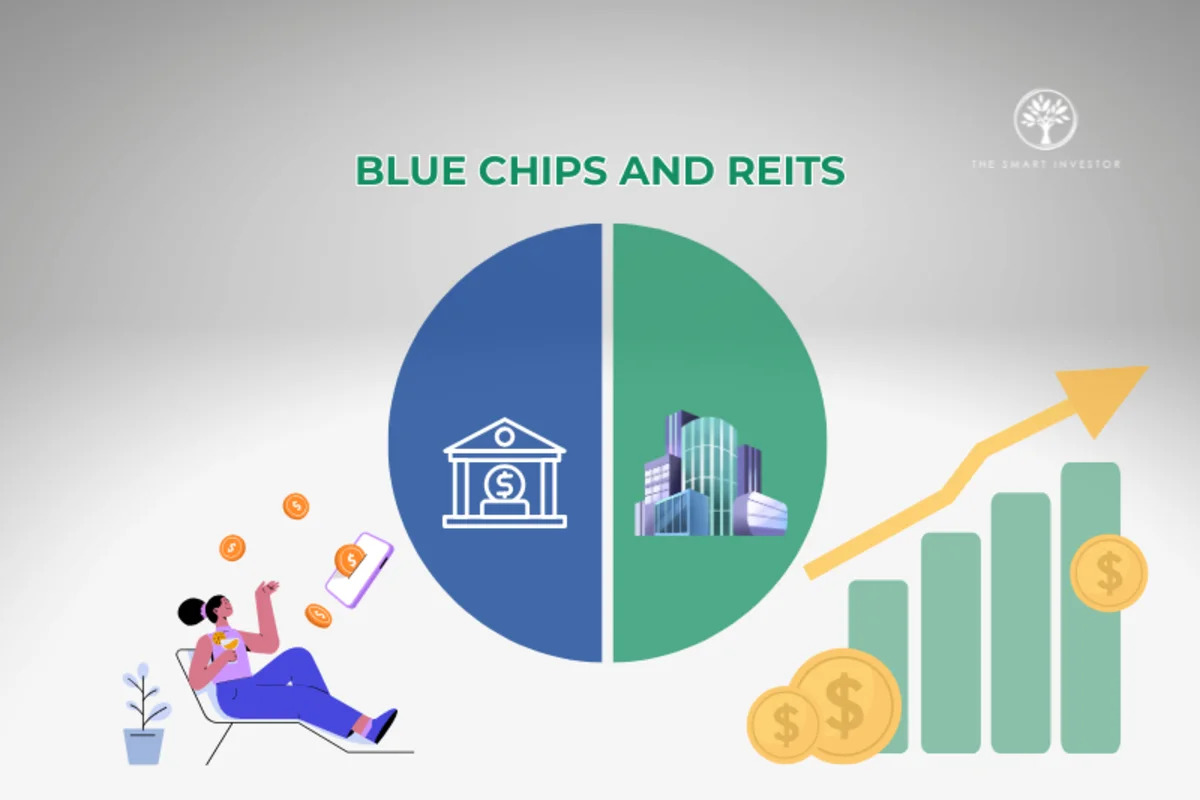
A portfolio break up between blue-chip shares and REITs can present a balanced mixture of revenue, stability, and development:
-
50% blue-chip shares: DBS Group, ST Engineering, and Singapore Airways (SGX: C6L)
-
50% REITs: CICT, Parkway Life, and Mapletree Logistics Belief (SGX: M44U)
Blue chip dividends and REITs’ distributions generate portfolio revenue from two complementary sources.
Collectively, they’ll create a gradual stream of revenue that helps money circulation wants whereas decreasing reliance on a single asset class.
Over the long run, this allocation can even assist wealth creation by way of each revenue development and capital appreciation.
A 50/50 portfolio can provide traders each dependable revenue right this moment and significant portfolio development sooner or later.
What Traders Ought to Watch
Rates of interest: Modifications to rates of interest have an effect on asset courses otherwise. Rising rates of interest can strain REIT valuations as a result of greater borrowing prices scale back profitability, whereas banks sometimes profit from greater charges as they enhance lending margins.
Distribution sustainability: Sustainable payouts supported by wholesome monetary fundamentals are usually extra dependable than unusually excessive distributions with weak underlying money era.
Financial circumstances: Broader financial circumstances comparable to recessions, inflation, and development cycles can impression REITs and blue-chip shares otherwise. Inflation can profit sure REITs if landlords can elevate rents, whereas robust financial development might assist company earnings and dividend growth.
Widespread Errors Earnings Traders Make
One of the frequent errors revenue traders make is focusing solely on the highest-yielding investments.
A really excessive yield can generally sign monetary misery or unsustainable payouts moderately than real alternative.
Yield ought to all the time be evaluated alongside enterprise high quality, money circulation power, and development potential.
As well as, concentrating solely on solely REITs or blue chips would expose traders to pointless dangers.
Diversification throughout a number of asset courses helps scale back dependence on any single supply of revenue.
Lastly, focusing completely on present revenue could cause traders to overlook alternatives for long-term wealth creation.
Traders who steadiness current revenue with future development are sometimes higher positioned to protect buying energy and construct lasting wealth.
Which Traders Might Profit Most?
Retirees typically profit from a blended portfolio as a result of it may present constant and diversified revenue streams.
This mixture can assist common withdrawals whereas decreasing dependence on promoting belongings throughout unfavourable market circumstances.
Alternatively, youthful traders profit considerably from reinvesting dividends and distributions moderately than spending them.
Over very long time horizons, this compounding impact can considerably improve portfolio worth, particularly when mixed with dividend development and long-term capital appreciation.
Traders who desire a steadiness between stability, revenue, and development might discover a mixture of REITs and blue-chip shares notably engaging.
Get Good: Do not Select Between Blue Chips and REITs
Each REITs and blue-chip shares have their very own strengths and weaknesses.
A balanced portfolio consisting of each asset courses creates a extra diversified and resilient passive revenue portfolio.
The neatest traders don’t discover that single good asset however as a substitute construct a portfolio that generates revenue by way of any market situation.
This new 10-minute learn might change the way you make investments this yr. Inside:
5 SG dividend-paying blue chips which have quietly powered by way of previous downturns, and will reward you handsomely within the subsequent.
Seize the free report now. It is likely to be essentially the most worthwhile factor you learn right this moment.
Disclosure: Wenting A. doesn’t personal any shares talked about.
The publish How Blue Chips and REITs Can Work Collectively for Passive Earnings appeared first on The Good Investor.
https://weblog.passive-income4u.com/create-your-very-own-auto-publish-news-blog-site-and-earn-passive-income-in-just-4-easy-steps/