Simply weeks into the brand new faculty yr, the Division of Schooling (DepEd) ordered all its regional administrators and college heads to strictly implement DepEd Order No. 6, s. 2026which bans cellphones and different devices throughout tutorial hours.
A day later, Senate President Sherwin Gatchalian renewed his push for the Electronic Gadget-Free Schools Actwhich he refiled within the twentieth Congress as Senate Invoice No. 627. If handed, it should prohibit gadget use by Ok-12 college students in all private and non-private faculties nationwide, with exceptions for teacher-directed actions, well being situations, and emergencies.
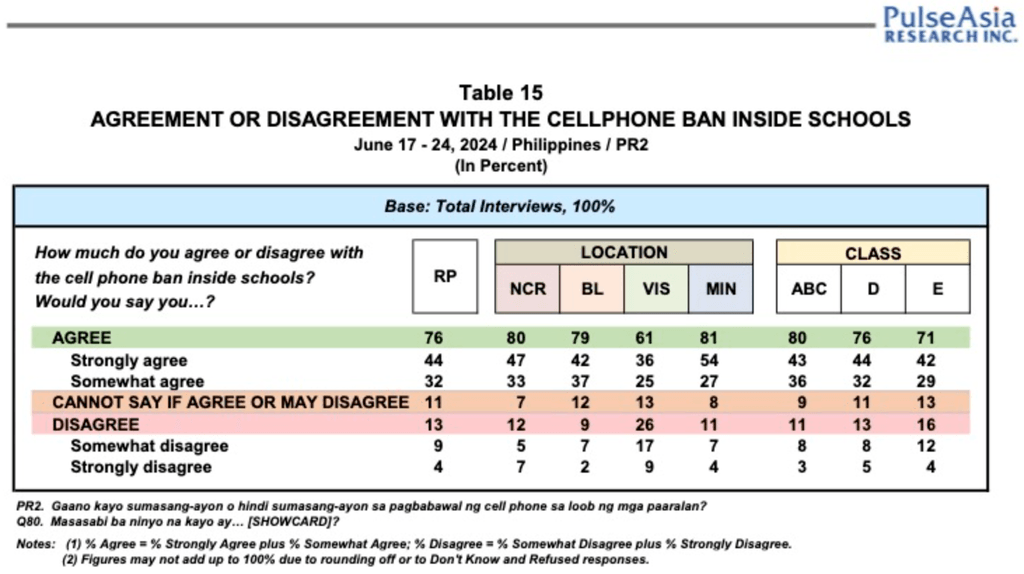
The general public appears offered. A Pulse Asia survey in June 2024 (see desk under) commissioned by Gatchalian discovered that 76% of Filipino adults favor banning cellphones in faculties, with majorities throughout all areas and revenue courses.
We’re hardly alone. By UNESCO’s rely, fewer than 1 in 4 countries restricted smartphones in faculties in 2023. By early 2025 it was 40%, and at the moment 114 training programs, or almost 3 in 5 nations, have some type of nationwide ban. France banned telephones in main and center faculties as early as 2018. The Netherlands adopted in 2024.
So, the Philippines appears to be using a worldwide wave. However does banning telephones truly work? Right here the proof is extra instructive (and extra sobering) than the rhetoric suggests.
What the research say
A well known study by economists Louis-Philippe Beland and Richard Murphy tracked faculties in 4 English cities earlier than and after they banned telephones. Check scores in high-stakes exams rose by about 0.07 customary deviations, roughly the equal of including 5 days to the varsity yr.
Strikingly, the positive aspects went virtually totally to the weakest college students: these within the backside quartile improved by twice the common, whereas prime college students have been unaffected.
Another study in Norway by Sara Abrahamsson discovered one thing related. After center faculties banned smartphones, women’ grades improved, bullying fell for each girls and boys, and consultations for psychological signs amongst women declined. Once more, the most important positive aspects accrued to college students from poorer households.
For a rustic like ours, with a few of the world’s most dismal Programme for Worldwide Scholar Evaluation (PISA) scores and widest studying gaps, these outcomes matter. Telephones distract everybody, college students and lecturers alike, however they seem to tug down struggling college students most. A cellphone ban might be an affordable coverage towards instructional inequality.
However take into account the counter-evidence. A 2025 study masking 1,227 college students in 30 English faculties discovered that college students in faculties with strict cellphone bans have been no higher off in psychological wellbeing than these in permissive faculties. Why? As a result of bans didn’t scale back whole display time. College students merely shifted their scrolling to after faculty, nonetheless logging 4 to six hours every day.
The research is a snapshot, not an experiment, so it may’t rule out the advantages of cellphone utilization. Nevertheless it punctures the idea or hope that faculty bans alone will magically repair youngsters’ relationship with their screens.
The Dutch expertise splits the distinction. A government-commissioned evaluation of their nationwide ban discovered that three-fourths of surveyed excessive faculties reported higher scholar focus, and almost two-thirds noticed a greater social local weather. Meaning youngsters truly speaking to one another at recess. However solely a 3rd reported improved tutorial outcomes.

Classes for the Philippines
Three classes appear to face out. First, design issues loads. Within the Norwegian research, results have been strongest in faculties that bodily collected telephones initially of the day, not people who merely advised college students to maintain them pocketed.
DepEd’s present order bans use solely throughout tutorial hours. That’s the loosest variant, which college students can evade the second the instructor turns round. Stricter variations, nonetheless, want storage (pouches, lockers) that many public faculties can’t presently afford.
Second, in lots of Filipino public faculties, the smartphone is the de facto textbook, library, and typhoon-emergency hotline rolled into one. DepEd itself pushes digital studying platforms accessible primarily by cellphone. Any ban should carve out real studying makes use of with out the exceptions swallowing the rule and erasing the advantages of cellphone utilization. That’s simpler mentioned than performed when enforcement falls on overworked lecturers dealing with courses of fifty or 60.
Third, and most vital: we’d like correct impression analysis of those nascent insurance policies.
Senator Gatchalian’s invoice and DepEd’s order each cost forward with none plan to measure impression (so far as I do know). Since implementation will inevitably be staggered throughout divisions and faculties anyway, DepEd might simply observe check scores, bullying incidents, and attendance in early-adopting versus late-adopting faculties. Different nations stumbled into their proof. However we will do higher and generate ours intentionally, at little additional value.
The proof, on steadiness, favors limiting telephones in faculties, modestly and largely for the scholars who need assistance most. However a ban isn’t training reform. It is not going to construct lecture rooms, practice lecturers, or feed hungry pupils.
At greatest, it buys again consideration: these minutes {that a} scholar must refocus after each ping. In a college system as far behind as ours, although, even a number of stolen minutes are nicely value reclaiming. – Rappler.com
Jan Carlo “JC” Punongbayan, PhD is an affiliate professor on the College of the Philippines College of Economics (UPSE). His skilled expertise consists of the Securities and Trade Fee, the World Financial institution Workplace in Manila, the Far Japanese College Public Coverage Heart, and the Nationwide Financial and Improvement Authority. JC writes a weekly economics column for Rappler.com. He’s additionally co-founder of UsapangEcon.com and co-host of Usapang Econ Podcast.
His first guide, False Nostalgia: The Marcos “Golden Age” Myths and Learn how to Debunk Them, was revealed by Ateneo de Manila College Press in February 2023. His second guide, Twin Plagues: How Duterte and Covid-19 Wrecked the Philippine Financial system, will probably be revealed by Penguin Random Home SEA in June 2026. Comply with him on Instagram (@jcpunongbayan).
Listed below are different In This Financial system items you might have missed:
Click on right here for different In This Economy articles.
https://weblog.passive-income4u.com/create-your-very-own-auto-publish-news-blog-site-and-earn-passive-income-in-just-4-easy-steps/
https://www.rappler.com/voices/thought-leaders/in-this-economy-will-banning-cellphones-schools-work/