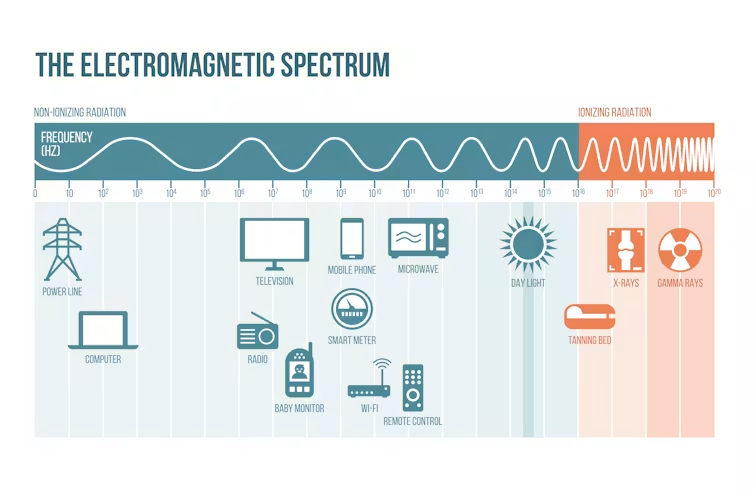
Electromagnetic waves are all over the place. They’re the rationale you’ll be able to hear music if you activate the radio, use wi-fi, discover your means utilizing satellite tv for pc navigation, and make calls on a cell phone.
They’re a type of electromagnetic radiation and sit on the weaker finish of the spectrumwhich means they’ve the bottom power and the longest wavelength.
However as a result of very high-energy types of electromagnetic radiation – reminiscent of x-rays – may cause most cancers, there has lengthy been concern that radio waves may additionally hurt human well being.
With the explosion of cell phone use over the previous 20 years, there was explicit concern over whether or not holding these gadgets to your ear may enhance your threat of mind most cancers.
In 2019, the World Well being Group (WHO) commissioned 13 critiques on the well being results of electromagnetic waves.
A brand new examine, released today has analysed the findings of those critiques. It’s discovered no proof that electromagnetic waves emitted by cell phones trigger most cancers within the mind, head or neck. Let’s check out what else they discovered.
Did the concern of most cancers have any foundation?
Anxiousness in regards to the potential well being results of low-energy radiation has its roots within the Chilly Warfare.
This was the interval when new applied sciences reminiscent of microwave ovens and televisions had been first broadly adopted and entered many houses.
Microwaves, the electromagnetic radiation we use to warmth meals, have considerably larger power than the waves emitted by cell phones, however are still low.
Over time, the proof that emerged confirmed there aren’t any clear, constant results on well being for people uncovered to lower-energy electromagnetic radiation.
However there have been nonetheless authentic security issues. For instance, microwaves can nonetheless make issues very popular. These issues formed the requirements for consumer electronicswhich govern and limit how a lot radiation they’ll emit. These requirements guarantee their security, primarily based on the perfect proof out there.

elenabs/Getty
In fact, high-energy electromagnetic radiation was recognized to be very harmful, and able to inflicting cancers such as leukaemias.
Coupled with sensational Chilly Warfare occasions – such because the Soviets’ suspected intentional use of “electromagnetic indicators” to focus on employees on the US embassy in Moscow with microwave radiation, and an envoy growing leukaemia – these risks probably formed public opinion and led to some concern about any form of radiation, together with low-energy radiation.
And, as our publicity to electronics emitting low-energy radiation has dramatically elevated within the intervening a long time, the priority about its impact on well being has remained widespread and even perhaps grown.
What the brand new examine checked out
The 13 critiques the WHO commissioned in 2019 aimed to grasp what we already know and what we nonetheless want to seek out out about any well being results of electromagnetic waves.
Groups of scientists regarded via the revealed scientific proof out there for a specific well being concern and wrote a report summarising not solely the findings but in addition the standard, or power, of the out there knowledge. Opinions had been accomplished for a variety of totally different well being issues, together with fertility, signs reminiscent of complications or tinnitus, and most cancers.
However the WHO has not but accomplished its evaluation of the commissioned critiques.
So two authors of the overview on mind most cancers have summarised their very own outcomes, and people of the opposite critiques. This new research provides us an perception into the WHO’s anticipated findings.
What the brand new examine discovered
The authors’ personal overview targeted on brain cancer and mobile phone use. In it, they analysed 63 totally different research revealed between 1994 and 2022, and located no affiliation between cell phone use and mind most cancers, or cancers of the pinnacle or neck.
It additionally didn’t matter how a lot somebody used their cell phone, or whether or not they had been utilizing it over lengthy intervals (ten or extra years).
The identical overview additionally discovered there was no proof linking radio or tv transmission and leukaemia in youngsters (one other persistent concern).
Most proof is restricted or low-quality
The opposite critiques of observational research in people equally discovered no proof that publicity to cell phones – and different gadgets that emit electromagnetic waves – affected well being. However a key discovering was that, for a lot of well being results, the amount or high quality of the proof was actually too poor to make agency conclusions.
It’s because figuring out the exact results of something on people is difficult. Many different factors affect health outcomestogether with food plan, train, genetics and socioeconomic concerns.
Thankfully, the proof for mind most cancers was given the best high quality score potential for an observational examine (which means a examine wherein scientists solely observe the consequences of electromagnetic waves on individuals, with out controlling publicity).
The authors additionally lower to the center of the matter for mind most cancers, noting: “If there was an elevated threat of mind most cancers from cell phone exposures, will increase within the incidence could be anticipated.”
In Australia, rates of all types of brain cancer have remained regular because the Nineteen Eighties, properly earlier than widespread and common cell phone use.
The takeaway
Because the authors of the abstract report state: “No science can ‘show’ the absence of any threat.”
One objective of the WHO critiques was to grasp what future analysis continues to be wanted so publicity pointers may be stored updated as expertise develops.
However the takeaway must be that no clear affiliation has been discovered between cell phone use and any kind of mind, head or neck most cancers.
This can hopefully reassure you that present publicity limits are probably secure.
Sarah DiepstratenSenior Analysis Officer, Blood Cells and Blood Most cancers Division, WEHI (Walter and Eliza Hall Institute of Medical Research) and John (Eddie) La MarcaSenior Analysis Officer, Blood Cells and Blood Most cancers, WEHI (Walter and Eliza Hall Institute of Medical Research) . This text is republished from The Conversation beneath a Artistic Commons license. Learn the original article.
https://weblog.passive-income4u.com/create-your-very-own-auto-publish-news-blog-site-and-earn-passive-income-in-just-4-easy-steps/
https://interaksyon.philstar.com/trends-spotlights/2026/07/21/316618/no-evidence-mobile-phones-cause-brain-cancer-new-study/