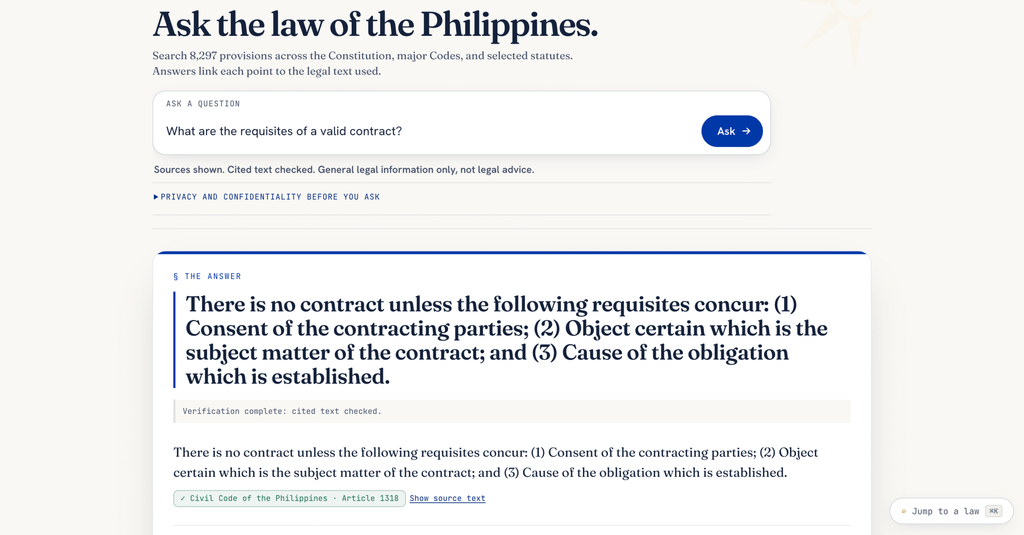
MANILA, Philippines – For Karlo Dizon, the thought behind Kartilya.PH — a free analysis archive of chosen Philippine authorized supplies powered with an AI search engine — started with a primary drawback that the Philippines remains to be within the means of fixing: widespread entry to justice.
Dizon, a Filipino lawyer and technologist who was born in Bataan, and now strikes between New York, the Philippines, and Guam, stated he had seen family members battle to entry authorized providers. For many individuals, hiring a lawyer is one thing they take into account solely in essentially the most severe circumstances, he stated.
However Dizon believes the legislation shouldn’t really feel like an unique useful resource.
“The legislation is a public useful resource,” he stated. “It’s publicly obtainable.”
The issue, he argued, is that having the legislation publicly obtainable shouldn’t be the identical as making it accessible.
Individuals might know the query however it’s typically intimidating to even try to start in search of these authorized solutions.
That, Dizon stated, is the place AI can change the equation.
Dizon is a political science graduate from Yale, holds a masters in comparative politics from the London Faculty of Economics, and a juris physician from Stanford. He presently serves on the New York State Bar Affiliation’s Committee on Synthetic Intelligence and Rising Applied sciences.
In the meantime, Rein Serrano is Kartilya’s tech lead, a graduate of the Ateneo de Manila College in Administration Info Programs and a full-stack software program engineer at Manulife.
Turning authorized analysis into natural-language questions
Bear in mind how AI made computing coding extra accessible to folks by letting folks program utilizing pure, on a regular basis language?
wheelbarrow works like that. It turns authorized language, which could possibly be esoteric to put folks, into one thing much more comprehensible.
As an alternative of requiring a consumer to know the related doctrine or case quotation, the platform permits them to ask a query in bizarre language and search a corpus of Philippine authorized supplies.
AI, Dizon stated, permits folks to strategy authorized data by asking a selected query in plain language.
Isn’t this one thing {that a} common use LLM like ChatGPT can already do?
What makes wheelbarrow distinctive is that it encompasses a “structured corpus” that comprises over 8,000 provisions, the 1987 Structure, main Codes, statutes and guidelines, textual content from the LawPhil challenge together with court docket choices and a jurisprudence catalog of 4,164 data from 2019 by April 29, 2026. It’s a physique of knowledge that continues to be expanded as nicely.
Dizon explains: “As an alternative of getting an unbounded LLM that searches its total corpus of knowledge, you could have a extra bounded LLM that searches solely authorized data — Philippine legislation on this case.”
Apart from a closed, protected database, Dizon additionally highlights different instruction layers for Kartilya that finally goals to strengthen its data retrieval, and knowledge synthesis course of to deal with the issue of hallucinations.
“We added a verification layer the place each single proposition that’s offered to you is linked to an precise supply (which you can have a look at),” Dizon stated. The AI additionally checks that precise supply earlier than it’s ever offered to you. A extra technical clarification will be discovered on the site.
Dizon acknowledged that the system can nonetheless encounter issues behind the scenes. Authorized language will be extraordinarily exact, and even seemingly minor variations in wording can matter. An AI system might deal with phrases as interchangeable when attorneys wouldn’t.
That’s the reason, he stated, customers are inspired to examine the underlying main sources themselves.
Kartilya works underneath the philosophy that AI clarification shouldn’t be meant to switch the legislation, however it’s meant to make the legislation simpler to succeed in.
“Major sources are all the time going to be there,” Dizon stated.
For privateness, search queries are instantly hashed into keys, making them non-readable to people, and are deleted after roughly seven days. Public queries are by no means saved or considered by the crew.
Making attorneys extra accessible, not out of date
That distinction can be vital to Dizon’s imaginative and prescient for the authorized occupation.
One of many widespread fears surrounding AI in legislation is that it’ll remove the necessity for attorneys. Dizon sees the opportunity of the alternative occurring.
An individual may use the platform to grasp a contract involving household property, or to get a primary sense of their rights in a dispute with a landlord. However when the matter includes felony legal responsibility, vital quantities of cash, quite a few events, or complicated litigation, Dizon stated, the necessity for a lawyer turns into higher.
“Simply because folks perceive the authorized course of doesn’t imply that they’ve the time or the flexibility to undergo the entire rigmarole of litigation,” he stated.
There are filings to make, proof to gather, witnesses to depose, and circumstances to pursue.
His hope is subsequently that AI can decrease the limitations to coming into the authorized system whereas creating extra alternatives for attorneys.
Higher entry to data may probably make authorized providers extra aggressive and reasonably priced, whereas bringing extra folks into the system who beforehand might need been too intimidated or unable to afford illustration.
Even the specter of authorized motion will be intimidating, Dizon famous. Merely being instructed that somebody is taking you to court docket will be sufficient to discourage an individual from pursuing one thing they might even have a authorized proper to do.
Extra data, he believes, could make that course of much less horrifying.
The following step: clarify the legislation itself
Kartilya remains to be a piece in progress.
Dizon stated the platform has just a few hundred common customers, with suggestions typically constructive. One recurring drawback, nonetheless, is {that a} search can lead customers to a judicial opinion or a provision in a code, just for them to come across one other wall of adverse authorized language.
The following step, subsequently, is to place AI instruments immediately on opinion and code pages.
The aim is to permit customers to ask questions on specific provisions and have the system clarify parts of a judicial opinion or statute.
Language accessibility is one other a part of the roadmap. Dizon stated the crew desires to make the platform obtainable in Philippine languages, together with Tagalog.
For now, the startup platform is being constructed by a small crew of roughly 4 full-time folks, together with interns, volunteers, and different contributors. The crew has been creating Kartilya for a couple of yr.
AI belongs within the legislation faculty, too
That have informs Dizon’s view of one other rising debate: whether or not legislation faculties ought to prohibit college students’ use of AI.
He pointed to the completely different approaches being taken by American universities. Some establishments have restricted AI use equivalent to University of the Philippineswhereas others have been extra open to college students experimenting with the know-how.
Dizon understands why faculties are involved however he additionally believes the authorized occupation has reached a degree the place avoiding AI altogether might go away college students unprepared for the world they’re about to enter.
“I believe the truth is all of the attorneys and all of the judges are going to be utilizing AI,” he stated.
The query, in his view, is not merely whether or not college students ought to use AI. It’s how they will study to purpose and write successfully whereas utilizing it.
Authorized schooling has all the time tailored to technological adjustments, Dizon famous. Authorized analysis as soon as meant working by bodily books. Know-how ultimately remodeled that course of, and AI is the most recent main change.
He believes legislation faculties ought to retain conventional approaches to instructing, but in addition create areas — equivalent to AI labs or devoted applications — the place college students can develop the abilities they are going to want in follow.
He additionally says they’re exploring a model of Kartilya that could possibly be enhanced for legislative use.
On the most speedy stage, that would imply giving congressional workplaces higher instruments for authorized analysis and invoice drafting, in addition to establishing integrity and traceability of authorized paperwork.
The Filipino’s position within the AI race
Dizon’s ambitions for Kartilya are additionally tied to a broader query in regards to the Philippines’ place within the AI economic system.
He believes the nation wants a nationwide and sovereign AI technique.
He pointed to international locations equivalent to Saudi Arabia which might be investing closely throughout the AI stack, from vitality and chips to giant language fashions.
The Philippines might not have the ability to compete with these international locations in each a part of that infrastructure.
However Dizon believes there are areas the place the nation has benefits — significantly language and the nation’s broader instructional and human-capital base.
That might imply creating AI techniques and infrastructure round distinctly Philippine wants slightly than merely importing know-how constructed elsewhere.
Authorized AI is only one attainable instance, and learnings from Kartilya, as an illustration, could also be tailored and deployed in different settings.
Kartilya, for Dizon, is an try and rethink how Filipinos encounter the legislation: from one thing that may really feel distant, technical and intimidating into one thing that may be searched, questioned and understood.
Dizon can be watching the opportunity of a nationwide authorized AI database within the Philippines.
He desires to see a verified authorized corpus change into a part of the nation’s broader authorized and governmental infrastructure, and hopes that if a nationwide system is ultimately created, some model of the concepts behind Kartilya will probably be a part of it. – Rappler.com

https://weblog.passive-income4u.com/create-your-very-own-auto-publish-news-blog-site-and-earn-passive-income-in-just-4-easy-steps/
https://www.rappler.com/know-how/options/karlo-dizon-kartilya-ph-ai-search-engine/