- SUPCON’s robots direct visitors and warn rule-breakers
- Firm says the pilot lowered some violations by over 40%
- Chery-backed AiMOGA sees export potential, however knowledge hurdles loom
HANGZHOU/BEIJING — It’s not fairly the “RoboCop” of the 1987 film: no gun, no energy to arrest and wheels quite than the Hollywood cyborg’s mechanical stride.
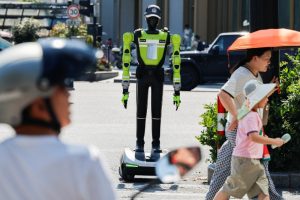
However at a busy intersection within the japanese Chinese language metropolis of Hangzhou, the 1.88-m (6-foot-2-inch) robotic can spot a helmetless e-bike rider, situation a well mannered warning and swing its mechanical arms in sync with visitors lights.
Developed by native know-how agency SUPCON Info, the 98-kg (216-pound) T2 robotic is a part of a pilot aimed toward handing a few of law enforcement officials’ most repetitive traffic-control duties to machines.
The robocop makes use of cameras, radar and onboard computing to establish riders with out helmets, e-bikes carrying passengers, autos stopping over marked traces and pedestrians crossing in opposition to indicators, SUPCON’s clever unmanned methods innovation centre head Cao Hui stated in an interview.
The visitors robots characterize a broader Chinese language business push to maneuver machines past exhibition-floor acrobatics and showroom greetings into sensible jobs.
The robots also can reply questions on instructions, parking and visitors guidelines, whereas an emergency perform connects customers with native police. Their seven-jointed arms reproduce normal traffic-police gestures synchronized with the indicators, Cao stated.
SUPCON has deployed 15 robots in Hangzhou since Could. The corporate says they’ve issued greater than 170,000 warnings and helped scale back month-to-month instances of helmetless using and autos crossing cease traces by greater than 40%.
Hangzhou’s visitors police didn’t reply to a request for remark, and Reuters couldn’t independently confirm the figures.
Robocops by no means want a break
The corporate has examined the machines for hundreds of hours in vacationer areas, faculty zones, enterprise districts, rush-hour visitors and poor climate, Cao stated.
Cameras and radar can nonetheless be affected by robust daylight, rain and temperature extremes, although SUPCON says its violation-recognition accuracy exceeds 95%.
The goal, Cao stated, is to switch punishment after a violation with a well timed reminder earlier than behaviour turns into ordinary.
“It doesn’t get drained,” he stated of the robotic. “It may well work steadily for lengthy intervals.”
Cao stated the robots function autonomously from 7 a.m. to six p.m., transferring between pre-set positions at intersections with out distant management. A central platform permits traffic-police groups to watch and dispatch them.
SUPCON says almost 50 such robots are working throughout about eight cities in three Chinese language provinces, and it expects deployments to strategy 200 by year-end.
Robocop exports have potential however hurdles forward
Chery-backed robotics firm AiMOGA sees potential for police robots in abroad markets the place visitors officers face punishing roadside circumstances, citing excessive temperatures within the Center East and chronic wet seasons in Southeast Asia.
However AiMOGA govt Zhang Guibing stated deploying them overseas could be extra difficult than exporting a automobile.
Police robots would wish to suit native law-enforcement IT methods, get hold of certifications and adjust to data-protection guidelines, Zhang stated, notably as a result of they use cameras and different sensors.
—Reporting by Chenxi Yang in Hangzhou and Qiaoyi Li and Eduardo Baptista in Beijing; Modifying by Jamie Freed
https://weblog.passive-income4u.com/create-your-very-own-auto-publish-news-blog-site-and-earn-passive-income-in-just-4-easy-steps/
https://interaksyon.philstar.com/trends-spotlights/2026/08/25/318227/china-puts-robocops-on-traffic-duty-minus-the-arrest-powers/