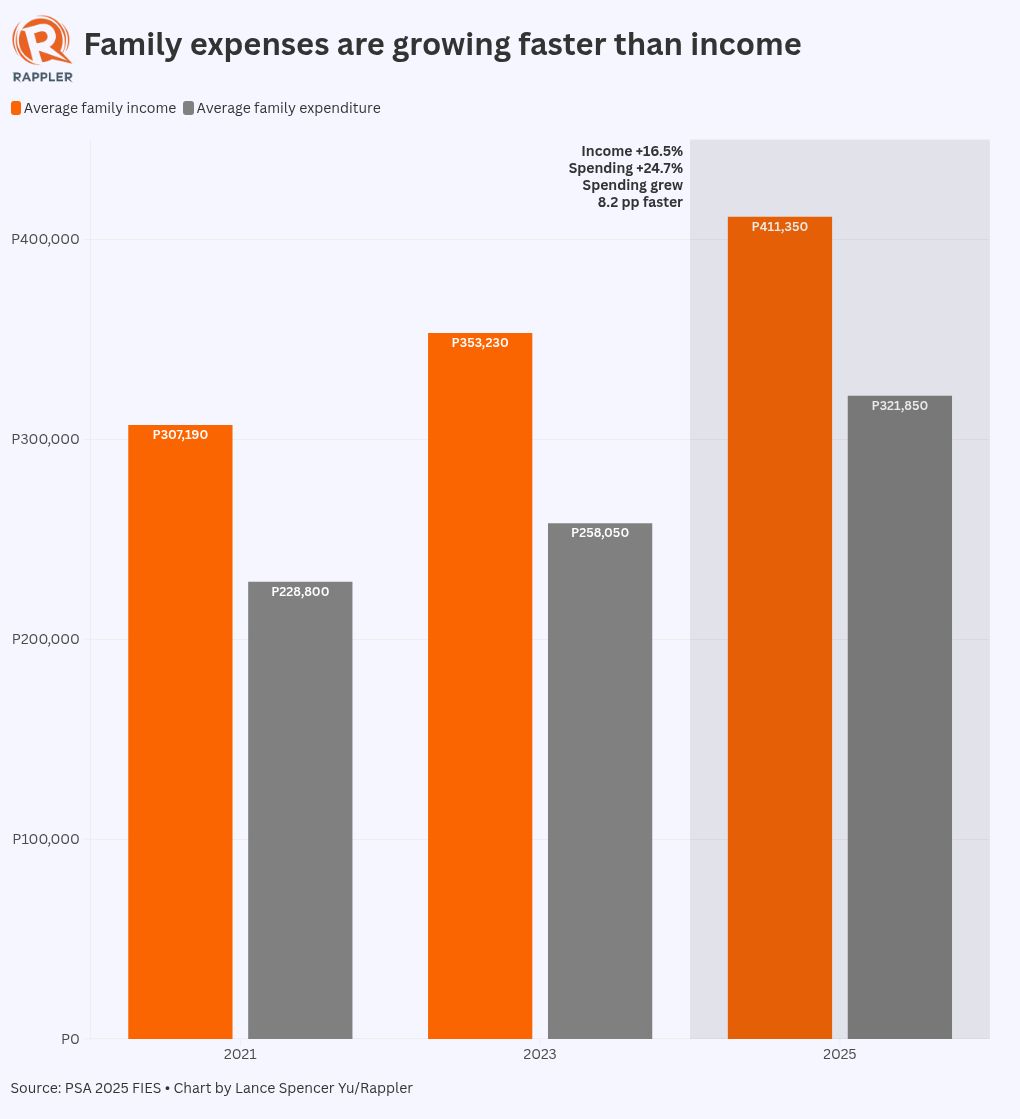
MANILA, Philippines – On paper, Filipino households acquired a large revenue increase between 2023 and 2026, however there’s a cause why most nonetheless discover their family budgets stretched skinny.
The typical Filipino household earned P411,350 in 2025, up 16.5% from P353,230 in 2023, in line with the newest Household Earnings and Expenditure Survey (FIES). That’s about P34,300 a month, in contrast with P29,400 two years earlier.
However the headline determine doesn’t imply the everyday employee acquired a 16.5% increase, nor that households all of the sudden have that rather more cash to spend .
The most important cause: Bills elevated even quicker than revenue.
Household revenue could have risen, however common annual household expenditure surged previous that at 24.7%, hitting P321,850 in 2025 from P258,050 in 2023. That works out to about P26,800 a month.
In peso phrases, common revenue elevated by P58,120 over the two-year interval, whereas expenditure rose by P63,800. The distinction between common revenue and expenditure consequently narrowed to P89,500 in 2025 from P95,180 in 2023.
In keeping with Rappler resident economist JC Punongbayan, this implies households had much less monetary respiration room.
“The truth that common revenue minus expenditure fell from 2023 to 2025 meant that Filipino households had much less room for financial savings, emergencies, and debt funds,” Punongbayan advised Rappler. “This will likely assist clarify why many households could not really feel higher off regardless of increased incomes.”
The squeeze additionally reduce throughout revenue teams. Regardless of which revenue bracket you have a look at, expenditure grew quicker than revenue between 2023 and 2025.
Among the many poorest 10% of households, common revenue rose 19.1%, whereas expenditure elevated 21.7%. For the fifth decile, revenue grew 16.8% in opposition to a 23.6% enhance in spending. Among the many richest 10%, revenue elevated 15.6%, whereas expenditure jumped 27.2%.
Nonetheless, Punongbayan cautioned that quicker spending doesn’t mechanically imply Filipino households turned worse off.
“Costs elevated from 2023 to 2025, however inflation alone can’t clarify the rise in bills,” Punongbayan mentioned. “Households can also have consumed extra or shifted towards costlier gadgets reminiscent of housing, utilities, transport, well being, and eating out.”
Some households can also have accommodated increased spending by saving much less, dipping into financial savings, or borrowing, he added.
“Thus, increased expenditure shouldn’t be mechanically proof of worsening welfare. However its quicker progress relative to revenue indicators a squeeze on households.”
The FIES figures are additionally nominal averages, which means they don’t seem to be adjusted for inflation and don’t present what occurred to each particular person family. Punongbayan additionally famous that the newest poverty statistics, the truth is, confirmed a decline in poverty.

Results of Center East disaster not but mirrored
The 2025 figures don’t but seize how a lot more durable family budgets have been squeezed this 12 months.
Inflation accelerated sharply in 2026 because the conflict in the Middle East pushed up world oil and different commodity costs.
By JulyPhilippine inflation stood at 6.2%, bringing the typical for the primary seven months of 2026 to five% — far above the federal government’s goal vary of two% to 4%. Transport costs alone had been 11.9% increased than a 12 months earlier.
“Within the wake of the 2026 US-Iran warincreased oil costs affected budgets immediately by means of gasoline and electrical energy and not directly by means of fares, freight, and meals costs,” Punongbayan mentioned. “So the 2025 FIES information in all probability understate as we speak’s squeeze, though its exact influence on the hole between incomes and spending can’t be measured till newer family information develop into obtainable.”
Even earlier than that newest shock, requirements already ate up most household budgets.
Meals and non-alcoholic drinks accounted for 33.3% of common household expenditure in 2025, whereas housing, water, electrical energy, fuel and different fuels took one other 21.6%. Collectively, these two classes accounted for almost 55% of household spending.

The place does household revenue come from?
Throughout all Filipino households, wages and salaries had been the most important supply of revenue in 2025, accounting for 54.6% of whole household revenue collected throughout all households surveyed.
Entrepreneurial actions accounted for one more 15.5% of whole household revenue, whereas 8.7% got here from imputed lease. Money receipts from overseas, which embody remittances, contributed 8.5%, whereas money receipts from home sources made up 5.3%. Different sources, together with pensions, items, leases, dividends, and curiosity, accounted for the remaining 7.4%.
Imputed lease is completely different from the opposite sources as a result of it’s not money a household really receives. For owner-occupied properties, the PSA assigns an estimated rental worth to the housing service the household will get from dwelling in its personal property.
Take word that the P411,350 determine itself can be a nationwide common throughout households, not the revenue of a typical particular person family. Precise household incomes can fluctuate broadly relying on location, variety of earners, employment, companies, remittances, and different sources of revenue. – Rappler.com

https://weblog.passive-income4u.com/create-your-very-own-auto-publish-news-blog-site-and-earn-passive-income-in-just-4-easy-steps/
https://www.rappler.com/enterprise/family-income-expenditure-survey-2025/