The findings immediate a reevaluation of the accepted narrative surrounding the Battle of Kota Kalawi, elevating questions concerning the historic accuracy of the occasions attributed to the US army marketing campaign in Mindanao
CAGAYAN DE ORO, Philippines – For many years, the Battle of Kota Kalawi has stood within the historic document as a bloody encounter between American forces and Meranaw defenders alongside the shores of Lake Lanao. Now, an archaeological excavation is difficult that account, elevating questions on probably the most consequential episodes attributed to the US army marketing campaign in Mindanao.
On the presentation and turnover of the Kota Kalawi Archaeological and Historic Venture on August 24 on the Lanao del Sur Provincial Capitol, mission crew chief Leee Anthony Neri, dean of the College of the Philippines’ College of Archaeology (UPSA), delivered this evaluation: the battle was a “historic hoax” written by Individuals within the twentieth century.
Neri mentioned the archaeological dig, commissioned by the Bangsamoro Commission for the Preservation of Cultural Heritage (BCPCH) and performed by a crew from UPSA from July 29 to August 19, 2024, confirmed no proof that the purported Battle of Kalawi ever happened.
This was the primary formal archaeological excavation in Lanao del Sur. The mission was a collaboration among the many UP College of Archaeology (UPSA), Mindanao State College-main campus and Mindanao State College-Iligan Institute of Expertise (MSU-IIT), organized by the BCPCH.
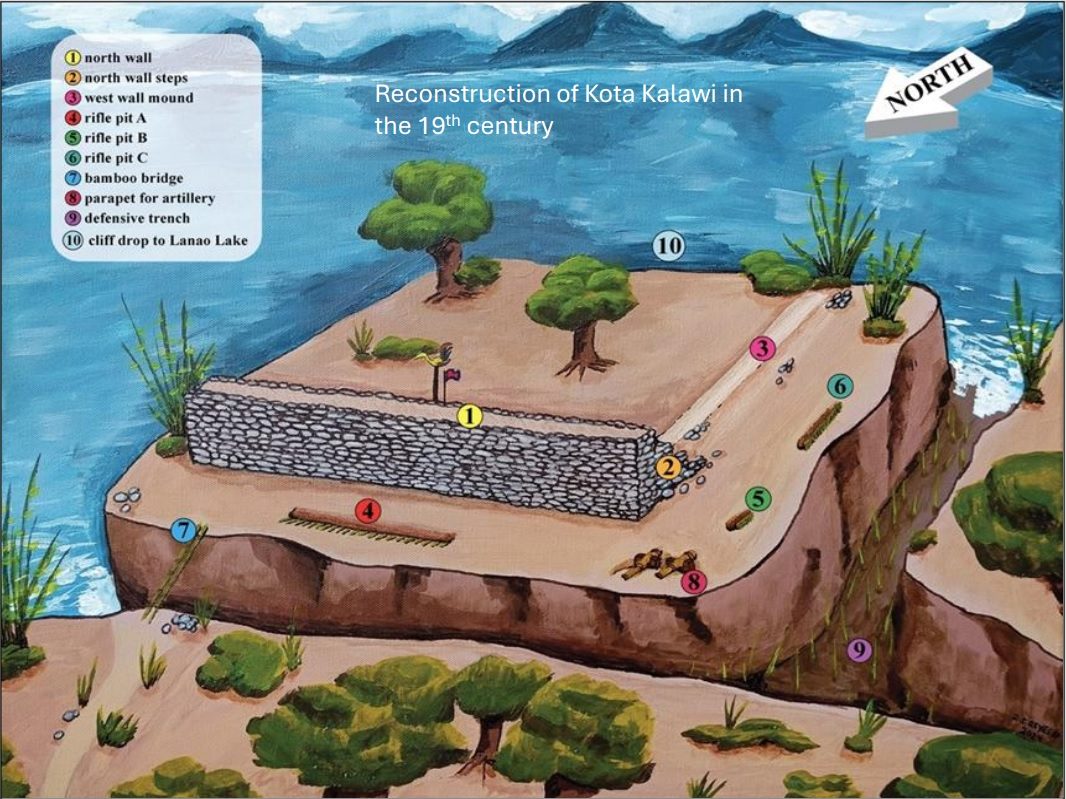
“Of the six trenches we dug on the Kota Kalawi web site, we discovered solely a single bullet and no proof of bullet penetration on the North Wall from the purported machine gun fireplace or mortar fireplace,” Neri famous. “There’s additionally merely no house throughout the kota (earthen/stone forts) to accommodate 100 defenders.”
“Archeologically, this doesn’t help the historic narrative,” Neri harassed.
Iligan historian Ricardo Jorge Caluen mentioned the excavation was the primary formal archaeological re-examination of the accepted narrative surrounding the Battle of Kota Kalawi.
“Neri’s assertion is due to this fact a daring problem to the traditionally-accepted occasions of the battle that might alter its historiography,” Caluen mentioned. “It’s tough to problem findings of archaeology which can be primarily based solely on materials proof.”
American account
The American account dated June 30, 1903 was written by American Brigadier Basic Samuel S. Sumner, commander of the Division of Mindanao, and included as Appendix II within the Annual Report of Main Basic George W. Davis, United States Military commanding Division of the Philippines from October 1, 1902 to July 26, 1903.
In response to Sumner’s report, the Battle of Kota Kalawi – typically referenced alongside the Battle of Bacolod Grande – was a violent conflict that happened at Bacolod Grande from April 6 to eight, 1903, and at Kalawi on April 9, alongside the shores of Lake Lanao. Kalawi can also be spelled Calahui within the American account.
On the time of the battle, then-captain John J. Pershingwho later commanded the American Expeditionary Forces (AEF) on the Western Entrance throughout World Struggle I, was newly promoted as commander of Camp Vicars, overseeing the early American pacification campaigns within the Meranaw and Iranun areas surrounding Lake Lanao.
The defensive fortifications, or kota, served as important strongholds throughout native resistance towards overseas invaders round Lake Lanao. Constructed strategically on plateaus and alongside the shores of the lake to regulate motion and commerce, they have been constructed with heavy timber, stone, earth and bamboo, and infrequently bristled with sharp bamboo spike pits (push) and excessive partitions. Defenders used indigenous blades such because the kris and sword, together with swivel cannons known as then.
Sumner described Kota o Panondiongan as “the strongest fort in Mindanao.” Based mostly on his account, the Individuals’ superior firepower, together with machine weapons, mountain artillery and mortars, gave US forces a decisive benefit over conventional Meranaw defenses.
The American subject expedition was led on the bottom by Pershing, commanding roughly 700 troopers composed of 4 corporations from the twenty seventh Infantry, three troops of the fifteenth Cavalry, and two mountain artillery batteries.
Sumner recounted that American forces surrounded the earthen partitions of Kota o Panondiongan, with preliminary bombardments from Vickers-Maxim mountain weapons countered by conventional Meranaw lantakas (brass cannons). He wrote that the US tightened the siege utilizing 3.6-inch mortars, dropping shells instantly into the fort. Regardless of a water-filled moat and heavy fireplace from hidden loopholes, Meranaw defenders repeatedly drove again infantry advances and rejected all presents of give up.
Relentless artillery fireplace, primarily based on the account, breached the entrance wall, permitting US forces to overrun Kota o Panondiongan. Supposedly, a fast physique rely taken within the still-burning fort confirmed 30 Moro warriors lifeless on the highest ground, with one American killed and 14 wounded.
The next day, April 9, 1903, the Individuals supposedly bombarded Kota Kalawi with mortars and Maxim-Vickers machine weapons. Sumner claimed the Meranaw defenders deserted their positions after struggling 23 casualties.

For over a century, the American account has formed the historical past of Kota Kalawi. However the archaeological findings merely confirmed a single bullet, and no bodily proof of the extraordinary alternate of gunfire and artillery described in Sumner’s report.
The findings have raised questions on what actually occurred at Kota Kalawi in 1903 and prompted a more in-depth examination of the account that for generations was seen as established historical past. – Rappler.com
https://weblog.passive-income4u.com/create-your-very-own-auto-publish-news-blog-site-and-earn-passive-income-in-just-4-easy-steps/
https://www.rappler.com/philippines/archaeological-dig-challenges-story-1903-battle-kota-kalawi-lanao-del-sur/