On September 2, the peso-dollar alternate fee closed at P62.50 per dollaryet one more all-time low. This time final 12 months, we had been nonetheless at around P57.3 per dollarimplying a 9% drop.
Policymakers have gotten more and more alarmed by the peso’s regular depreciation. On August 27, on the Senate briefing of the Improvement Funds Coordination Committee (DBCC), the financial managers had been requested if there’s any method we will rein within the alternate fee.
Bangko Sentral ng Pilipinas (BSP) Governor Eli Remolona Jr. defined why the central financial institution can’t merely drive the peso again to P60 per greenback.
At finest, he mentioned, the BSP can decelerate a pointy depreciation by promoting a part of the nation’s greenback reserves. In doing so, the BSP could make the peso dearer vis-à-vis the greenback, and due to this fact strengthen the peso a bit.
However the BSP can’t afford to promote an excessive amount of of our bucks. Macroeconomic prudence dictates that we must always all the time put aside an ample provide of “worldwide reserves.” Governor Remolona rightly warned,“We’ll run out of reserves. We’ll run out of {dollars}.” (We’ll run out of reserves and {dollars}.)
As of end-July, the nation had $103.3 billion in gross international reservesor international belongings (principally {dollars}) the BSP can readily deploy, sufficient for six.7 months of imports and associated funds. Whereas substantial, that quantity shouldn’t be bottomless.
Subsequently, the BSP can solely accomplish that a lot to arrest the continuous slide of the peso. In any case, their major mandate is to make sure low and secure inflation, to not handle the alternate fee. We’ve experimented with the latter within the 20th century, however that proved to be disastrous—particularly since we’re not almost incomes sufficient {dollars}.
That brings us to Remolona’s different remarks. He instructed senators that he wished our exports had been stronger, so we will earn extra {dollars}, presumably by means of the proposed Pax Silica or the Luzon Financial Hall. The extra {dollars} stream into the nation, the stronger the peso shall be in opposition to the greenback.
Remolona added that the nation’s saving fee is moderately low. Then got here the sound chunk that provoked outrage in some circles: “It is a bit arduous to say… however we’re proud. It is known as consumption tradition.” (That is moderately troublesome to say, however we’re boastful. It’s known as a consumption tradition.)
Predictably, many individuals had been triggered. Labor coalition United said employees shouldn’t be blamed for getting primary requirements. “Meals, transportation, electrical energy and medication usually are not a ‘consumption tradition.’ That’s survival,” they mentioned. Gabriela Girls’s Social gathering Consultant Sarah Elago echoed this and mentioned individuals can’t save as a result of wages are too low.
IBON Basis, in the meantime, said that such a remark was “astoundingly entitled, and bordering on willful ignorance.” They added, “Could be good if financial coverage was within the arms of parents who’ve a greater than rhetorical grasp of the day by day misery confronted by the vast majority of Filipinos.”
The difficulty blew up on social media, however right here let’s attempt to make sense of all this. Whereas the BSP governor may have chosen his phrases higher, primarily he’s appropriate. Then again, whereas critics are proper to lift considerations, additionally they inadvertently put phrases in Governor Remolona’s mouth.
‘Consumption tradition’
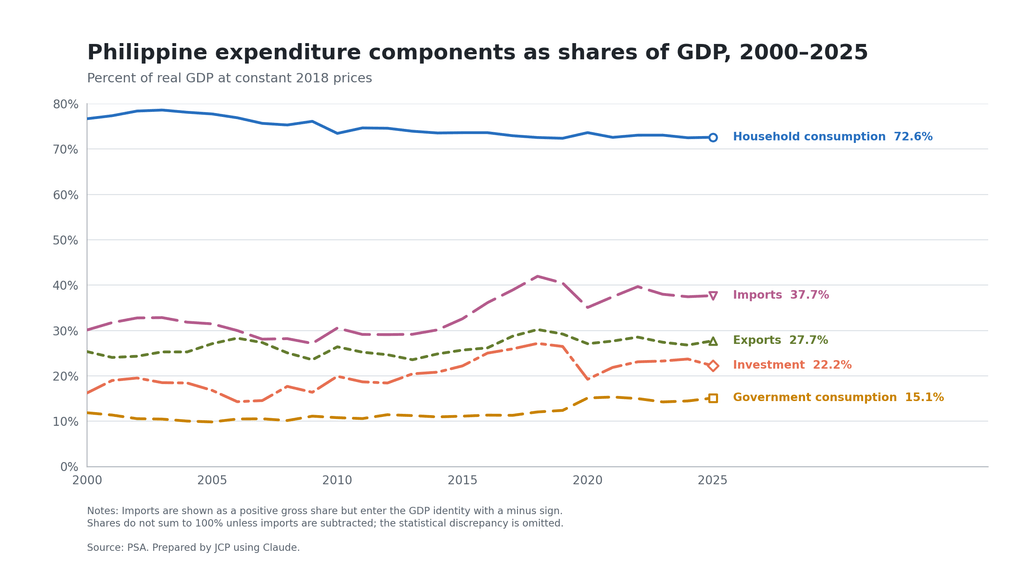
To start out with, should you don’t know but, the Philippine economic system is certainly consumption-driven. The information present it plainly.
Determine 1 under exhibits that in 2025 as a lot as 73% of complete spending within the economic system, as measured by GDP or gross home product, was accounted for by consumption spending by the personal sector.
From a macroeconomic perspective, intense consumption implies that our nation can solely save a lot. In truth, the Philippines’ general saving fee—nationwide financial savings as a share of nationwide earnings—was simply 30.1% in 2025. That’s fairly low in comparison with Singapore (40%), Vietnam (37% in 2024), and Indonesia (35%).
Decrease financial savings additionally imply decrease sources for funding. Not coincidentally, we even have one of many lowest funding charges within the area.
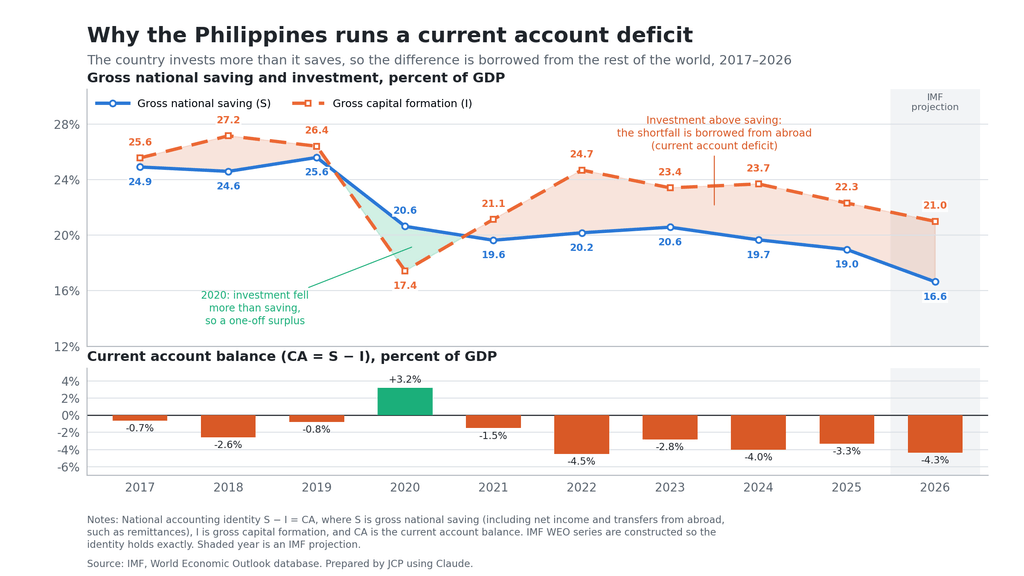
However even with meager financial savings, we will nonetheless pay for investments if we earn sufficient sources from overseas. For this reason Governor Remolona referred to the idea known as “present account.” Roughly, it’s the distinction between greenback inflows and outflows.
The issue is that we’ve lengthy had a present account deficit, which means that extra {dollars} are pouring out than coming in (see Determine 2 under).
Determine 3 under exhibits that whereas we’ve got a big present account deficit, many neighboring ASEAN economies take pleasure in present account take pleasure in surpluses as an alternative.
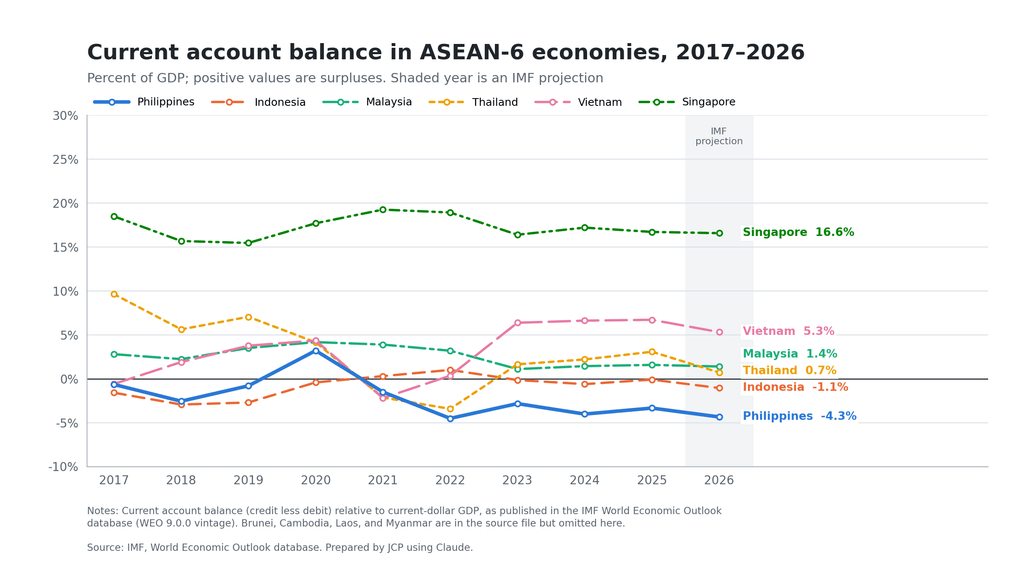
The rationale for the Philippines’ present account deficit is that remittances from abroad Filipinos and earnings from the IT-BPM sector usually are not almost sufficient to offset the outflow of {dollars} for, say, import and international debt funds.
Low personal financial savings, coupled with a present account deficit, implies that there’s actually not sufficient sources to fund investments within the nation.
I feel that is what Governor Remolona was attempting to say within the Senate. That’s why he put emphasis on the necessity to develop exports as a supply of greenback earnings. This shall be more and more essential since inflows of remittances usually are not as sturdy as in previous a long time, and the earnings of Filipinos within the IT–BPM sector face many threats like US protectionism (“onshoring”) and synthetic intelligence (AI). Tourismby the way in which, is one other potential supply of {dollars} for us.
To make sure, a present account deficit shouldn’t be inherently dangerous. But when it’s too giant, then it turns into a trigger for concern. If we earn sufficient {dollars} from overseas, we will abate the present account deficit and pay for extra investments right here at dwelling. On the similar time, it may assist scale back the stress on the peso to additional depreciate—the unique concern raised by senators final week.
The issue is that many individuals centered an excessive amount of on Governor Remolona’s remarks on consumption: “It is a bit arduous to say… however we’re proud. It is known as consumption tradition.” Admittedly, Remolona may have chosen his phrases higher, and deemphasized the saving fee angle (to some individuals, that sounded just like the BSP was blaming peculiar residents’ lack of saving).
However the truth is, Remolona by no means mentioned that Filipinos should additional scrimp on cash or tighten their belts amid these difficult occasions. Saving by people on the micro degree is completely different from saving by nations on the macro degree. Lack of financial savings on the nationwide degree will be augmented by exports, remittances, and earnings from overseas.
I’d add that whereas we’re borrowing from overseas, it’s finest to place that cash in productive and worthwhile makes use of. For this reason it’s infuriating to know that a big a part of public investments has gone to corruptible flood management initiatives or farm-to-market roads or multipurpose buildings.
Oil and AI
Remolona drew extra criticism when Senator Risa Hontiveros requested why Philippine inflation exceeded that of a number of neighbors. He cited our lack of home oil and mentioned economies with AI industries may partly compensate. He himself known as the comparability “oversimplified.”
There’s a grain of fact right here. An economic system with high-value expertise exports can earn extra {dollars}, entice funding, and lift productiveness. The Worldwide Financial Fund has famous that the worldwide AI funding growth is already boosting demand for Asian expertise exports.
However AI doesn’t straight make imported oil cheaper. Information facilities additionally devour super quantities of electrical energy: the Worldwide Power Company estimates that world data-center electrical energy use surged by 17% in 2025, whereas AI-focused facilities used 50% extra.

A greater formulation is that sturdy, export-oriented expertise industries may help an economic system take up an oil shock. In equity, Remolona did point out a few occasions within the Senate briefing the pressing want to spice up exports. AI is one potential supply of productive capability and greenback earnings. However in no way is it an alternative choice to vitality safety or a magic remedy for inflation.
Miscommunication
In conclusion, I agree that BSP Governor Eli Remolona’s Senate assertion wanted extra precision. He was hinting at an financial logic that makes a number of sense, but additionally troublesome to speak—therefore susceptible to misinterpretation.
Governor Eli Remolona didn’t inform employees to skip meals or medication. That’s not what he mentioned, and that might be each merciless and economically foolish. Let’s keep away from placing phrases into his mouth.
He additionally didn’t say that consumption is the enemy. As an alternative, the underlying message is that our nation as an entire wants to seek out higher methods to finance our investments—what personal saving can’t rescue, possibly a lift in exports, remittances, or incomes from overseas can.
In the end, if we would like greater nationwide financial savings, we must always guarantee secure incomes and better-paying jobs for Filipinos, extra environment friendly corporations, sounder public funds, and monetary establishments that channel financial savings into productive funding. – Rappler.com
Jan Carlo “JC” Punongbayan, PhD is an affiliate professor on the College of the Philippines College of Economics (UPSE). His skilled expertise contains the Securities and Trade Fee, the World Financial institution Workplace in Manila, the Far Jap College Public Coverage Middle, and the Nationwide Financial and Improvement Authority. JC writes a weekly economics column for Rappler.com. He’s additionally co-founder of UsapangEcon.com and co-host of Usapang Econ Podcast.
His first e book, False Nostalgia: The Marcos “Golden Age” Myths and How one can Debunk Them, was revealed by Ateneo de Manila College Press in February 2023. His second e book, Twin Plagues: How Duterte and Covid-19 Wrecked the Philippine Economic system, was revealed by Penguin Random Home SEA in June 2026. Observe him on Instagram (@jcpunongbayan).
Under are In This Economic system items you might have missed:
Click on right here for different In This Economy articles.
https://weblog.passive-income4u.com/create-your-very-own-auto-publish-news-blog-site-and-earn-passive-income-in-just-4-easy-steps/
https://www.rappler.com/voices/thought-leaders/in-this-economy-should-filipinos-consumption-culture-blame-weak-savings-peso/