A transaction showing in an AMLC report doesn’t, by itself, imply that the cash was illicit or {that a} crime was dedicated
MANILA, Philippines – Because the Senate impeachment courtroom conducts hearings on the presentation of Vice President Sara Duterte’s financial records in relation to her alleged unexplained wealth, a number of the key items of proof will come from experiences submitted to the Anti-Cash Laundering Council (AMLC) overlaying probably billions of pesos in transactions linked to Duterte and her husband, Manases Carpio.
The data, together with testimonies and data from the related banks, might make or break the prosecution’s case on the allegations of unexplained wealth and inaccurate asset declarations in opposition to the Vice President. However the proof introduced by AMLC must be learn fastidiously.
A transaction showing in an AMLC report doesn’t, by itself, imply that the cash was illicit or {that a} crime was dedicated.
There are usually two varieties of transactions that the AMLC would look into. These are coated transactions, which mechanically set off reporting due to their measurement, and suspicious transactions, that are reported due to the circumstances surrounding them.
For banks and most monetary establishments, a coated transaction report (CTR) is mechanically triggered when a money transaction or its equal above P500,000 is made inside one banking day. The brink serves as a reporting set off, not a judgment that the cash is illicit.
A suspicious transaction report is totally different. There isn’t any automated threshold. As a substitute, banks and different coated establishments verify transactions primarily based on circumstances outlined underneath the Anti-Cash Laundering Act. If the establishment determines {that a} transaction meets any of those, it’s required to file an STR with the AMLC.
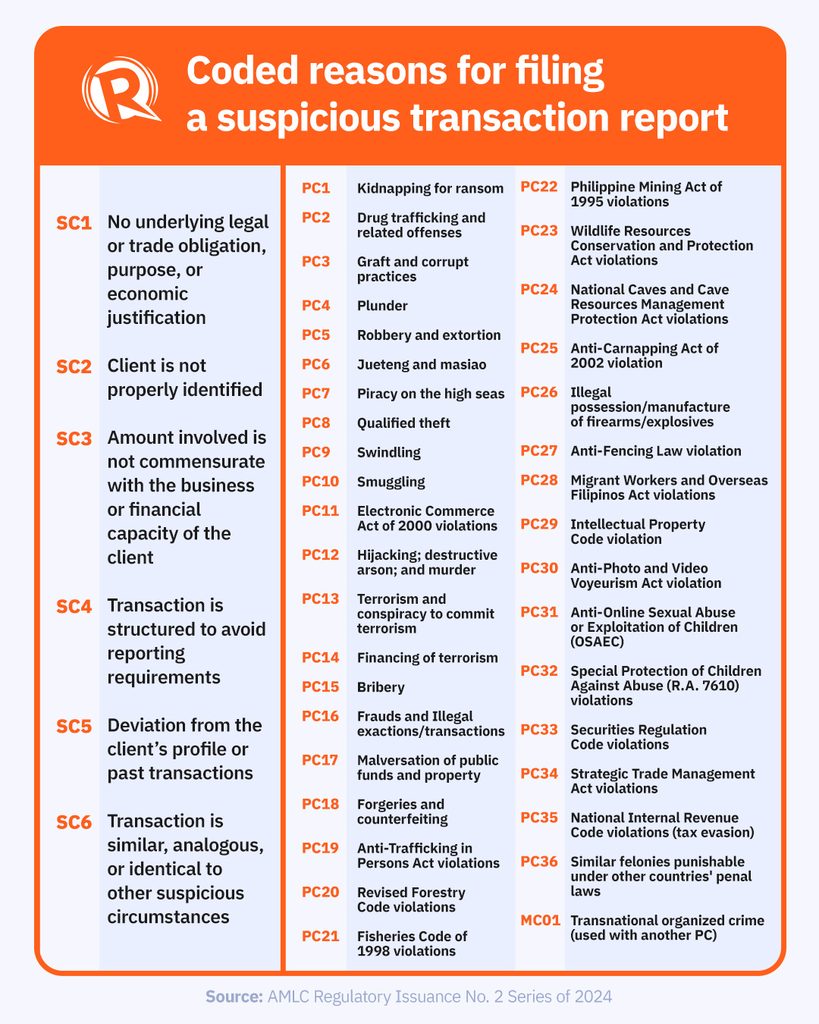
The regulation identifies a number of standards that may increase suspicion, together with when there is no such thing as a obvious authorized, enterprise, or financial goal; the client can’t be correctly recognized; the quantity is inconsistent with the individual’s identified enterprise or monetary capability; transactions seem structured to keep away from reporting necessities; or the transaction seems related to an illegal exercise, amongst others. (READ: Why didn’t banks flag large check encashments by Sara Duterte staff?)
A extra complete listing of causes for STR filings is proven within the graphic beneath:
In follow, this implies banks look past the scale of a switch. AMLC steering says a transaction could also be thought of uncommon when its quantity, origin, vacation spot or kind is inconsistent with the client’s identified authentic actions.
A big fee can have a wonderfully abnormal clarification, such because the sale of property or an funding redemption. Conversely, a a lot smaller fee can immediate an STR if its supply, recipient, or goal raises considerations.
The questions investigators would usually need answered embrace who despatched and obtained the cash, the place it got here from, the place it finally went, what the transaction was for, whether or not there are paperwork supporting that clarification, and whether or not the quantity suits the client’s identified earnings, belongings and regular monetary exercise.
AMLC data have figured in a number of high-profile instances. In the course of the 2012 impeachment trial of then-chief justice Renato Corona, Ombudsman Conchita Carpio-Morales testified on an AMLC report detailing a whole bunch of transactions in accounts attributed to Corona.
Within the pork barrel instances, AMLC testimony and financial institution data helped trace the movement of government funds via NGO accounts linked to Janet Lim Napoles. – Rappler.com
https://weblog.passive-income4u.com/create-your-very-own-auto-publish-news-blog-site-and-earn-passive-income-in-just-4-easy-steps/
https://www.rappler.com/philippines/things-to-know-covered-suspicious-transactions-anti-money-laundering-act/