MAGUINDANAO DEL SUR, Philippines – Some died earlier than they might see it. Others practically misplaced hope.
After greater than twenty years of authorized battles, bureaucratic delays and relentless battle, the Teduray and Lambangian indigenous communities in the Bangsamoro area have secured formal recognition of 117,101 hectares of ancestral land — a hard-won victory that now leaves them with one other combat: defending it for generations to come back.
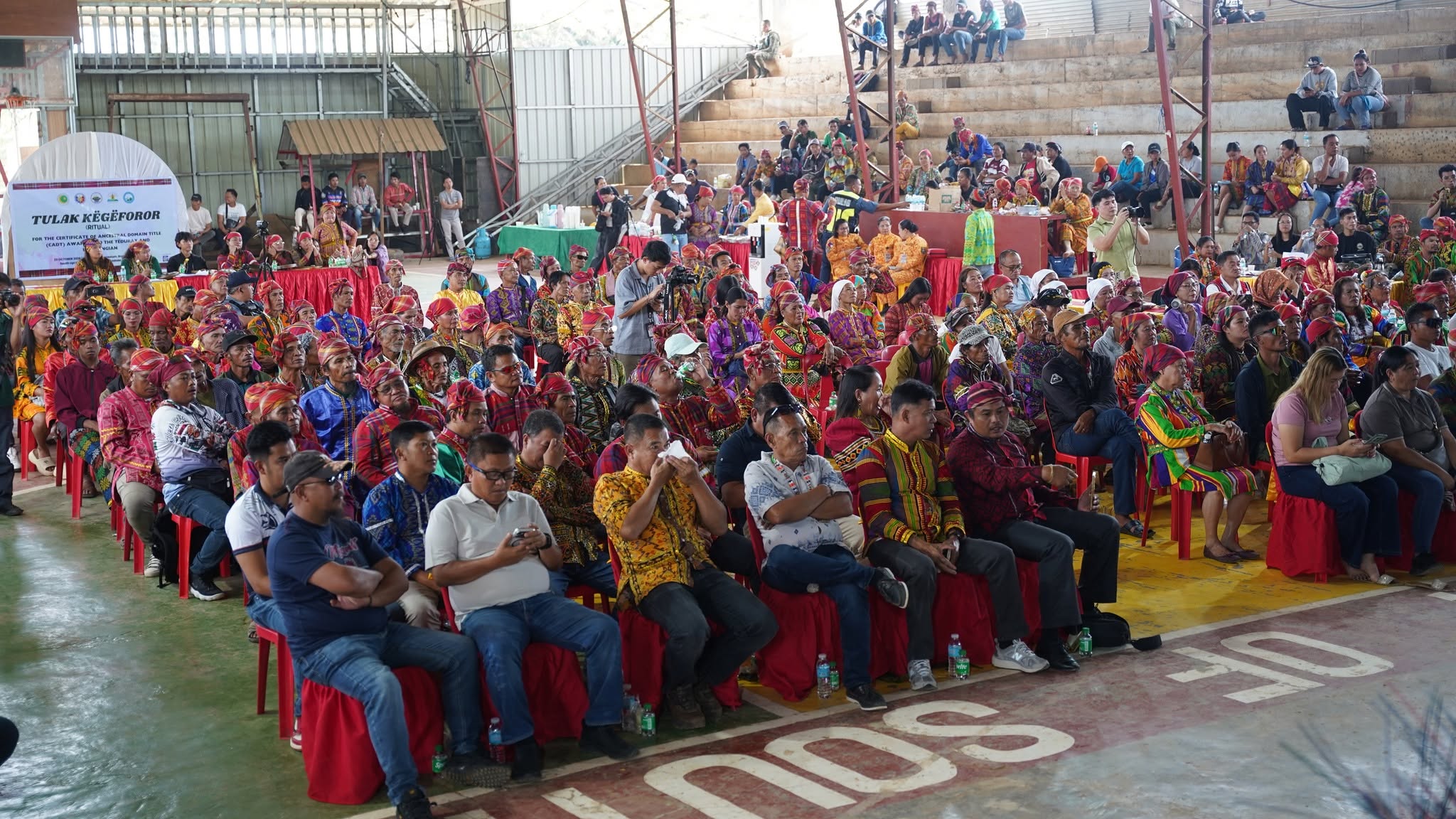
The turnover of the Certificates of Ancestral Area Title (CADT), protecting 11 separate parcels, was marked by the standard Tulak Kegëforor ritual in South Upi, Maguindanao del Sur, the place most members of the 2 communities stay. The gathering on Friday, October 23, reaffirmed their shared id and their resolve to protect their ancestral homeland.
The Structure and the Indigenous Peoples’ Rights Act defend indigenous communities’ rights to their ancestral lands, that are held collectively for current and future generations. A CADT formally acknowledges these rights.
Ancestral domains usually can’t be offered to “outsiders,” and growth tasks are topic to necessities totally free, prior and knowledgeable consent from the affected communities, that are collectively have the best over the lands.
Timuay Alim Bandara, reflecting on the decades-long journey, emphasised that the achievement belongs to the youthful era.
“Due to you, we’re doing this… not for the aged however for you Teduray and Lambangian youth,” Bandara mentioned through the gathering, underscoring the responsibility of safeguarding the doc and the bodily land for future generations.
(What we’re doing right here is due to you… not for the elders, however for you, the younger Teduray and Lambangian individuals.)
Organized in collaboration with the Institute for Autonomy and Governance (IAG), the Nationwide Fee on Indigenous Peoples (NCIP), and different related authorities companies, the occasion drew collectively tribal leaders within the area, native executives, and nationwide officers.
Two-decade journey
The trail to recognition formally started on August 26, 2005, when the Teduray, Lambangian, and Dulangan Manobo Ancestral Area Convention (TLADMADC), represented by Bandara as Timuay Labi and head claimant, filed a petition for recognition, delineation, segregation, and the issuance of a CADT.
The unique declare coated roughly 201,850 hectares throughout the municipalities of Upi, South Upi, and southern parts of Datu Odin Sinsuat, Talayan, Guindulungan, Datu Unsay, Shariff Aguak, and Ampatuan within the Maguindanao space.

The highway to recognition was far from easy.
Bandara traced the formal processing roots again to August 12, 1996, beneath a Division of Setting and Pure Sources (DENR) administrative order. Nonetheless, as a consequence of administrative bottlenecks, the neighborhood shifted its processing efforts to the NCIP by the Mamalo Descendants Group, formally commencing on January 10, 2005.
Jurisdictional complexities and authorized overlaps between nationwide legal guidelines and the previous Autonomous Area in Muslim Mindanao (ARMM) framework created important delays. An important turning level got here with the issuance of Bangsamoro Transition Authority (BTA) Decision Quantity 38, which initially posed a cease-and-desist problem earlier than paving the best way for renewed institutional cooperation.
By means of the NCIP Regional Workplace XII, the BARMM Ministry of Indigenous Peoples’ Affairs (MIPA), civil society organizations (CSOs), safety sectors, and native governments throughout 11 municipalities, overlapping boundaries have been reconciled, clearing the trail for the official turnover.
Heritage safety and useful resource administration
Spanning 117,101 hectares break up into 11 parcels, the ancestral area faces new challenges centered on neighborhood group and useful resource administration. Bandara referred to as on neighborhood members and native leaders to foster unity, defend boundary monuments established through the 2016 perimeter surveys, and deal with urgent points on the bottom, similar to land depletion and unauthorized gross sales.
“The most important problem right here is how we will set up the individuals round these parcels… as a result of the 117,000 hectares are scattered all through our declare,” mentioned Bandara, emphasizing that unified stewardship stays very important beneath the brand new growth path set by MIPA.
(The most important problem is easy methods to set up the individuals residing round these parcels of land, as a result of the 117,000 hectares are scattered throughout our whole declare.)
Bandara famous that coverage points have now been largely established, with native legal guidelines for indigenous peoples within the BARMM prepared for implementation.
He pointed to the Fusaka Inged Growth Workplace (FIDO) and the Reservation and Arbitration Board (RAB) as established mechanisms to deal with growth and resolve land disputes.
Addressing the necessity for institutional help, Bandara mentioned the BARMM parliament would want to extend monetary allocations for MIPA throughout price range hearings.
“Though we perceive that by MIPA there may be already an automated allocation of round P200 million, we expect that as a result of this isn’t the one ancestral area we’re taking a look at, the price range for creating ancestral area areas contained in the BARMM must be elevated additional,” he added.
Bandara additionally addressed the problem of strengthening community-level insurance policies to curb unauthorized land transactions.
“The one downside left is easy methods to actually strengthen it on the neighborhood degree to stop it…. (The) excuse earlier than: we had nothing to indicate as titles. So now, with the issuance of CADT, we really have a authorized foundation to take authorized motion in opposition to individuals who violate the legislation.”
Bandara mentioned governance constructions inside the Timuay Justice and Governance (TJG) can be strengthened, and communities can be organized for each parcel. He mentioned the next physique might have to preserve watch given vastness of the ancestral land.
Leaders’ views
NCIP Chairperson Nancy Catamco emphasised that with the main focus now turning towards growth, ancestral lands have to be guarded extra intently than ever.
She identified the standard mindset relating to land titles. “IPs actually should not have titles of their consciousness. As a result of for them, land will not be claimed. Land must be used for everybody. That’s the reason the considering of needing a title got here late. As a result of proper now, it’s like waking up one morning and realizing the land is not theirs, regardless that they’ve been there. Then all of the sudden another person owns it as a result of they managed to get a title” she narrated.
On addressing buyers and growth tasks protecting the claimed lands, Catamco pushed for the Train of Precedence Rights (EPR), emphasizing the true essence of Free, Prior, and Knowledgeable Consent (FPIC).
“It’s extra of them exercising their precedence rights. Which means, so long as there may be FPIC, what they need to get is their consent to say sure. However the important perform of FPIC is basically to safeguard the rights of the ICCs/IPs to their self-determination, to not safe consent from a proponent or a venture,” Catamco clarified.
BARMM MIPA Minister Guiamal Campong cited the historic significance of the CADT issuance and mentioned coordination is ongoing to make sure the title is legally stable and integrated with the EPR framework:
Campong added that his technical workforce would coordinate instantly with the NCIP to discover the Train of Precedence Rights (EPR). The NCIP additionally acknowledged MIPA’s essential function in championing the rights and welfare of Non-Moro Indigenous Peoples within the Bangsamoro.
South Upi Mayor Helen Benito-Padua, who can also be a descendant of the Teduray-Lambangian indigenous neighborhood, was emotional through the gathering.
“To my fellow leaders, particularly in South Upi, might we proceed to face by and respect our ancestral land. Could we not say that ‘that’s simply paper, that’s simply you.’ Could we present true unity and respect the hardship of the individuals who fought to get this title”, she mentioned.
“To my fellow Teduray and Lambangian, allow us to combat for it. Allow us to not be ashamed of it, ‘allow us to not promote it or let cash sway us.’ Cash could be seen whereas we’re alive, however the respect and this title that we will go on to our descendants can’t be introduced again as soon as we spoil it,” she mentioned. – Rappler.com
https://weblog.passive-income4u.com/create-your-very-own-auto-publish-news-blog-site-and-earn-passive-income-in-just-4-easy-steps/
https://www.rappler.com/philippines/mindanao/barmm-teduray-lambangian-tribes-ancestral-land-long-struggle/