Electrical energy costs within the Philippines hold skyrocketing for all types of causes past the management of strange Filipino shoppers.
Risky worth modifications have led to a surge in demand for solar installationwith the Philippines changing into the largest market for solar panels after the Netherlands in 2026.
It’s clear that an increasing number of Filipinos are recognizing that rooftop photo voltaic is the trail ahead for anybody who fears mounting electrical energy payments and frequent energy outages.
However the primary query for anybody contemplating switching to photo voltaic is that this: Can an strange Filipino family actually afford it?
Photo voltaic panel costs have been falling dramatically over the previous 15 years, making it the world’s “cheapest electricity in history” since 2020, in accordance with the Worldwide Vitality Company.
Within the Philippines, estimates for a way a lot a full photo voltaic setup can value differ relying on the power capability, tools used, and the place the tools is sourced. One such estimate from Let’s Go Renewablea Philippine advocacy platform marketing campaign for extra inexpensive photo voltaic power, stated {that a} fundamental photo voltaic system for a typical Filipino family could vary from P80,000 to P200,000, whereas bigger methods for greater houses can exceed P500,000.
Other than decrease costs, financing choices have come a great distance within the final 12 months with regards to easing the burden on a Filipino family’s month-to-month bills.
“When (the federal government’s rooftop photo voltaic program) was first rolled out (in 2014 or 2015), households that needed to place up photo voltaic panels actually needed to have sufficient money saved to pay for the panels up entrance,” stated Mona Dimalanta, senior advisor for power literacy and democracy on the Institute for Local weather and Sustainable Cities (ICSC). “However at this time, 2026, there are such a lot of financing choices already out there.”
However for Philline Donggay, mission lead for the Mindanao Goes Photo voltaic motion, the nation’s roster of current choices nonetheless has an extended option to go earlier than we will say that photo voltaic financing within the Philippines is really accessible.
In response to her, choices for residential photo voltaic financing in Mindanao and different provinces outdoors the Better Manila Space stay restricted, whereas the at the moment out there choices from authorities financing establishments are topic to extraordinarily tedious processes and necessities.
Confused about tips on how to navigate all the brand new prospects — and remaining constraints — in getting a rooftop photo voltaic setup? Right here’s what you must know concerning the present photo voltaic financing panorama and the place it could be headed.
What are the financing choices?
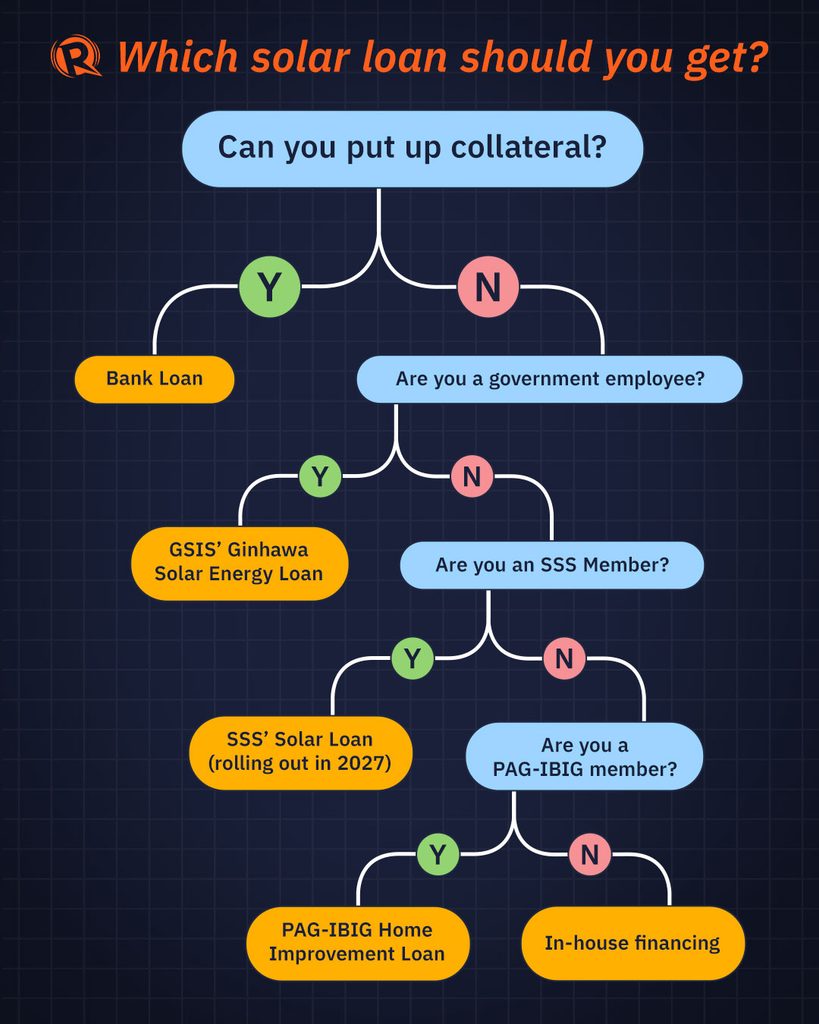
Financing for photo voltaic installations most frequently come within the type of loans. The commonest and accessible of those are from authorities our bodies.
- Authorities workers can avail themselves of a solar loan from the Authorities Service Insurance coverage System (GSIS).
- Love has a home improvement loan that can be utilized to amass a photo voltaic setup.
- Personal workers will quickly have the ability to get a mortgage from the Social Safety System (SSS). The rollout for the mortgage is eyed for early 2027.
The GSIS and SSS loans had been introduced simply this 12 months, within the wake of the Center East oil disaster and the photo voltaic increase that ensued within the Philippines.
Some industrial and rural banks have since adopted swimsuit with photo voltaic mortgage choices of their very own.
For households that can’t put up collateral or produce other difficulties assembly the necessities of those establishments, Donggay and Dimalanta stated that some photo voltaic installers additionally present an possibility referred to as in-house financing. In comparison with loans from monetary establishments, nonetheless, this feature normally has a shorter time interval — subsequently, greater month-to-month funds — and the next rate of interest.
Some installers additionally provide lease or lease-to-own preparations. Whereas Donggay stated a wide selection of financing choices is at all times welcome, she nonetheless strongly advises households to be the total proprietor of their very own photo voltaic setups.
“To me, the promise of photo voltaic goes past simply getting clear electrical energy; it’s additionally with the ability to be a prosumer — a producer and client of unpolluted electrical energy,” she stated.
When is it a good suggestion to go photo voltaic?
For each Donggay and Dimalanta, a rooftop photo voltaic setup is value it no matter your family’s present revenue degree or electrical energy consumption. To them, there is no such thing as a higher time than now to start out going photo voltaic.
In response to Donggay, going photo voltaic must be a consideration for anybody who feels the burden of rising electrical energy charges. She stated if a family can save for a trip, they might as effectively think about using that quantity to spend money on photo voltaic know-how. Financial savings from that funding will add up in the long term, in spite of everything.
Dimalanta shares the same view.
“We have to have a look at how a lot of a family’s revenue goes towards paying for his or her electrical energy invoice,” she stated. “More often than not, we need to think about these choices (rooftop photo voltaic) as a result of we need to hold extra of our revenue for our different wants.”
In the long run, it’s a query of the place you need your family’s month-to-month revenue to go. Staying related to a conventional distribution utility means endlessly paying a month-to-month electrical invoice, with no management over whether or not these providers enhance, deteriorate, or get dearer.
With photo voltaic financing choices, your infinite electrical energy payments could also be changed with finite month-to-month amortizations. And since rooftop photo voltaic setups have an estimated lifespan of 20 to 25 years, you’ll mainly be free from month-to-month funds after the mortgage interval is over.
Suggestions and methods
There are different methods to make your photo voltaic setup extra inexpensive.
Dimalanta shared two ideas. First, she stated putting in batteries instantly isn’t actually a necessity — particularly since these elements are normally the most costly a part of a rooftop photo voltaic setup.
“If you’re, for instance, within the Meralco franchise space or in a franchise space the place the distribution utility is comparatively dependable — and blackouts don’t continuously occur — possibly you don’t want the battery but,” she stated.
As an alternative, she advises shoppers to ask their installer to arrange a battery-ready system. Since battery costs are anticipated to go down because the know-how develops, shoppers can purchase them later to get much more financial savings out of their photo voltaic system.
Her second tip is for households to use for net-metering, which is a program that permits certified shoppers with renewable power methods to promote the surplus energy they generate in trade for credit on their electrical energy payments.
Which means if there are months within the 12 months or occasions within the day when nobody is house or electrical energy consumption is low, electrical energy generated throughout that point may very well be offered. Because of this, the price restoration on a family’s photo voltaic system turns into quicker.
“So, a mission that will have been projected to take 10 years earlier than you bought a return on funding could as an alternative take solely 5 years,” she stated.
Lengthy option to go
Whereas photo voltaic financing choices have come a great distance since rooftop photo voltaic applied sciences had been first pushed within the nation a decade agoDonggay stated the fact is that current choices stay restricted — particularly outdoors extremely urbanized areas.
That’s not the one approach rural areas are deprived with regards to getting worth for his or her photo voltaic setups. Internet-metering is an enormous draw for a lot of potential photo voltaic patrons, however the actuality is that off-grid and geographically remoted areas merely should not have that possibility out there.
“However even with out net-metering, photo voltaic installations can nonetheless be worthwhile and might be useful to households situated in off-grid areas for power safety,” she stated. “And then you definitely handle your prices, as a result of (virtually the entire energy) provide to our off-grid areas comes from diesel crops. And that’s why — whereas diesel prices proceed to extend — your payments can even proceed to extend,” she stated.
However past all that, the very fact stays that there are communities the place particular person photo voltaic house methods are nonetheless thought-about too costly even with the present financing choices. Dimalanta acknowledged this.
“And my reply to that’s: then let’s make it out there to strange Filipinos,” she stated.
For each Dimalanta and Donggay, one of many key options lies in our communities — particularly in neighborhood photo voltaic tasks the place residents solely use the ability for their very own consumption, while not having to promote it.
“For instance, if this whole barangay or this sitio can not afford particular person photo voltaic house methods, is there idle land there or is there a rooftop in all these multipurpose halls that will probably be constructed?” she stated. “Can they host photo voltaic services that may provide the speedy neighborhood (with energy)?”
Donggay’s personal suggestion is comparable: rooftop photo voltaic being pre-installed in authorities housing tasks for the city poor.
“We should be extra artistic in how we incorporate photo voltaic in different tasks which can be addressing rural and concrete growth — particularly for the folks we all know would by no means be accepted for a mortgage by industrial banks,” she added.
Photo voltaic could also be comparatively extra inexpensive now than a decade in the past, however there’s nonetheless an extended option to go to make it really accessible to the households that want it essentially the most.
“The reply shouldn’t be: let’s put aside or dismiss photo voltaic as a result of it’s just for the wealthy,” Dimalanta stated. “No. I feel it poses an actual problem for all of us — authorities in fact included — to make photo voltaic inexpensive to all.” – Rappler.com
Quotes had been translated to English for brevity.
https://weblog.passive-income4u.com/create-your-very-own-auto-publish-news-blog-site-and-earn-passive-income-in-just-4-easy-steps/
https://www.rappler.com/philippines/rooftop-solar-affordable-financing-options/