MANILA, Philippines – A year after Typhoon Tino devastated communities throughout Cebu, residents are nonetheless grappling with flooding, unsafe dwelling situations, and questions over flood-control efforts.
These considerations took middle stage within the Continue Cebu chat room on Muni within the Rappler app, the place survivors shared tales, mentioned situations in affected communities, and highlighted actions that marked the primary anniversary of Storm Tino on Wednesday, November 4.
Main as much as the anniversary, Cebuanos within the chat room initiated a dialogue titled “One 12 months after Tino, how is Cebu?” (How is Cebu a 12 months after Storm Tino?). They mirrored on the devastation of the catastrophe, and mentioned the challenges that affected communities proceed to face a 12 months later.
Cebu-based Mover Jerome Valdez shared the story of Alma Quingco, 46, from Barangay Maslog, Danao Metropolis, who was on obligation on the College of the Philippines Cebu when Tino struck. When she returned dwelling, floodwaters had made their home inaccessible, and lots of of their belongings had been swept away.
“Regardless of the assistance, the expertise left a long-lasting influence. Alma shared that there are nonetheless fears and trauma related to what occurred. Even now, the reminiscence of how rapidly the floodwaters rose stays together with her,” Valdez shared within the chat room.
The dialogue additionally introduced consideration to villages in Tambisan, the place extreme flooding continues even throughout atypical rainfall, and households who stay with out protected, everlasting relocation a 12 months after their properties have been destroyed.
Violy Musngi of La Paloma Village, throughout Rappler’s #MoveCebu roadshow in October, recalled how residents have been caught off guard by Storm Tino, with floodwaters reaching waist-deep ranges in her space and rising above head degree in Tambisan.
“We have been stunned by the waist-deep flooding, which endured even after Storm Tino. Residents in Tambisan are additionally affected by leptospirosis. After Tino, there’s flooding after flooding. Even mild rains now trigger flooding nearly instantly,” Musngi mentioned in the course of the discussion board.
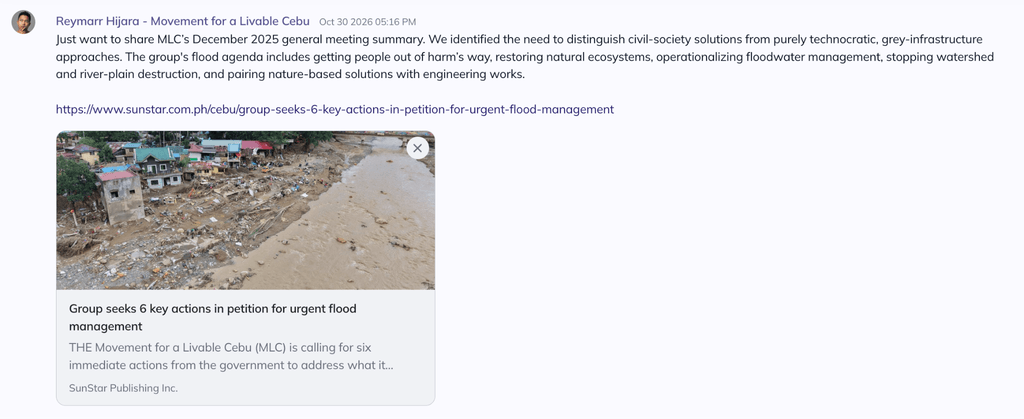
Reymarr Hijara of the Motion for a Livable Cebu (MLC) additionally joined the web dialogue. MLC is a civic group in Cebu, advocating for safer and extra sustainable flood administration.
In November 2025, they proposed a petition for urgent flood-management measurestogether with the creation of a Cebu Floodwater Administration Workplace, relocation of households from high-risk areas, safety of watersheds, and a assessment of flood-control constructions. The group additionally referred to as for no-build zones in areas inundated throughout Tino.
However even a 12 months later, in line with Hijara, implementing the six proposed flood-management actions remained largely unfinished or unverified a 12 months after Tino.
Essentially the most concrete growth, he mentioned, was MLC’s invitation to hitch the Provincial Flood Management and Drainage Job Power, created below Govt Order 74 after the November 2025 flooding. Nevertheless, Hijara harassed that the duty pressure’s formation and MLC’s participation didn’t quantity to implementation of the group’s proposed measures.
“A process pressure will not be but implementation,” Hijara mentioned within the chat room.
The discussions in Padayon Cebu additionally highlighted two actions across the November 4 anniversary: a multi-stakeholder dialogue on flood-control accountability and a sustainability stroll by means of downtown Cebu.
To look at city vulnerabilities, College of the Philippines (UP) Cebu’s Faculty of Communication, Artwork, and Design (CCAD), along with individuals from the College of the Philippines Open College and Japan’s Meiji College, held a stroll by means of downtown Cebu.
The guided stroll handed by means of areas together with San Nicolas, Pasil, Taboan, Carbon Market, Plaza Independencia, and Colon, analyzing Cebu’s constructed setting, public areas, transportation methods, and cultural heritage.
Based on an announcement by UP Cebu’s CCAD, Tino’s extreme flooding served as some extent of reflection as individuals thought-about how cities can adapt to flooding and excessive warmth whereas preserving their cultural id.
The stroll additionally drew comparisons between local weather adaptation approaches within the Philippines and Japan, together with classes Cebu might apply to constructing safer and extra livable communities.
Dialogue raises considerations over relocation, flood-control accountability
Other than a group stroll, varied teams additionally organized a dialogue to debate the urgent considerations amongst survivors.
The dialogue titled, “Do you continue to bear in mind us? (Do you continue to bear in mind us?) A Multi-Stakeholder Dialogue on Flood Management Accountability and the Persevering with Issues on Storm Tino Survivors,” was organized by Sugbuanong Pakigbisog Kontra Kurapsyon (SuPaKK) in collaboration with accomplice organizations.
Through the dialogue, John Roy Rigodon of the Sectoral Transparency Alliance on Pure Useful resource Governance (STANCe) shared findings from visits to communities alongside main rivers in Cebu, together with the Kinalawan River in Toledo Metropolis and the Cotcot River in Liloan and Compostela, the place he examined the state of affairs of residents dwelling in flood-prone areas a 12 months after Tino.
Based on Rigodon, the communities proceed to face considerations over their security when typhoons hit. This contains being in danger to flooding and lack of protected and everlasting relocation.
“Will they be protected within the subsequent hurricane?” he requested, pointing to relocation as a significant concern amongst residents.
The dialogue additionally raised questions on flood-control spending. Organizers cited P17.4 billion in main river flood-control tasks from 2016 to 2025, together with P11.1 billion for the Butuanon River, and referred to as for transparency and accountability. These figures have been additionally reported in a SunStar Cebu investigation on how Tino’s floods exposed how flood control projects failed in Cebu.
Furthermore, Norika Ishikawa of the Cebu Anti-Corruption Coalition and Middle for Emergency Help, Rehabilitation and Growth Inc.(CONCERN) questioned how the federal government would lead rehabilitation efforts for Tino-affected communities amid reported cuts to catastrophe rehabilitation and housing funds for 2027.
She mentioned restoration should transcend offering homes, calling for protected and reasonably priced housing with entry to livelihoods, utilities, roads, hospitals, and colleges.
“Catastrophe rehabilitation will not be an expense. Constructing again higher is a public funding,” Ishikawa mentioned.
Ishikawa mentioned the following steps recognized in the course of the dialogue embrace formulating a relocation agenda with Tino-affected casual settler households and mobilizing for an accountability motion on November 30.
“Sharing is unhappy, inaction is indignant, however nonetheless hopeful (The sharing is saddening, the inaction is infuriating, however there may be nonetheless hope),” she mentioned.
Storm Tino prompted widespread devastation in Cebu, affecting almost 2 million folks, displacing over 636,000, and leading to 96 confirmed deaths with many nonetheless lacking. It additionally broken roughly 262,000 properties (over 24,000 completely destroyed), leaving affected communities struggling to get well a 12 months later.
A 12 months after Tino, affected communities nonetheless proceed to name for protected relocation, clear flood-control spending, and rehabilitation that addresses their long-term wants. – Rappler.com
https://weblog.passive-income4u.com/create-your-very-own-auto-publish-news-blog-site-and-earn-passive-income-in-just-4-easy-steps/
https://www.rappler.com/moveph/how-communities-cebu-mark-tino-first-anniversary/