DAVAO CITY (MindaNews / 10 November 2026) — When costs rise rapidly whereas development loses momentum, households and companies really feel squeezed from each side. That’s the Philippines’ central macroeconomic stress in late 2026: inflation has accelerated, funding has weakened, and the labor market is softer than a 12 months earlier but nationwide output continues to be increasing.
This text separates what the official information present from what forecasts and evaluation recommend. It asks whether or not “stagflation” is the fitting description, how the shock might journey via Mindanao’s economies, and which alerts will decide whether or not the slowdown stays manageable or turns into materially worse.
The Philippines is greatest described as experiencing stagflationary circumstances or a stagflation danger not an formally declared stagflation episode. Mindanao is more likely to sluggish from its usually strong 2025 efficiency, however no single island broad 2026 charge could be responsibly said.
What Stagflation Means and What it Does Not
Stagflation describes an financial system through which inflation is persistently elevated whereas actual development is weak or slowing, usually alongside a deteriorating labor market. It’s a descriptive analytical time period, not a single official statistical classification utilized by the Philippine Statistics Authority (PSA).
It’s not the identical as a recession. A recession usually implies a broad and sustained contraction in financial exercise. Sluggish constructive development could be painful and may really feel recession-like, however it’s not the identical as a nationwide fall in output. Nor does a excessive inflation studying alone show stagflation; the expansion and employment sides matter too.
Three Exams for Studying the Current State of affairs
- Costs: inflation should be materially above the coverage goal or rising sufficient to erode actual incomes.
- Exercise: output should be rising weakly, shedding momentum, or contracting in vital sectors.
- Jobs: employment circumstances ought to present stress, similar to increased unemployment, weaker employment, or persistent underemployment.
Taken collectively, these checks assist distinguish a stagflationary slowdown from both odd inflation throughout a wholesome enlargement or a traditional recession with falling costs.
Do the Present Philippine Information match the Description?
Official readings. The most recent releases from PSA GDP, CPI and labor state of affairs level to a pointy lack of momentum alongside a renewed value shock:
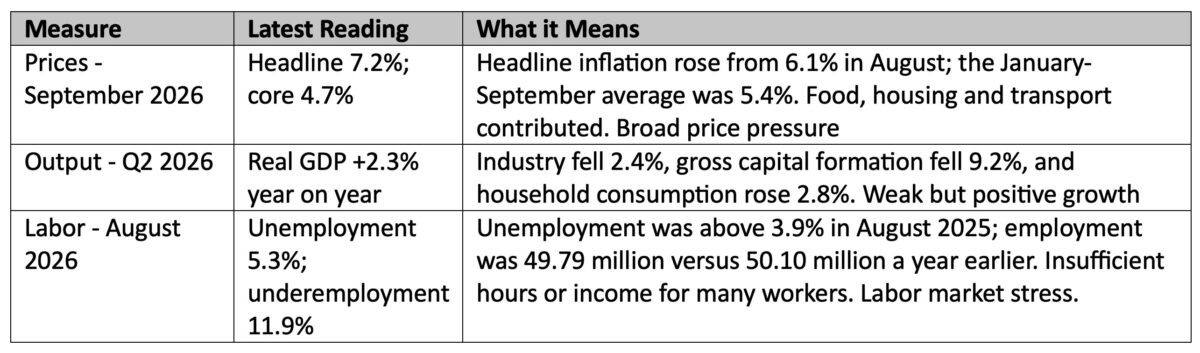
The mixture is in keeping with stagflationary circumstances: inflation is excessive and rising, development is constructive however weak, and labor market circumstances are worse than a 12 months earlier. That’s an analytical interpretation of the official readings although not a PSA declaration that the nation is in stagflation, and never proof of a recession.
As of late October 2026, the nationwide image was plainly uncomfortable however blended. Headline inflation reached 7.2% in September, whereas core inflation was 4.7%. Actual GDP grew 2.3% 12 months on 12 months within the second quarter, weak development, however nonetheless nonetheless development. In August, unemployment was 5.3% and underemployment 11.9%, pointing to labor market stress that may be felt even when the financial system isn’t contracting nationwide.
Coverage Response. On October 21, the BSP raised its coverage charge by 50 foundation factors to five.50%. The BSP anticipated inflation to speed up additional in coming months, keep excessive in 2027, and method its 3% goal in 2028, whereas anticipating home exercise to recuperate with fiscal assist. Larger charges might assist include inflation, however they’ll even have a direct influence on borrowings and investments within the close to time period. This interprets to increased borrowing prices may also make it tougher for households to finance purchases and for companies to fund inventories, gear, enlargement, and hiring.
How the Slowdown reaches Mindanao
Mindanao isn’t uncovered via one channel. Larger meals, gasoline, electrical energy, logistics and transport prices scale back actual family buying energy whereas elevating working prices for farms, fisheries, producers, builders and distributors. Companies might reply by delaying hiring, trimming margins, or passing prices to prospects; the dimensions of every response relies on native demand and market construction. Mindanao can continue to grow whereas households and companies really feel more and more squeezed. That stress is the center of the query: what occurs when costs rise quicker than incomes, demand softens, and productive prices climb on the similar time?
The reply is balanced: Mindanao can climate these circumstances, however inconsistently. Resilience is feasible the place households, companies, and authorities defend productive capability, preserve items shifting, and protect the flexibility of individuals to earn. Resilience, nonetheless, isn’t immunity.
- Households: When necessities take a bigger share of revenue, discretionary spending can weaken. That issues for retail, meals service, transport and different domestically oriented companies.
- Producers: Gas, energy, fertilizer, feed, ice, freight and development inputs can compress margins in agriculture, fishing, manufacturing, development and distribution.
- Investments: Larger rates of interest and weaker confidence can delay non-public initiatives, working capital enlargement and gear purchases.
- Public Execution: If procurement, development or releases sluggish, the anticipated assist from public initiatives might arrive later than deliberate.
Potential offsets. Export-oriented or commodity-producing areas might profit from increased nominal costs or agency exterior demand. That profit isn’t computerized: imported inputs, climate associated losses (with the onset of the tremendous El Niño circumstances), infrastructure bottlenecks and weak native worth seize can offset increased promoting costs. These are transmission mechanisms and conditional inferences, not area particular forecasts.
The sensible implication is uneven adjustment. A producer with pricing energy and dependable logistics might stand up to the shock higher than a small family enterprise dealing with costly transport and weaker native demand. A area’s headline development can due to this fact diverge from the nationwide common even when the identical inflation shock is current.
The Backdrop: Stress with no Nationwide Recession
These figures present totally different beginning factors, not a 2026 forecast. Davao’s publicity to companies, commerce and agriculture differs from Northern Mindanao’s manufacturing and logistics combine; Caraga has a definite useful resource and agriculture profile; SOCCSKSARGEN is delicate to farm, fishery and commodity circumstances; Zamboanga Peninsula combines commerce, agriculture and fisheries; and BARMM faces distinctive infrastructure, entry and governance constraints. The comparability is beneficial for asking the place pressures might land, however it can’t set up the route or dimension of every area’s 2026 development.
Agriculture and Fisheries: The place Price Shocks Meet Skinny Margins
Agriculture and fisheries are the primary main transmission channel as a result of producers usually face rising prices earlier than they’ll modify promoting costs. Larger gasoline, fertilizer, feed, ice, electrical energy, freight, development, and transport prices can scale back margins even when nominal farmgate or touchdown costs improve.
The strain is amplified when climate disrupts manufacturing, roads and ports sluggish supply, cold-chain capability is restricted, or post-harvest losses devour a part of the harvest. Imported inputs expose producers to world costs and exchange-rate actions. Weak market entry and restricted native worth seize can imply that the producer receives solely a small share of the ultimate value paid by shoppers.
Why the influence shall be uneven
- Smallholders face the tightest squeeze. Producers with little working capital, restricted storage, and weak bargaining energy could also be compelled to promote rapidly, even when market circumstances are unfavorable.
- Dependable logistics create a bonus. Farms, fisheries, cooperatives, and processors with reliable electrical energy, chilly storage, transport, and purchaser relationships can defend high quality and attain increased worth markets.
- Farmgate costs matter as a lot as retail costs. Robust client inflation doesn’t routinely translate into proportionate good points for farmers and fishers; the distinction could also be absorbed by transport, intermediaries, spoilage, or enter prices.
Worth addition can cushion volatility. Processing, grading, packaging, and direct purchaser connections might assist retain extra worth domestically, though they require capital, requirements, expertise, and reliable infrastructure.
Providers: Weaker Buying Energy, Selective Alternatives
Providers really feel stagflationary strain via family budgets. When meals, transport, electrical energy, and different necessities soak up extra revenue, households have much less to spend on retail purchases, eating, recreation, journey, schooling, well being companies, and different domestically oriented actions. Companies then face a troublesome mixture: prospects change into extra price-sensitive whereas their very own working prices rise.
Larger rates of interest can deepen the warning. A retailer might delay a second outlet, a restaurant might postpone gear purchases, and a transport or logistics operator might defer fleet renewal. Weaker confidence may also sluggish hiring, even when companies stay open and worthwhile. The consequence could also be fewer hours, slower wage development, or lowered enlargement somewhat than an outright shutdown.
Not each service will transfer in the identical route
- Native client companies are uncovered. Retail, meals service, private companies, transport, schooling, and well being suppliers rely closely on family buying energy and the price of reaching prospects.
- Tourism could be each weak and helpful. Larger journey prices can deter guests, however locations with sturdy demand, distinctive merchandise, and dependable entry should convey spending into native communities.
- Commerce and logistics might retain exercise. Companies linked to important items, regional provide chains, and environment friendly ports or corridors might face sustained demand whilst discretionary spending weakens.
- Digital and enterprise companies can present partial offsets. The place exterior demand stays agency, digitally delivered work, skilled companies, and business-process exercise might convey revenue into Mindanao with out relying totally on native consumption.
The important thing phrase is “partial.” Exterior demand can assist chosen companies and staff, however it can’t routinely defend each neighborhood enterprise or compensate for broad losses in actual buying energy.
Official Regional Baseline. The most recent PSA GDP Accounts cowl 2025, not 2026. The reported actual development charges have been:

Mindanao additionally shouldn’t be lowered to 1 island-wide development quantity. The most recent official regional baseline out there right here is 2025 actual GRDP development: 2.6% in Zamboanga Peninsula, 4.9% in Northern Mindanao, 5.15% in Davao Area, 4.8% in SOCCSKSARGEN, 5.704% in Caraga, and 5.0% in BARMM. These are 2025 actuals and beginning factors — not forecasts for 2026.
The regional inflation image already suggests uneven publicity. September inflation reinforces that warning: BARMM recorded 9.7%, Caraga 9.0%, Davao Area 8.7%, and Northern Mindanao 6.6%, towards 7.2% nationally. Inflation information reveal strain on prices and buying energy; they don’t by themselves decide regional real-GRDP development.
Sulu is included in Zamboanga Peninsula somewhat than BARMM in these PSA regional accounts. An island-wide Mindanao charge would require weighting every area’s development by its actual financial output. Merely averaging the six percentages could be deceptive, so no single official or defensible 2026 Mindanao development charge is said right here.
What the Forecasts Say and What They Do Not
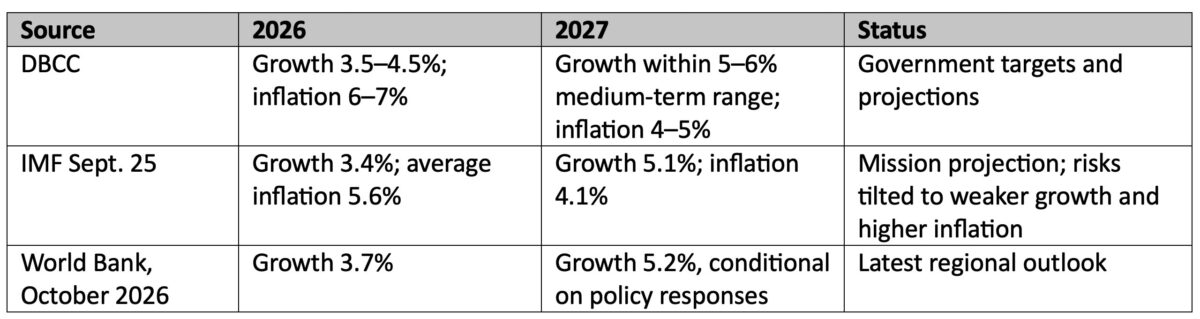
The out there forecasts level to weak 2026 development adopted by a doable restoration, however they differ in assumptions and timing. They’re projections, not measured outcomes:
Is that this the Worst Philippine Financial Outlook?
No, not in historic phrases. The present outlook is materially worse than the expansion ambitions set earlier than the 2026 shocks, and the mix of excessive inflation and weak funding warrants concern. However IMF and World Financial institution forecasts of three.4 – 3.7% development nonetheless indicate nationwide enlargement, not a forecast contraction. For perspective, the PSA reported that actual GDP contracted 9.6% in 2020 after revision.
That is due to this fact a severe stagflationary slowdown with significant draw back dangers, not the “worst ever” Philippine outlook. The evaluation might change if inflation stays excessive, funding stays weak, power prices rise, public challenge execution falters, or exterior demand deteriorates. For policymakers and companies, the sensible response is to plan round eventualities somewhat than assume {that a} nationwide restoration will arrive evenly throughout Mindanao.
What to Watch Subsequent
The subsequent information units ought to take a look at whether or not the strain is broadening, easing, or just shifting between sectors. As a result of there isn’t any single official island-wide 2026 development charge, we should always resist turning one regional anecdote or one nationwide indicator right into a forecast for all of Mindanao. The excellence between a troublesome slowdown and a deeper stagflationary episode will rely on whether or not value pressures broaden, funding stabilizes, and employment begins to recuperate. Key indicators embody:
- Inflation: Headline and core readings, particularly meals, housing, gasoline and transport elements. Monitor whether or not meals, gasoline, electrical energy, transport, and different necessities are driving the headline charge, and whether or not core inflation can be accelerating.
- Quarterly GDP: business, gross capital formation and family consumption, not solely the headline development charge. Watch nationwide development alongside out there regional and sectoral element somewhat than treating 2.3% Q2 development as a Mindanao broad consequence.
- Employment: unemployment, employment ranges and underemployment relative to the identical month a 12 months earlier. A steady unemployment charge can nonetheless conceal fewer hours, weaker earnings, or a shift into decrease high quality work.
- Funding: New gear, development, enterprise formation, and hiring can present whether or not companies nonetheless see a path to productive enlargement. Authorized spending issues much less if roads, ports, energy, irrigation, broadband, and different initiatives are delayed or poorly applied.
- Working prices: Electrical energy and gasoline costs, freight prices and different logistics prices that have an effect on regional companies. These prices affect farms, fisheries, factories, retailers, transport operators, and repair suppliers on the similar time.
- Agricultural output: manufacturing, climate disruptions, farmgate costs and enter prices throughout crops, fisheries and livestock. Evaluate manufacturing, producer costs, client costs, and postharvest losses to see who’s absorbing the shock.
- Regional GRDP: the following PSA releases, which can present whether or not variations throughout Mindanao are widening or narrowing. It will present a extra dependable foundation for comparability of regional efficiency than a single island broad narrative.
A Sensible Agenda for Weathering the Squeeze
The response ought to deal with defending productive capability somewhat than attempting to remove each fluctuation in costs. A reputable coverage and enterprise agenda would come with:
- Stabilize meals and power logistics by decreasing avoidable bottlenecks from ports and roads to storage, distribution, and native supply.
- Shield productive agricultural and fisheries inputs via extra dependable entry to gasoline, fertilizer, feed, ice, electrical energy, working capital, and danger administration instruments.
- Enhance chilly chains, ports, roads, energy, and broadband in order that producers and repair companies can scale back spoilage, attain patrons, and function extra effectively.
- Speed up lawful and clear public-project execution with clear procurement, seen milestones, and accountability for delays and outcomes.
- Assist viable MSMEs with working capital, monetary steering, and sensible danger administration with out masking companies that aren’t economically sustainable.
- Join farmers, fishers, and repair suppliers to patrons and digital markets so extra worth can stay with native enterprises and staff.
- Measure outcomes, not solely spending. Monitor actual incomes, margins, jobs, productiveness, post-harvest losses, and native worth seize.
Conclusion: Resilience Should be Constructed, not Assumed
The direct reply is certified however clear: the Philippines is experiencing circumstances that may moderately be described as stagflationary, or as a significant stagflation danger, however it’s not in a proper or formally declared stagflation episode. Optimistic Q2 development means the financial system is slowing sharply somewhat than contracting nationwide.
Mindanao can climate stagflationary circumstances, however not uniformly and never by counting on development headlines alone. The 2025 regional baselines present totally different beginning positions, whereas the September 2026 inflation readings present that publicity is already uneven. Agriculture and fisheries face direct price and logistics strain; companies face weaker family demand, increased working prices, and extra cautious funding.
Mindanao is more likely to sluggish from its usually strong 2025 efficiency, however the route and magnitude will differ throughout Davao, Northern Mindanao, Caraga, SOCCSKSARGEN, Zamboanga Peninsula and BARMM. The subsequent regional accounts, along with inflation, jobs, funding, power and agricultural information, shall be extra informative than any unsupported single-number island-wide forecast.
The sensible name to motion is obvious: defend the programs that permit individuals produce, transfer, promote, work, and make investments. Households can monitor actual buying energy and keep away from pointless danger; companies can overview margins, suppliers, power use, patrons, and dealing capital; and policymakers can prioritize clear execution and measurable enhancements in infrastructure and market entry. The aim isn’t immunity from shocks. It’s a Mindanao financial system that retains extra individuals productive whereas the shocks cross via.
(Antonio “Tony” S. Peralta is a enterprise and civic chief who serves because the Honorary Consul of Finland in Mindanao and Chairman of the European Chamber of Commerce of the Philippines–Southern Mindanao Enterprise Council, in addition to Company Secretary of the Japanese Chamber of Commerce of Mindanao. His background is in banking, finance, and regional improvement, and he’s concerned in selling overseas funding, sustainable development, and academic hyperlinks between Europe and Mindanao. He additionally serves as Vice Chairman of the Davao Metropolis Media Residents Council, participates in improvement initiatives via ECCP SMBC, and helps initiatives associated to rural improvement, media engagement, enterprise cooperation, and worldwide partnerships within the area.)
https://weblog.passive-income4u.com/create-your-very-own-auto-publish-news-blog-site-and-earn-passive-income-in-just-4-easy-steps/
https://mindanews.com/enterprise/2026/11/development-perspective-is-the-philippines-already-in-stagflation-what-it-means-for-mindanaos-growth/