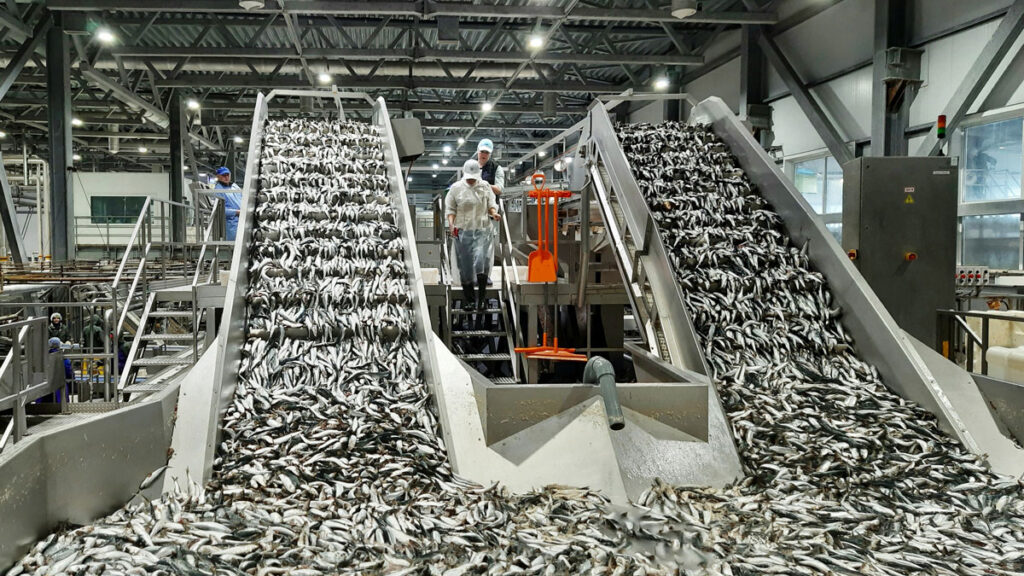
PART 1 | Food for feed: The price paid beyond the plate
An archipelago nation consisting of greater than 7,000 islands, the Philippines has a minimum of 22,000 miles of shoreline and a fishing fleet of roughly 5,000 business fishing vessels. Seafood — particularly wild-caught, greater than farm-raised — is the most well-liked type of animal protein, above hen, beef, and pork.
Small species like sardines and scad have at all times been staples in poorer Filipino households. Up to now few a long time, nevertheless, overfishing and local weather change have made these fish much less accessible, and Philippine seafood corporations have aimed to reroute seafood for export slightly than home consumption.
Consultants say that is trigger for concern as a result of the necessity for extra reasonably priced sources of protein has by no means been higher. By 2050, the Philippines’ inhabitants is projected to achieve a minimum of 150 million, rising demand for fish by greater than 1.6 million tons yearly, based on a 2023 research in The Philippine Journal of Fisheries.
Lots of the fishers who provide the nation’s fishmeal vegetation work in exploitative preparations. Nearly all of the crew on tuna handliners and purse seiners within the Philippines, for instance, labored below some type of debt bondage to pay again money loans or advances, based on a research by Secure Seas.
Firms averted minimal wage legal guidelines by hiring fishers as contractors slightly than workers, or modified their flags, that means that Philippine legal guidelines now not utilized. They then illegally dismissed and blacklisted fishers who tried to unionize.
Fishers have been among the many most impoverished teams in Mindanao as of 2022, and their households expertise excessive charges of childhood malnutrition, based on a research by Mrag Asia Pacific. Many fishers primarily based on the island have been locked into unfair profit-sharing schemes with ship homeowners and solely retained a fifth of the earnings for the fish they landed.
The compensation didn’t account for the extent of danger they confronted; globally, fishing is ranked because the deadliest occupation, with greater than 100,000 fatalities yearly.
Crew members supplying the fishmeal {industry} in Zamboanga lacked formal coaching in occupational security and well being, telling inspectors that they realized their first support expertise from on-line movies, based on a 2023 paper by the Institute for Labor Research. Once they wanted to be taken to shore for formal remedy, staff stated they paid for the medical bills by taking money advances from their employers, leaving them with as much as $1,700 price of debt.
Local weather change and overfishing, amongst different components, have led to a decline in fish shares within the waters close to the Philippines, worsening issues additional for staff within the fishing and seafood processing industries.
Indian mackerel, one of many species focused for fishmeal, was first declared overfished within the Philippines by a 2020 research within the Worldwide Journal of Fisheries and Aquatic Analysiswhich discovered the fish had been caught at a fee exceeding their capability to breed.
In some areas, fishers have additionally noticed a decline in tuna catches. The depletion of this species in nearshore waters pressured Common Santos fishers farther from shore to seek out wealthy fishing grounds and switch a revenue, exposing them to harsher situations, longer working hours, and maritime conflicts, based on the Secure Seas research. The fishers’ boats have been usually not geared up for lengthy voyages at sea and lacked any provides for medical emergencies. The rising prices of diesel additionally took up a good portion of the employees’ month-to-month earnings.
Sustainability checks
Within the Philippines and elsewhere, many seafood corporations have turned to certification packages to indicate clients that they take labor rights and environmental sustainability severely. Critics query the validity of those packages.
Because the manufacturing of seafood has grown extra globalized, its provide chains have stretched longer, and it has turn into harder for shoppers to know whether or not it was harvested sustainably or legally. Most grocers who promote seafood are at nighttime as effectively as a result of monitoring is tough and expensive.
Robert Stumberg, professor at Georgetown Legislation and provide chain professional, stated that is partly as a result of grocers sometimes purchase from wholesalers and infrequently observe their suppliers. He stated that the opposite purpose could also be believable deniability, including “Firms can escape blame or the necessity to repair issues in the event that they’re unaware of them.”
The place authorities regulators have confirmed missing in making certain that provide chains are free from unsustainable, unlawful, or unethical practices, industry-led certification packages have sought to fill the hole. Critics say these packages serve extra as a sustainability smokescreen, giving downstream clients a strategy to keep away from trying deeper into their provide chains. The packages typically concentrate on environmental crimes, whereas principally overlooking labor abuses on ships.
Allie Brudney, a senior employees legal professional on the strategic litigation nonprofit group Company Accountability Lab, stated that on land — at processing vegetation or on farms — certification packages hardly ever conduct true spot checks to authenticate the reassurances given by managers on the factories. As a substitute, the packages continuously alert corporations earlier than inspectors present up, which provides them an opportunity to scrub up the scene so there are not any violations.
At sea, these packages additionally usually depend on self-reported info from ship captains slightly than having auditors instantly go to and test situations offshore on vessels, the place crimes are commonest.
Devan Meserve, a spokesperson for the International Seafood Alliance, which runs a program known as Greatest Aquaculture Practices, said that her group represents the “most complete program for farmed seafood,” partly as a result of it covers the “total aquaculture manufacturing chain.”
Defending staff on the fishing vessels that provide feed mills is, nevertheless, an “immense problem,” she famous, as a result of audits happen strictly at port and don’t witness harvest situations. Meserve added that her group helps the {industry} counter unlawful and overfishing by requiring feed mills to supply many of the fish they use in fishmeal or fish oil from fisheries accredited by certification packages like MarinTrust and Marine Stewardship Council.
Assessing advertising claims
Partly bolstered by these certification packages, seafood corporations routinely make advertising claims in regards to the ethics and sustainability of their seafood. Typically, these claims fail to reckon with crimes or social considerations additional up their provide chains, together with on the ships or vegetation that produce the feed for the fish farms.
This disconnect is creating rising authorized danger for seafood corporations and grocers. Since 2020, a minimum of 9 lawsuits alleging false promoting have been introduced towards six seafood corporations throughout six US jurisdictions. The authorized complaints centered on a typical sample: advertising claims that portrayed merchandise as sustainable or ethically sourced, paired with supply-chain proof that urged in any other case. Plaintiffs challenged language similar to “sustainable,” “eco-friendly,” “all-natural,” “wild-caught,” and “from the coast of Maine,” in addition to claims of superior worker-safety requirements.
In a minimum of 4 instances, using fishmeal or fish oil and their hyperlink to industrial fishing and ecosystem depletion have been central to arguments that the merchandise weren’t environmentally sustainable. Further allegations included pressured labor on fishing vessels and reliance on dangerous pesticides and antibiotics. Throughout this identical interval, seafood corporations have paid greater than $2 million in settlement charges to resolve false-advertising instances.
The Outlaw Ocean Project investigation assessed greater than 800 seafood corporations that made advertising claims corresponding to — or stronger than — these cited within the lawsuits and located that over half of the businesses had documented crimes or considerations inside their provide chains.
Dana Cleaveley, a analysis marketing consultant previously with SeaChoice, a Canadian sustainable seafood group, stated that many industries have already needed to start reckoning with the human rights and environmental abuses buried of their provide chains. She cited sweatshop clothes, blood diamonds, and fair-trade espresso as examples.
Seafood has been slower to face that sort of scrutiny. However because the world searches for extra protein and leans additional into aquaculture, that will change, Cleaveley stated, notably if extra governments start proscribing imports tied to illegality or unsustainable practices. She added, “That’s when traders will start to see materials — not simply reputational — danger, and corporations must modify.”
Gaps in fisheries administration
In the meantime, issues persist.
The stress to show a revenue has led to unlawful fishing by Philippine vessels. These boats caught a minimum of 500,000 tons of fish per yr through the use of banned fishing methods or illegally getting into different international locations’ waters or different prohibited zones, based on the US Company for Worldwide Improvement in 2024.
Philippine handline fishers traveled so far as Indonesia, Papua New Guinea, Fiji, Palau, and Australia for higher fishing grounds, risking arrest by international governments. 1000’s of fishers additionally poached from the Philippines’ municipal waters, together with on the coast of Mindanao.
As a result of native governments lack the funding to police municipal waters, “compliance is actually voluntary,” based on a Meals and Agriculture Group (FAO) research.
The federal government within the Philippines has taken steps to raised management the {industry} and police its waters.
Since 2011, it has imposed a closed season on sardine fishing in Zamboanga to guard the inhabitants of the inventory, in addition to the livelihoods of those that rely upon the {industry} of catching and processing the small fish. Yearly, between December and March, industrial sardine fishing across the Zamboanga peninsula is closed.
Some fisheries specialists have applauded the closed season coverage as a hit. It has helped protect the inventory with minimal affect on working hours or jobs amongst processing staff, based on a 2020 research by College of the Philippines Los Baños. This was partly as a result of the federal government prevented the lack of earnings by offering staff with loans to assist them by the off-seasons.
“Extra large-sized fish have been noticed just lately, which suggests restoration of fish inventory from intensive exploitation,” discovered the research. However the FAO categorised sardine shares within the Sulu Sea off the coast of Zamboanga as overfished one yr later.
Researchers warned that sardine shares in different areas of the nation have been seemingly in an analogous state of affairs and pointed to “a scarcity of political will to implement legal guidelines, and a scarcity of coordination” amongst municipalities, resulting in gaps within the administration of the fishery.
To assist impoverished fishers whereas additionally defending the oceans, the Philippine authorities has created alternatives for them to enter the aquaculture enterprise.
Throughout a “blue financial system” roundtable that introduced collectively quite a lot of seafood staff in April 2025 to debate the way forward for the {industry}, Roberto de Ocampo, former finance chief of the Philippines, emphasised that sustainable aquaculture may “give fisherfolk various sources of earnings whereas decreasing stress on wild fish populations.”
However any proposals to broaden milkfish or tilapia aquaculture within the Philippines face an apparent problem.
“It’s mathematically not possible to offer sufficient fishmeal for the aquaculture {industry},” stated feed mill government Norberto Chingcuanco in 2022.
Except the Philippines scales up its personal fishmeal {industry} or imports extra from international locations the place the enterprise is tied to a slew of hidden prices, it should wrestle to fulfill rising demand for meals and employment by aquaculture alone. – Rappler.com
The reporting for this story was half of a bigger investigation carried out by a global team of journalists primarily based at The Outlaw Ocean Mission.
https://weblog.passive-income4u.com/create-your-very-own-auto-publish-news-blog-site-and-earn-passive-income-in-just-4-easy-steps/
https://www.rappler.com/surroundings/food-for-feed-fish-farming-struggle-police-seafood-supply-chains/