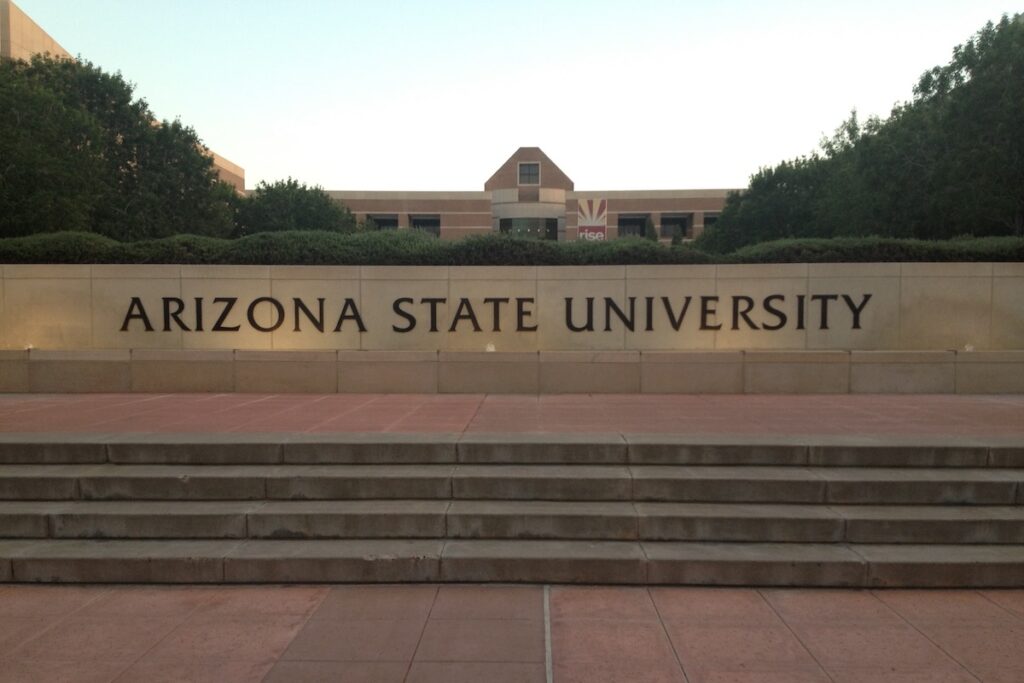
The Justice Division on August 27 filed complaints in opposition to Arizona, New Mexico, Oregon, and Washington, difficult state legal guidelines that enable undocumented college students pay in-state tuition and, in some circumstances, obtain state monetary help. The 4 lawsuits deliver the administration’s marketing campaign to 21 states, up from the 12 we counted when DOJ sued Massachusetts and Rhode Island in June.
The authorized principle is that federal statutes bar states from giving residency-based increased training advantages to immigrants not lawfully current until each U.S. citizen will get the identical profit no matter the place they stay.
Affiliate Legal professional Common Stanley E. Woodward Jr. mentioned the 4 states “are pushing residents to the aspect and ignoring federal regulation,” per the DOJ launch. The complaints additionally argue the legal guidelines create incentives for unlawful immigration, a declare that goes past Arizona’s residency necessities and targets the coverage itself.
Why It Issues
The DOJ’s Arizona criticism places the distinction between resident and nonresident tuition at roughly $24,000 per yr, and KTAR stories Arizona State College fees $14,814 for residents versus $39,262 for out-of-state college students. That unfold is why we inform households that making use of out of state can value tens of 1000’s over a level.
The DOJ says a minimum of 720 undocumented college students obtained in-state charges in Arizona in Fall 2025, together with 432 at ASU, and estimates ASU alone gave up about $10.5 million in tuition consequently. As a result of undocumented college students can’t file the FAFSA or obtain federal help, in-state pricing and state grants are sometimes the one options to personal pupil loans out there to them.
The Particulars
- Arizona: Proposition 308, accepted by voters in 2022 with 51.2% assist permits college students to qualify for in-state tuition by attending an Arizona highschool for a minimum of two years and graduating. The Arizona Legal professional Common’s workplace says the regulation “doesn’t situation eligibility on residence” however on highschool attendance, a distinction that issues underneath the federal statute’s residency language.
- Washington: Gov. Bob Ferguson instructed UPI the state “gained’t be bullied into altering how we offer alternatives for younger folks” and expects to win in court docket.
- Different States: Courts have already blocked legal guidelines in Texas, Kentucky, Oklahoma, Nebraska, and Illinois, in keeping with The Bulletin. Circumstances stay pending in Minnesota, Virginia, California, New Jersey, Kansas, Massachusetts, Rhode Island, Maryland, Colorado, New York, Connecticut, and Vermont.
How This Connects
A number of of the 5 “wins” the DOJ cites occurred rapidly. Texas, Kentucky, and Oklahoma have been completely enjoined and Nebraska signed a consent decree, as we famous in our June protection.
The brand new defendants are a bit totally different although. Arizona’s regulation was handed by voters, Arizona’s legal professional basic is already contesting DOJ’s studying of the statute, and Washington’s governor has mentioned the state will litigate.
That units up the primary actual check of whether or not the “highschool attendance, not residency” construction that roughly two dozen states use survives in-state tuition challenges underneath § 1623.
What’s Subsequent
Look ahead to motions to dismiss from the 4 states and whether or not DOJ seeks preliminary injunctions earlier than the spring 2027 time period. Any pupil presently paying in-state charges underneath these legal guidelines ought to test with their monetary help workplace about what occurs to out-of-state tuition billing if a court docket blocks the regulation earlier than or throughout a time period, as Texas college students confronted in 2025.
Editor: Colin Graves
The publish DOJ Sues Arizona, New Mexico, Oregon And Washington Over In-State Tuition For Undocumented College students appeared first on The Faculty Investor.
https://weblog.passive-income4u.com/create-your-very-own-auto-publish-news-blog-site-and-earn-passive-income-in-just-4-easy-steps/