
Key Factors
- Roth conversions allow you to voluntarily pull cash from a conventional IRA or 401(ok), pay tax on it right this moment at your present marginal bracket, and transfer it right into a Roth the place future progress and certified withdrawals are tax-free.
- The 2026 inflation-adjusted tax brackets create particular goal quantities pre-retirees can purpose to fill every year.
- Conversions elevate MAGI, which might set off future Medicare IRMAA surcharges and cut back or get rid of ACA premium tax credit so plan the conversion in opposition to each federal brackets and these secondary thresholds.
People with cash in a conventional IRA or 401k can lock in right this moment’s tax charges on retirement cash that might in any other case be taxed at a a lot increased charge underneath required minimal distributions many years from now.
The 2026 inflation-adjusted brackets permit for conversions to occur at barely increased ranges, with the 12% ceiling at $100,800 for married filers and the 24% ceiling at $403,550. That further headroom issues if you’re making an attempt to maneuver pretax retirement {dollars} right into a Roth account with out pushing your self into the subsequent tax bracket.
What follows makes use of these 2026 brackets as targets, with three labored situations for readers nonetheless within the workforce. It additionally covers two traps (Medicare IRMAA and ACA premium tax credit) that may quietly erase the financial savings.
Would you want to save lots of this?
We’ll electronic mail this text to you, so you possibly can come again to it later!
What “Filling Up A Bracket” Really Means
A Roth conversion strikes cash from a conventional retirement account (comparable to a 401(ok) rollover IRA) right into a Roth IRA. The transformed quantity is added to your extraordinary earnings for the 12 months. You pay tax on it at your marginal charge. As soon as contained in the Roth, the cash grows tax-free and certified withdrawals after age 59½ are tax-free.
“Filling up a bracket” means changing precisely sufficient to achieve (however not exceed) the highest of a selected tax bracket. Go one greenback previous, and each extra greenback will get taxed on the subsequent charge up.
Listed below are the 2026 tax brackets:
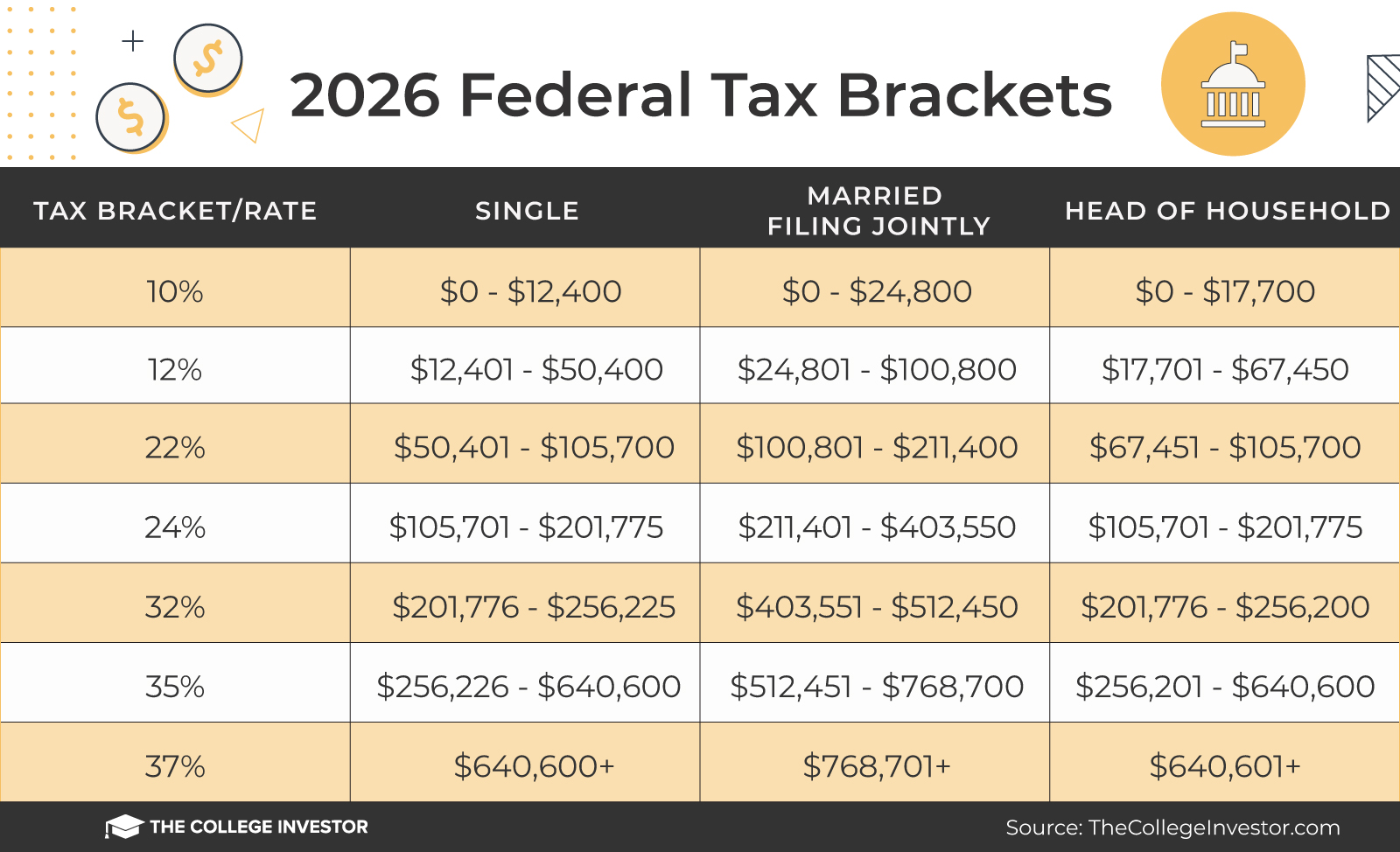
The 2026 normal deduction is $16,100 for single filers and $32,200 for married submitting collectively.
Your goal bracket is determined by the speed you anticipate to pay in retirement. Changing at 12% right this moment if you anticipate the 22% or 24% bracket later is a simple win. Changing at 32% if you would possibly drop to 22% later is a loss.
Most pre-retirees concentrate on the 12% and 24% ceilings as a result of the jumps above them (to 22% and 32%) are the steepest cliffs within the bracket construction.
Three Eventualities
Situation A — The Sabbatical 12 months
Mark and Samantha, each 56, married submitting collectively. Samantha took an unpaid sabbatical. Family W-2 earnings for 2026: $90,000.
After the $32,200 normal deduction, taxable earnings earlier than any conversion is $57,800. That leaves $43,000 of area earlier than they hit the highest of the 12% bracket at $100,800.
In the event that they convert $43,000 from Mark’s rollover IRA, their taxable earnings rises to precisely $100,800. The incremental federal tax on the conversion is $43,000 × 12% = $5,160. Their all-in federal tax on the total $100,800 climbs from $6,440 to $11,600, which is a $5,160 distinction that matches the marginal math.
Had they pushed one other $10,000 into the 22% bracket, that final $10,000 would value $2,200 in tax as an alternative of $1,200, which is a ten% penalty on the overflow. Stopping on the ceiling retains each transformed greenback at 12%.
Situation B — The Laid-Off Single Filer
Jenna, 48, single, was laid off in March. She earned $25,000 by March plus a $10,000 severance, bringing her 2026 earned earnings to $35,000. She resides on financial savings and has an previous 401(ok) she rolled into a conventional IRA price $400,000.
After her $16,100 normal deduction, taxable earnings earlier than conversion is $18,900. She has $31,500 of room earlier than the highest of the 12% bracket at $50,400.
Changing $31,500 prices her $3,780 in federal tax (12% marginal). That very same slice of {dollars} taxed in retirement at 22% would value $6,930, which is a $3,150 financial savings on this block alone, earlier than any tax-free Roth progress over the subsequent 20 years.
She may push additional into the 22% bracket, however every extra greenback now prices 22 cents of federal tax. Whether or not that’s price it is determined by whether or not she expects to retire within the 22%, 24%, or increased bracket.
For many middle-income savers, stopping on the 12% line is the conservative name.
Situation C — Excessive Earners Filling the 24% Ceiling
Dan and Mia, each 54, married, each working. Family AGI: $320,000. They’re peak earners with a mixed $1.8 million in pretax 401(ok) balances that may drive massive RMDs beginning at age 75.
After the $32,200 normal deduction, taxable earnings earlier than conversion is $287,800, which is already within the 24% bracket. The highest of the 24% band for MFJ in 2026 is $403,550, giving them $115,750 of headroom earlier than the 32% bracket kicks in.
In the event that they convert $115,750 from Dan’s rollover IRA, the incremental federal tax is $115,750 × 24% = $27,780. Their whole federal tax on $403,550 of taxable earnings is $82,048, up from $54,268. Once more, a $27,780 delta that confirms your complete conversion stayed contained in the 24% band.
The planning case: if their pretax balances develop to $3.5 million by age 75, RMDs alone may push taxable earnings to $450,000-plus in right this moment’s {dollars}, nicely into the 32% bracket underneath present regulation. Paying 24% now on a block of that cash saves 8 proportion factors in opposition to these future RMDs, which is roughly $9,260 per $115,750 block of conversion, earlier than factoring in tax-free Roth progress.
Client Influence: The IRMAA and ACA Traps Most Individuals Miss
Federal tax brackets are just one a part of the image. Conversions elevate your modified adjusted gross earnings (MAGI), and two separate cliff methods use MAGI as a set off.
Medicare IRMAA As soon as both partner turns 65 and enrolls in Medicare, Half B and Half D premiums are surcharged primarily based on MAGI from two years earlier. For 2026, the primary IRMAA surcharge hits single filers with 2024 MAGI above $106,000 and married filers above $212,000 and the tiers climb from there. A conversion completed at age 63 will affect IRMAA at age 65.
A conversion completed at 53 is not going to, however aggressive late-50s and early-60s conversions can push future IRMAA increased except modeled fastidiously.
ACA premium tax credit. Pre-retirees not on employer protection (together with somebody on a sabbatical or between jobs) could also be shopping for ACA market plans with income-based subsidies. Conversion earnings counts towards MAGI for ACA functions, and the premium tax credit score phaseout was restructured after the improved subsidies expired on the finish of 2025.
A conversion that nudges MAGI previous the phaseout can claw again 1000’s of subsidy {dollars}, which frequently outweighs the federal tax financial savings. Jenna in Situation B ought to mannequin her 2026 ACA MAGI earlier than changing, as a smaller conversion could internet out higher as soon as subsidies are factored in.
Motion Steps
Should you’re fascinated by filling your brackets with Roth conversions, here is what to know:
- Challenge your 2026 taxable earnings earlier than December, subtracting the usual deduction, to pinpoint precisely how a lot room you must every bracket ceiling.
- Resolve which bracket ceiling (12%, 22%, or 24%) you’re concentrating on primarily based in your anticipated retirement tax charge, not right this moment’s charge.
- Estimate IRMAA publicity if both partner is inside two years of age 65, and ACA subsidy influence in case you are shopping for a market plan.
- Execute the conversion earlier than December 31 (the deadline is calendar-year, not tax-filing-year) and pay the tax from non-retirement funds so the total transformed quantity lands contained in the Roth.
- Recheck yearly. A single low-income 12 months (sabbatical, severance, enterprise loss, between-jobs stretch) is commonly the only greatest conversion window you’ll get.
Do not Miss These Different Tales:
@media (min-width: 300px){(data-css=”tve-u-19db6ea090f”).tcb-post-list #post-77049 (data-css=”tve-u-19db6ea0915″){background-image: url(“https://thecollegeinvestor.com/wp-content/uploads/2026/03/Roth-Conversion-Ladder-150×150.jpg”) !vital;}}
Roth Conversion Ladder Defined For FIRE
Roth Conversion Ladder Defined For FIRE@media (min-width: 300px){(data-css=”tve-u-19db6ea090f”).tcb-post-list #post-17561 (data-css=”tve-u-19db6ea0915″){background-image: url(“https://thecollegeinvestor.com/wp-content/uploads/2017/05/WP_megabackdoorroth-150×150.jpg”) !vital;}}
Understanding The Mega Backdoor Roth IRA
Understanding The Mega Backdoor Roth IRA@media (min-width: 300px){(data-css=”tve-u-19db6ea090f”).tcb-post-list #post-38006 (data-css=”tve-u-19db6ea0915″){background-image: url(“https://thecollegeinvestor.com/wp-content/uploads/2024/01/SDIRA_vs._IRA_1280x720-150×150.png”) !vital;}}
How To Do A Backdoor Roth IRA (And Pitfalls To Keep away from)
How To Do A Backdoor Roth IRA (And Pitfalls To Keep away from)
Editor: Colin Graves
The submit How you can Fill Your Tax Brackets With Roth Conversions appeared first on The School Investor.
https://weblog.passive-income4u.com/create-your-very-own-auto-publish-news-blog-site-and-earn-passive-income-in-just-4-easy-steps/