
As you dive into the world of investing, index funds are certain to pop up in your radar. With the assistance of those funds, you may construct your portfolio in a comparatively hands-off means.
However what precisely is an index fund? And why are so many buyers followers of such a funding car? On this article, we’ll discover all of these questions and extra. Let’s get began!
What Is An Index Fund?
An index fund is a sort of funding that’s designed to observe a selected benchmark of the inventory market.
The fund itself can monitor any specific choice inside the monetary market. For instance, the S&P 500 is a typical index on which a variety of funds are based mostly. A number of of the index funds which might be based mostly on the S&P 500 embody Vanguard’s VFINX, Constancy’s FUSEX, and Schwab’s SWPPX.
Index funds will be both an exchange-traded fund (ETF) or a sort of mutual fund. So long as the fund is designed to observe a selected phase of the monetary market, it is thought of an index fund.
Execs And Cons Of Index Funds
As with all monetary merchandise, you’ll discover that index funds have professionals and cons. Right here’s what it’s good to know.
Execs
Let’s begin with some great benefits of working with an index fund.
Cons
As with all monetary merchandise, there are some disadvantages to investing in an index fund. Listed below are some issues to pay attention to:
How Do Index Funds Examine To Lively Funds?
An index fund is commonly thought of a comparatively hands-off funding. They merely function a mirror to a selected part of the market. With that, they’re are all in regards to the attaining the common for no matter benchmark they’re following.
Actively managed mutual funds, in the meantime, don’t observe a selected index. As an alternative, they search to outperform the market. So how do these two funds stack up towards one another? Right here’s a better have a look at the efficiency and price variations.
Efficiency
Should you wished to easily hold tempo with the market, an index fund would suffice. However buyers that select actively managed funds are looking for overperformance. So is that what they get? It seems that lively funds do not come out forward practically as typically as you may anticipate.
In 2020, 60.33% of actively managed large-cap funds underperformed the S&P 500 in keeping with SPIVA. And that was in a yr during which we noticed huge volatility as a result of pandemic-induced crash that passed off in March.
Over three years, the share of actively managed funds which have lagged behind the general market will increase to 69.71%. And over the five-year interval that ended December 31, 2020, a whopping 75.27% of lively funds weren’t in a position to hold tempo with the S&P 500’s efficiency.
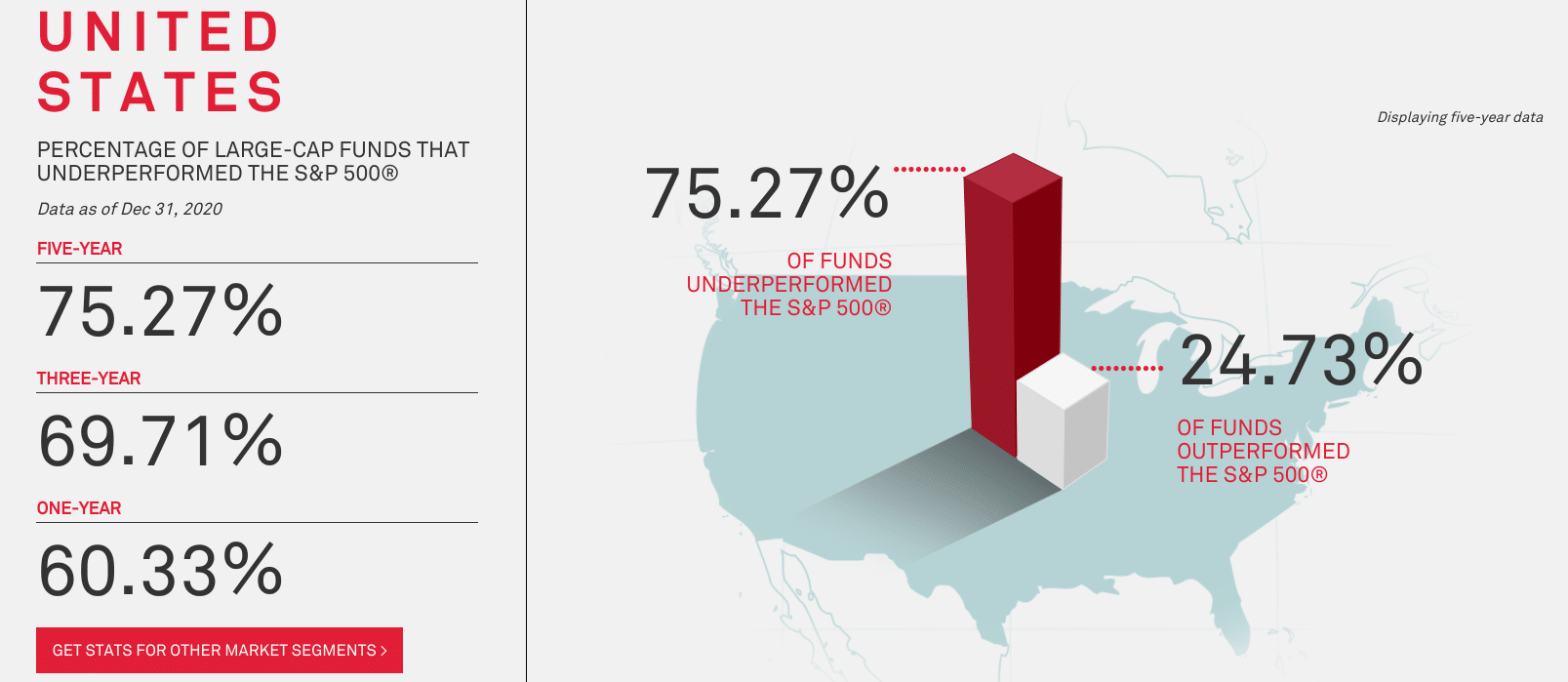
Picture by SPIVA
Clearly, some actively managed funds do fall in that 25% or so of funds that beat the market over the previous 5 years. ARK Funds, for instance, are extremely standard as a consequence of their fame for persistently outperforming the S&P 500. Nonetheless, the general odds of this taking place with simply any lively fund are usually not in your favor.
Prices
As you choose funds on your rising funding portfolio, it’s vital to contemplate the prices. In any case, the purpose of investing is to construct wealth. You don’t wish to overpay for charges that can create a powerful headwind on your investments to combat towards.
Actively managed funds are repeatedly monitored by fund managers that must make selections about what to incorporate within the fund. Which may embody hours of analysis, shopping for shares, and promoting inventory. All of that effort comes at a worth. The typical expense ratio for an actively managed mutual fund runs between 0.5% to 1.0%.
On the flip facet, index funds are comparatively passive endeavors. The fund is designed to reflect a selected index, and the alternatives for purchasing and promoting are restricted to the constructs of the index. With that, they’re much less labor-intensive to handle and are usually a extra inexpensive possibility, with common expense ratios of round 0.2%
Once you take the decrease price and potential lively administration blunders, chances are you’ll really feel drawn in direction of investing in an index fund. And also you wouldn’t be alone. In reality, buyers have been pulling out of actively managed funds for years in favor of lower-cost passive funds that promise to maintain tempo with the market.
Last Ideas
An index fund generally is a useful gizmo that can assist you construct a portfolio designed to achieve your funding targets. Should you’re content material to maintain tempo with the market as an alternative of attempting to beat the market, then an index fund is a simple alternative.
A few of our favourite inventory brokers for DIY index fund investing embody Vanguard, Constancy, and Charles Schwab. Or in case you’d nonetheless like a bit assist along with your investments, you may wish to contemplate opening an account with considered one of our prime robo-advisors, most of which construct their portfolios on the bedrock of index ETFs.
Need to discover your different funding choices? Check out our prime ten methods to begin investing with simply $1,000.
Editor: Clint Proctor
Reviewed by: Chris Muller
The put up What Is An Index Fund? (And Is It A Good Funding Alternative?) appeared first on The School Investor.
https://weblog.passive-income4u.com/create-your-very-own-auto-publish-news-blog-site-and-earn-passive-income-in-just-4-easy-steps/