The nationwide aim is for youngsters to be literate by the tip of Grade 3, to make sure that they don’t fall behind in later phases of education. Reaching this might be an uphill battle.
MANILA, Philippines – The power literacy crisis within the nation calls for pressing options, with current knowledge exhibiting that almost 9 out of 10 college students coming into Grade 7 usually are not “grade-level prepared” on the subject of studying.
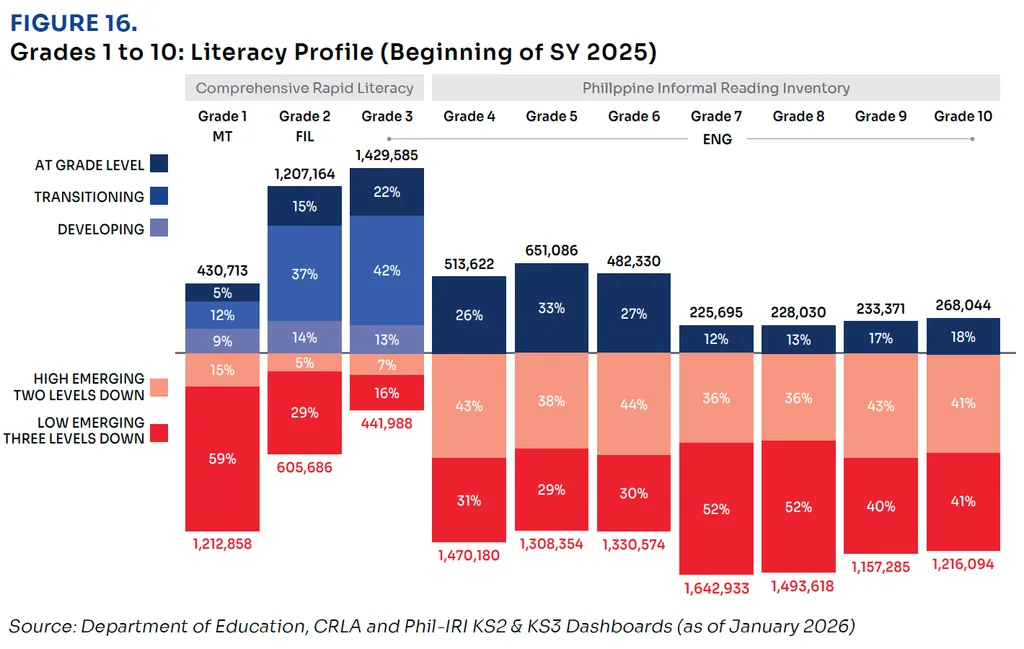
The Remaining Report of the Second Congressional Commission on Education (EDCOM 2), launched on Monday, January 26, confirmed that the proportion of struggling readers is at 88% in Grade 7, or the primary 12 months of junior highschool.
EDCOM 2 additionally famous that 40% to 52% of all junior highschool college students “are not less than two grade ranges down in studying.”
The fee’s findings had been based mostly on knowledge from assessments carried out by the Division of Schooling (DepEd).
“Regardless of highschool attendance and close to common early childhood participation, the system continues to wrestle with guaranteeing that years of education translate into precise mastery of fundamental literacy,” EDCOM 2 mentioned.
Within the Philippines’ Okay to 12 system, kindergarten to Grade 3 comprise Key Stage 1, which focuses on foundational expertise. The nationwide aim is for youngsters to be literate by the tip of Grade 3, to make sure that they don’t fall behind in later phases of education.
Reaching that aim could be an uphill battle, because the DepEd’s Complete Speedy Literacy Evaluation confirmed 48.76% or almost half of scholars from Grades 1 to three not studying at their respective grade ranges on the finish of college 12 months 2024-2025.
From early childhood to maturity
Many may additionally carry the burden of illiteracy into maturity. The Philippine Statistics Authority’s 2024 Purposeful Literacy, Schooling, and Mass Media Survey (FLEMMS) confirmed that almost 30% of Filipinos aged 10 to 64 are functionally illiterate, or have problem with comprehension.
“Being functionally illiterate means struggling to observe written directions, compute fundamental bills, learn remedy labels, or full kinds required for employment or public companies. These deficits translate immediately into diminished company and restricted participation in civic and financial life,” EDCOM 2 mentioned.
In an analytical piece printed on Rappler in Might 2025, EDCOM 2 Government Director Karol Mark Yee had written that the literacy disaster “is a problem to our nationwide survival.”
“It’s deeply associated to malnutrition, impacts alternative and productiveness, and perpetuates cycles of poverty,” Yee wrote.
Apparently, the problem has additionally existed for not less than a century. Yee identified within the newest EDCOM 2 report that 100 years in the past, a authorities evaluation already confirmed poor literacy amongst Filipino college students.
“The 1925 Monroe Survey warned that solely 40% of Grade 4 kids may learn on the anticipated degree, and pointed to weak trainer preparation, an overcrowded curriculum, and the persistent drawback of rural communities,” Yee mentioned.
This was adopted by related assessments in 1960 that “uncovered deep inequities,” and in 1991, when EDCOM 2’s predecessor EDCOM 1 “declared the system ‘in a state of disaster.’”
What now, many years later?
As a part of its Remaining Report, EDCOM 2 offered the Nationwide Schooling Plan (NatPlan), a 10-year roadmap for 2026 to 2035 that seeks to deal with the issues which have lengthy plagued the sector.
The NatPlan identifies the purposeful literacy of early learners as one of many key precedence areas, and offers the next suggestions to develop this particularly:
- “Tackle classroom backlog and congestion in faculties”
- “Revise procurement pointers and DepEd insurance policies to make sure full and well timed supply of textbooks”
- Present web entry and digital assets
- “Finish ‘mass promotion’ in faculties” or the apply of letting learners advance to the following degree regardless of low mastery; absolutely implement the Educational Restoration and Accessible Studying (ARAL) Program
- “Cut back administrative burden on academics”
EDCOM 2 did word that the ARAL Program, established by means of Republic Act No. 12028 in October 2024, has had “early wins” in offering free tutorials and assets to struggling Okay to 10 learners.
At Malanday Elementary Faculty in Marikina Metropolis, as an example, college students from Grades 1 to three categorized as “Growing, Transitioning, and Grade-Degree Prepared” jumped from 57.26% at the beginning of college 12 months 2025-2026 to 94.03% by the center of the college 12 months.
Underneath the NatPlan, EDCOM 2 hopes to extend the proportion of Key Stage 1 learners studying at grade degree from lower than 50% to 75% by 2028, 90% by 2031, and 95% by 2035.
Additionally it is focusing on grade-ready Grade 10 college students who had been assessed in Filipino to extend from 42.1% to 57% by 2028, 72% by 2031, and 87% by 2035. For individuals who had been assessed in English, the aim is to convey up the determine from 18.1% to 33% by 2028, 48% by 2031, and 63% by 2035. – Rappler.com
https://weblog.passive-income4u.com/create-your-very-own-auto-publish-news-blog-site-and-earn-passive-income-in-just-4-easy-steps/
https://www.rappler.com/philippines/filipino-students-literacy-crisis-edcom-2-report-january-2026/