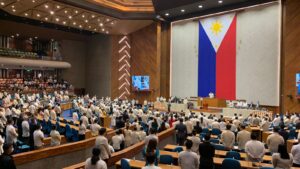
On high of its tattered fame these days, the current composition of the Senate is one compelling cause why Congress should lastly go the long-delayed anti-political dynasty regulation.
4 pairs of siblings sitting as incumbent senators basically put 4 households answerable for one-third of the 24-member Senate, which, not like the Home, whose members are elected per congressional district, represents a nationwide constituency.
Certainly, a nation of greater than 116 million Filipinos deserves wider illustration within the highly effective legislative physique than a handful of politically or financially influential households whose dad and mom and/or siblings take turns or serve concurrently each electoral time period.
That travesty of concentrated energy by the hands of some dynastic households grew to become evident because the Senate hit its lowest level earlier this month, due to a management change led by a brother-and-sister tandem, an alleged “shootout” courtesy of the Senate’s personal safety, adopted by the escape of a senator needed by the Worldwide Legal Courtroom.
Bastion of political dynasties
After all, the larger Home has lengthy been the bastion of political dynasties, the very cause why no enabling regulation has been handed to implement the 1987 Structure’s mandate to ensure equal entry to alternatives for public service by prohibiting political dynasties.
In line with the Philippine Middle for Investigative Journalism, eight in 10 members of the Home belong to dynasties. A 2015 research by the Philippine Institute for Improvement Research cited estimates that political dynasties managed 85 % of elected provincial governors, 75 % of vice governors, 74 % of district representatives, and 66 % of mayors.
Thus, the approval of the Home invoice prohibiting political dynasties is nothing in need of a miracle, marking the primary time since 1987 that the measure got here nearer to being enacted into regulation. The Senate has but to go its model.
Following months of debates and public consultations, the Home accepted (on second studying final week and third and ultimate studying on Monday) Home Invoice No. 8389, which prohibits spouses and family as much as the second diploma of consanguinity or affinity from concurrently operating for or holding elective posts on the nationwide, provincial, metropolis, and municipal ranges.
A cautious steadiness
Lanao del Sur 1st District Rep. Zia Alonto Adiong, chair of the Home committee on suffrage and electoral reforms, who sponsored the invoice’s approval, mentioned Congress might not afford to disregard the constitutional directive after practically 4 many years of failure to go the availability’s enabling regulation.
“Right now, now we have the chance to make historical past. Right now, we fulfill a long-standing constitutional mandate, 40 years within the making,” Adiong mentioned of the consolidated measure, principally authored by at least Speaker Faustino “Bojie” Dy III and Majority Chief Ferdinand Alexander “Sandro” Marcos and 173 members as coauthors.
President Marcos has formally urged Congress to fast-track the passage of an anti-dynasty regulation as among the many reforms to deal with the multibillion-peso flood management corruption he uncovered in his State of the Nation Deal with earlier than Congress in July final yr.
However whereas HB 8389 was overwhelmingly accepted, it fell in need of expectations for a real and efficient anti-dynasty regulation that might prohibit political clans from dominating political positions and perpetuating themselves in energy. Whereas a few of the payments referred to as for prohibiting family as much as the fourth diploma of consanguinity and to cowl extra positions, Adiong mentioned the committee settled for second-degree prohibition to strike “a cautious steadiness between reform and democratic rules.”
‘Logistical nightmare’
“Our activity will not be merely to put in writing essentially the most restrictive definition attainable. Our accountability is to craft a definition that’s constitutional, workable, and able to withstanding scrutiny right here in plenary session and within the courts,” Adiong mentioned.
Citing knowledge from the Fee on Elections (Comelec), Adiong mentioned as many as 5,000 elective positions could be vacated by political dynasties if the Home invoice is handed into regulation.
Adiong mentioned banning family as much as the fourth diploma could be a “logistical nightmare” for the Comelec. The Congressional Coverage and Funds Analysis Division of the Home estimated that with 43,033 people who filed certificates of candidacy within the 2025 elections, the second-degree restriction underneath the Home invoice would require the processing of about 946,726 further paperwork, whereas a fourth-degree ban might increase that quantity to greater than 2.84 million paperwork.
There’s certainly a lot to be desired in having an anti-dynasty regulation that might finish the dominance and function of political dynasties in perpetuating poverty and dangerous governance within the nation. However our political system is solely not prepared for that sacrifice.
If in any respect, the Home invoice may very well be thought-about a viable first step towards that final aim of lastly ridding ourselves of those monsters dragging our nation’s progress and draining our coffers for his or her egocentric ends.
https://weblog.passive-income4u.com/create-your-very-own-auto-publish-news-blog-site-and-earn-passive-income-in-just-4-easy-steps/
https://opinion.inquirer.web/191932/a-compromise-anti-dynasty-bill