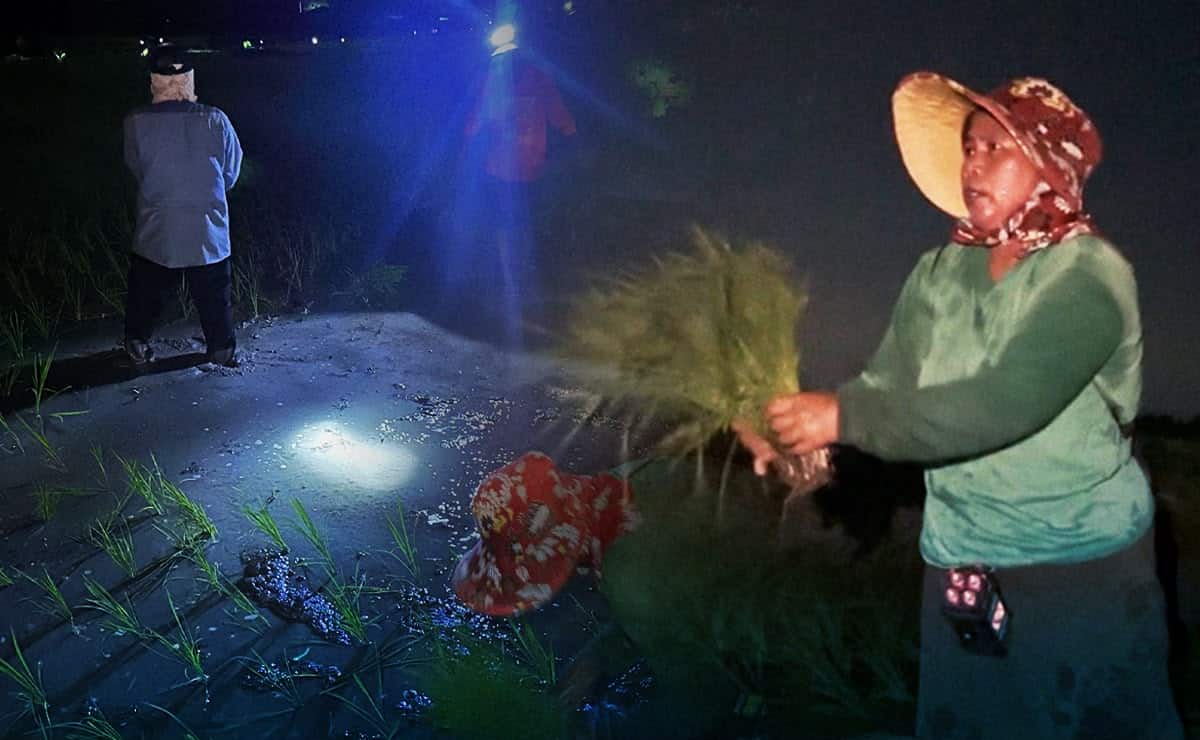
MANILA, Philippines — Lengthy earlier than dawn, when most Filipinos are nonetheless asleep, 47-year-old Marlyn Pascua is already knee-deep in a rice discipline in Alicia, Isabela.
For Pascua and dozens of fellow farmworkers, the workday begins not at daybreak however shortly after midnight.
As early as 4 p.m., she goes to mattress to get sufficient relaxation earlier than waking up at round 11 p.m. By 1 a.m., she and 29 different farmers are already transplanting rice seedlings throughout the huge fields of Barangay Salvacion.
“Agraraep kamin (We begin planting the seedlings),” they instructed the Inquirer, explaining that some employees even start as early as 11:30 p.m. to maximise the cooler hours earlier than dawn.
For Pascua, this schedule has turn out to be a necessity moderately than a selection.
She has spent 4 a long time working in rice fields, having began serving to her household farm when she was simply 7 years previous. Through the years, she has watched the warmth turn out to be more and more insufferable.
“The warmth is not bearable. That’s the reason we make the most of the cooler climate from midnight till early morning, till round 7 a.m.,” she stated whereas strolling throughout the fields below the night time sky.
“In the event you work at noon, you turn out to be dehydrated, your blood stress rises, and your physique turns into weak,” Pascua stated, including that what farmers worry most is struggling warmth stroke.
Though the Philippine Atmospheric, Geophysical and Astronomical Providers Administration has stopped issuing day by day warmth index bulletins following the official onset of the wet season, the warmth index in Echague, Isabela, nonetheless reached the “hazard” stage of 42 levels Celsius on July 2.

READ: Pagasa pauses heat index forecasts amid rainy season onset
Regardless of working via the night time to keep away from excessive warmth, the pay stays meager.
For each hectare planted, Pascua and 29 different employees divide a complete fee of solely P10,000. In the event that they end one hectare throughout their shift from 1 a.m. to 7 a.m., every farmer takes house round P333.
That actuality displays a wider battle confronted by Filipino farmers.
Based on the Philippine Statistics Authority, farmers and fisherfolk recorded the nation’s second- and third-highest poverty incidences in 2023, at 27 p.c and 27.4 p.c, respectively. Indigenous peoples posted the very best poverty incidence at 32.4 p.c.
READ: When those who feed the nation are the poorest: Farmers, fisherfolk in deepest poverty pit
Earlier than indigenous peoples had been categorized as a separate sector, nonetheless, fisherfolk and farmers constantly ranked because the nation’s poorest teams, with poverty charges of 30.6 p.c and 30 p.c, respectively.

READ: Fisherfolk, farmers, rural communities poorest in 2021 — PSA
For Pascua, the lengthy hours, harmful warmth and low wages are compounded by one other burden: working land they don’t personal.
She stated farmers like her have remained landless all through their lives and urged the federal government to increase extra help not solely to landowners but in addition to those that until the soil.
Her attraction echoes the long-standing place of former Agrarian Reform Secretary Rafael Mariano, who stated the poverty endured by Filipino farmers and fisherfolk is rooted in centuries-old landlessness.
READ: Day of the Landless: The failed promises of land reform in PH
Mariano, who beforehand chaired the Kilusang Magbubukid ng Pilipinas (KMP), instructed the Inquirer that wealth from agriculture continues to move to a small variety of landowners and firms whereas rural employees cope with worsening landlessness, land grabbing and the results of worldwide meals and financial crises.
He additionally famous the rising dominance of huge firms in agriculture, citing mega-mergers and multibillion-dollar offers involving corporations that management seeds, fertilizers, agrochemicals, farm equipment and meals manufacturing.
“We now have seen mega-mergers and multi-billion offers between corporations which have management over the worldwide seed market, agrochemicals, fertilizers, farm gear and equipment, and all the chain of meals manufacturing,” Mariano stated.
“Conglomerates are actually among the many world’s largest meals producers. They’ve made a worthwhile empire whereas trampling upon the lives and livelihoods of farming households and rural folks,” he added. /dm
https://weblog.passive-income4u.com/create-your-very-own-auto-publish-news-blog-site-and-earn-passive-income-in-just-4-easy-steps/
https://newsinfo.inquirer.internet/2256612/as-heat-worsens-isabela-farmers-shift-work-to-midnight