BAGUIO CITY, Philippines – Lengthy earlier than smartphones might warn folks about earthquakes, earlier than satellites tracked storms, and earlier than digital sensors quietly streamed knowledge the world over, a hill overlooking Baguio had already begun listening to the Earth and watching the skies.
For practically 120 years, Mirador Hill has been dwelling to one of many Philippines’ oldest earthquake remark websites. Hidden contained in the Mirador Jesuit Villa, the seismic station has survived warfare, reconstruction, technological revolutions, and even the devastating July 16, 1990, Luzon earthquake that crippled a lot of town.
Right this moment, the devices have modified.
The mission has not.
“The Mirador seismic station occupies a distinguished place within the historical past of Philippine science,” stated the Rev. Jose Quilongquilong, S.J., rector of Loyola Vista de Baguio, previously often called the Mirador Jesuit Villa and Retreat Home.
“It symbolizes the long-standing Jesuit dedication to integrating science, religion, and public service.”
A lookout with a scientific mission
That dedication traces its roots to the flip of the twentieth century.
Formally often called the Baguio Home of Retreats of St. Joseph, the Mirador Jesuit Villa stands on a hill as soon as named El Mirador, or “the lookout,” by Spanish colonial official Don Manuel Scheidnagel due to its commanding views of Lingayen Gulf, La Union, and what’s now often called the West Philippine Sea.
Quilongquilong stated Jesuit leaders had envisioned establishing a mountain sanatorium in Benguet as early as 1890, believing the cool local weather would assist restore the well being of missionaries serving within the tropics. The Philippine Revolution delayed these plans, however underneath the American colonial authorities, the Manila Observatory finally established a meteorological and seismic station on Mirador Hill within the early 1900s.
Its elevated location, secure geological setting, and panoramic view made it a perfect website for observing earthquakes and climate, extending the Manila Observatory’s scientific work past Manila.
The station grew to become the observatory’s northern subject website, increasing what was already considered considered one of Asia’s main scientific establishments. Based in 1865, the Manila Observatory pioneered analysis in meteorology, astronomy, geomagnetism, and seismology lengthy earlier than catastrophe science grew to become a part of authorities planning.
For engineers, navigators, scientists, and finally catastrophe managers, Mirador quietly provided knowledge that helped clarify how the Earth behaved.
Then got here July 16, 1990.
The earthquake that overwhelmed the machine
When the magnitude 7.7 Luzon earthquake struck, the observatory’s mechanical seismograph shook so violently that it will definitely failed.
However not earlier than doing its job.
The instrument managed to document the earthquake’s essential first moments, permitting scientists to triangulate the epicenter along with knowledge from the Manila Observatory in Loyola Heights and different stations within the nation’s seismic monitoring community.
The paper seismogram confirmed violent oscillations for greater than 20 seconds earlier than the recording needle was thrown off the rotating drum.
The machine grew to become one other casualty of the earthquake. Its document grew to become a part of Philippine earthquake historical past.
From paper drums to nanometers
The outdated mechanical recorder has since given method to a sensor that appears deceptively easy. Positioned atop a secure pedestal is a Nanometrics Trillium 120PA broadband seismometer, roughly the dimensions of a bike helmet.
A small signal beside it reads:
“PHIVOLCS Seismic Sensor. Please Don’t Contact.”
Not like the cumbersome mechanical devices of the previous, the trendy sensor repeatedly data floor movement digitally. “It could possibly detect actions as small as a nanometer,” Quilongquilong stated. “A nanometer is about 100,000 occasions smaller than the diameter of a human hair.”

The instrument data movement alongside three axes, permitting scientists to detect close by earthquakes, distant earthquakes, and even the Earth’s fixed background vibrations.
Its knowledge are transmitted repeatedly to the Manila Observatory, DOST-PHIVOLCS, and worldwide seismic monitoring networks.
Even energy interruptions don’t cease the station. The instrument operates on a devoted photo voltaic backup system whereas consuming little or no electrical energy.
A scientific mission that by no means left
Many assumed Mirador’s scientific function ended when the Manila Observatory transferred its primary headquarters to Loyola Heights in Quezon Metropolis in 1962. It by no means did.
Quilongquilong stated Mirador continued internet hosting seismic, photo voltaic, and geomagnetic remark stations as a result of its location remained priceless for long-term geophysical monitoring.
After World Struggle II destroyed a lot of the unique Manila Observatory, Mirador additionally grew to become one of many principal websites the place Jesuit scientific work was rebuilt.
When the current advanced was constructed between 1951 and 1952, a devoted wing was designed for the observatory, full with a separate public entrance so scientific work might proceed with out disrupting the Jesuit group.
The hill additionally carries one other chapter of Jesuit historical past.
In 1952, Jesuits expelled from Communist China relocated Bellarmine School, a home of theological research initially based in Shanghai, to Mirador. The establishment remained there till 1967 earlier than finally turning into a part of Fu Jen Catholic College in Taiwan.
“It grew to become a spot of refuge, studying, and continuity for Jesuits displaced from China,” Quilongquilong stated.
Trying past the Earth
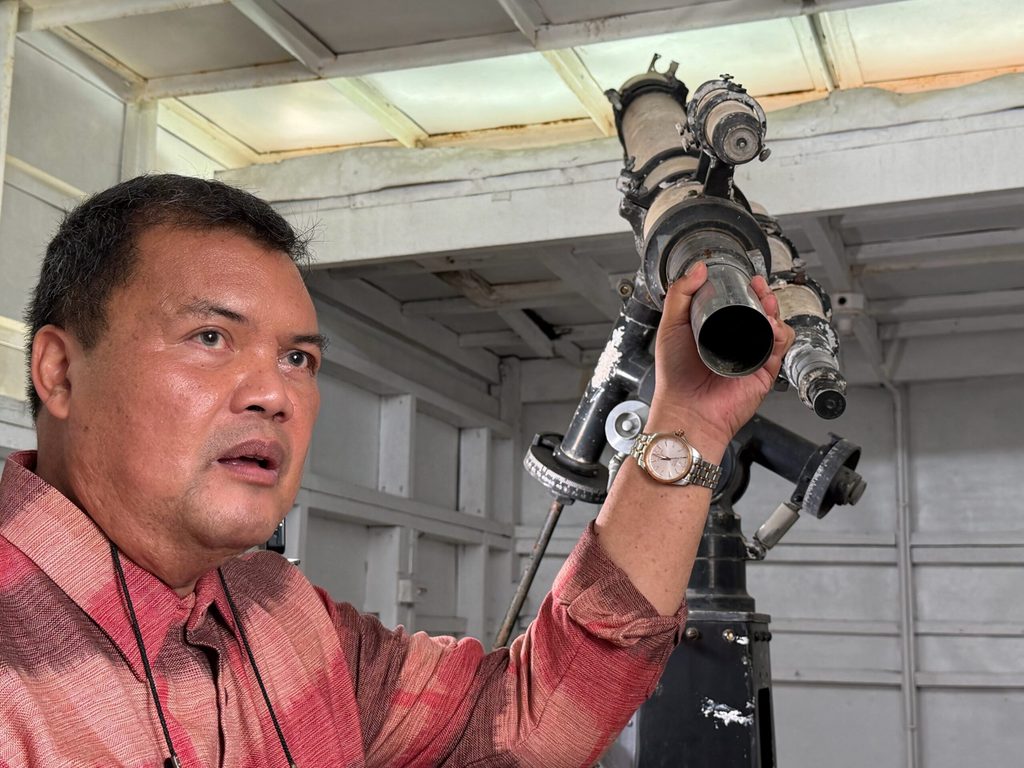
Mirador’s scientific work was by no means confined beneath the bottom. Contained in the outdated climate station stands an astronomical telescope that is still operational greater than a century after the observatory first started learning the skies.
The telescope as soon as fashioned a part of the Manila Observatory’s broader scientific mission, which mixed meteorology, astronomy, seismology, and geomagnetism to raised perceive the pure world.
Time, nonetheless, has introduced a brand new problem.
“The telescope remains to be working,” Quilongquilong stated. “However its vary and viewing high quality have been affected by town’s mild air pollution.”
As an alternative of the darkish mountain skies that early Jesuit scientists as soon as noticed, the telescope now seems to be out over the glow of an increasing metropolis. Even so, Quilongquilong stated native residents have expressed curiosity in serving to protect and revive the telescope so future generations can proceed exploring the night time sky from Mirador.
Science, religion, and heritage on one hill
Right this moment, Mirador is greatest identified to many guests for its heritage park, meditation areas, and the Lourdes Grotto in-built 1913. But beneath the pine bushes and above town’s skyline lies one other legacy.
Few locations within the Philippines deliver collectively science, spirituality, ecology, schooling, and cultural heritage in a single panorama. That historical past was formally acknowledged in 2018 when the Nationwide Museum of the Philippines declared the Mirador advanced, together with the Lourdes Grotto, an Vital Cultural Property.
The scientific custom additionally continues to evolve.
In 2024, the Manila Observatory, DOST-PHIVOLCS, and Academia Sinica of Taiwan put in a brand new era of seismic devices at Mirador, reaffirming the positioning’s contribution to earthquake science greater than a century after the primary devices have been positioned on the hill.

The cumbersome paper-drum recorder that documented the 1990 earthquake now belongs to historical past. Its successor has no transferring pen, no sheets of paper, and nearly no sound.
Close by, the telescope nonetheless factors towards the heavens, ready for darker skies.
Collectively, they inform the story of a spot the place Jesuits have spent greater than a century learning each the Earth beneath their ft and the skies above them.
For practically 120 years, Mirador has remained true to the that means of its title. It’s greater than a lookout over Baguio. It is without doubt one of the nation’s quietest witnesses to the forces that proceed to form each our planet and our understanding of it. – Rappler.com
https://weblog.passive-income4u.com/create-your-very-own-auto-publish-news-blog-site-and-earn-passive-income-in-just-4-easy-steps/
https://www.rappler.com/science/mirador-baguio-jesuits-earthquake-observation/