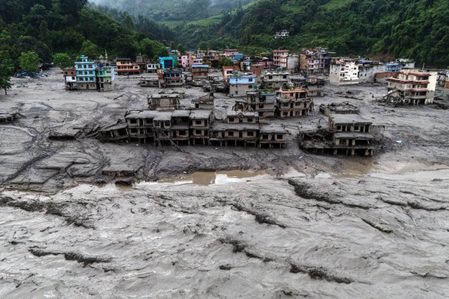
KATHMANDU, Nepal – Three months earlier than a wall of water, mud and rock killed lots of when it hurtled down a Himalayan valley bordering Nepal and China, specialists and officers from each international locations met in Kathmandu to debate the danger of such disasters.
On the Might 27 assembly in Nepal’s capital, 10 officers from Nepal and a couple of dozen from China, together with the Tibet area the place the catastrophe struck, mentioned strengthening cooperation to watch and reply to floods, climate and glacier-related hazards, based on an agenda ready by the Nepali aspect and seen by Reuters.
The individuals referred to as for joint risk-reduction measures, together with inventories of glacial lakes and hazard mapping.
However two Nepali officers informed Reuters they didn’t obtain as a lot data as they wished from China on glacier dangers and water ranges after the assembly and so they feared inadequate information sharing might hamper their potential to anticipate and put together for main disasters.
“What we really wished from them, and nonetheless need, is that if there are early actions of glaciers and early actions round that space, we might wish to know a bit early,” mentioned Sauhardra Joshi, a hydrologist at Nepal’s Flood Forecasting Division, who was within the Might assembly.
China says its data-sharing has been ‘well timed’
No officers or specialists have blamed both aspect for the pure catastrophe, which can price an estimated tenth of Nepal’s annual financial output to get well from. Nepali officers say the precedence is to deepen cooperation with China.
China’s overseas ministry didn’t reply to a request for touch upon the Might assembly or on Nepal’s request for added data sharing.
On the assembly, the Chinese language mentioned they didn’t have the mandate to signal an settlement to fulfill Nepal’s requests, asking for additional discussions, mentioned Binod Parajuli, one other Nepal authorities hydrologist.
Particulars of the assembly and Nepal’s calls for for broader cooperation in monitoring the glaciers that threaten communities on each side of the border haven’t beforehand been reported.
China’s embassy in Nepal mentioned in a press release on X on Saturday that Beijing and Kathmandu had stored in shut contact on the problem and had made “substantial progress” on the assembly in Might on selling cross-border catastrophe data sharing.
Nepal raised related considerations final 12 months, officers mentioned, although specialists and officers cautioned that what they describe as gradual progress was not a big issue within the newest catastrophe, through which a glacier collapse unleashed a catastrophic mudslide that has killed almost 800 folks in each international locations and left greater than 3,000 lacking, by the most recent depend.
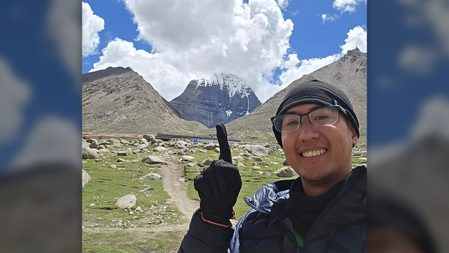
Rejecting criticism from some Nepali social media customers that China had failed to offer sufficient warning, the Chinese language embassy mentioned Chinese language and worldwide specialists confronted important challenges monitoring hazards within the distant Himalayan area.
Chinese language groups had shared essential data with Nepal “in a well timed method,” it mentioned.
Ultimately 12 months’s assembly, Nepal raised considerations a couple of flood in the identical space, triggered by the sudden launch of water from a glacial lake in Tibet that killed a minimum of 9 in Nepal and left greater than a dozen lacking.
“When the Chinese language aspect sees a heavy precipitation forecast within the Tibet space, then they supply us that forecast and people observations,” Parajuli mentioned. However “not for avalanche and water degree, landslides, excessive occasions.”
China started sharing forecasts of heavy rain in Tibet over China’s WeChat messaging app and e mail a month in the past, Parajuli mentioned.
Timeline to calamity
Twelve days earlier than the catastrophe, China’s World Meteorological Centre informed Nepali officers in an e mail, seen by Reuters, {that a} monsoon melancholy was forecast for the world from August 14 to 19.
“Enhanced rainfall is probably going throughout a lot of Nepal, and we want to draw your consideration to the potential for secondary and cascading hazards, together with however not restricted to landslides and flash floods,” China warned.
The Chinese language embassy mentioned China has been sharing data together with monitoring information on a lake fashioned by particles from final week’s calamity.
The discussions over data-sharing underline the complexity of monitoring, forecasting and offering early warning in a area the place regional geopolitical rivals – together with China and India – management distant mountainous areas holding huge portions of ice and snow that loom over densely populated South Asian plains.
Wednesday’s disaster was sparked by the collapse of the glacier in a comparatively unmonitored space, and a scarcity of bilateral cooperation was not a big think about Nepal’s response, based on environmental anthropologist Austin Lord, senior fellow on the Washington-based Stimson Heart assume tank.
“That’s to not forgive the truth that there isn’t actually a well-articulated system. And there may be very restricted change between Nepal and China,” mentioned Lord, who’s a part of a workforce supporting Nepal’s authorities on catastrophe and local weather danger administration.
“Chinese language scientists have a a lot better capability, have a lot better sources for monitoring than these on the Nepal aspect general.”
The time that the torrent took to succeed in Nepal exhibits the worth of early-warning techniques, Parajuli mentioned.
Round 8:32 am Nepal time on Wednesday, the deluge blasted by way of a border crossing in Tibet as folks tried to flee, based on surveillance footage that has turn out to be a defining picture of the catastrophe.
Twenty-six minutes later, Parajuli obtained a name from the chief of Nepal’s Nationwide Catastrophe Danger Discount and Administration Authority, alerting him to a flood on the Trishuli river. Parajuli’s workforce discovered {that a} border monitoring station had not transmitted any information since 8:40 am.
“We additionally then tried to contact downstream stations, however downstream stations additionally couldn’t publish the info,” leaving the workforce to suspect these units had been washed away, he mentioned.
After contacting native Nepali authorities to verify the flooding, Parajuli mentioned, his workforce despatched a public alert to cell phone customers at 9:13 am.
No less than 4 monitoring stations have been destroyed by the flood that rampaged 168 km downstream from the Nepal-China border, carrying some 57.4 million cubic meters of water, greater than half once more as a lot as regular, based on a Nepali authorities evaluation.
‘Large gush of mud coming straight at us’
Surging floodwaters, which dislodged large boulders and pulled massive buildings into the overflow, broken 19 bridges and a few 40 km of freeway, and knocked out greater than 10% of Nepal’s power-generation capability, based on the Stimson Heart.
“It wasn’t water. It was an enormous gush of mud coming straight at us,” mentioned Keshav Prasad Baral of Tupche village, about 25 km downstream of the border. “I attempted to seize my spouse’s hand, however she was swept away by the mud.”
When a part of the glacier broke away, crashing to the valley flooring lots of of meters beneath, it unleashed high-speed flash floods, based on preliminary assessments by Nepali authorities.
The Hindu Kush Himalayas, dwelling to lots of of tens of millions of individuals from Afghanistan to Myanmar, include the world’s largest quantity of ice outdoors the poles, with greater than 63,700 glaciers overlaying almost 56,000 sq. km, nearly the scale of Croatia, and storing as much as 5,700 cubic km of ice.
By comparability, the glacier chunk that triggered the most recent catastrophe carried an estimated 5 million cubic meters of ice and rock, based on Basanta Raj Adhikari, director of the Centre for Catastrophe Research at Nepal’s Tribhuvan College.
Pushed by local weather change, glacier soften is accelerating as snow cowl declines and snowfall turns into extra erratic, based on a 2023 examine by the Worldwide Centre for Built-in Mountain Improvement.
These modifications will improve the probability of floods and landslides, as mountain communities additionally take care of such hazards as sedimentation and erosion, the middle initiatives.
A number of of Nepal’s main river techniques originate in Tibet, then circulation by way of one of many world’s most seismically energetic and flood-prone areas.
Nepal’s authorities will search to work with China to conduct analysis and construct techniques to watch avalanches and the discharge of water from glacial lakes – main dangers for mountain communities – Parajuli mentioned.
He mentioned his division will suggest a data-sharing settlement with China, alongside the traces of an association that Nepal has with neighboring India, for extra frequent data on precipitation and river ranges, not simply high-precipitation forecasts.
Nepal will search information each 10 minutes in order that “we are able to warn our folks, save our folks,” he mentioned. “Our important goal is we shouldn’t miss any future catastrophe.” – Rappler.com
https://weblog.passive-income4u.com/create-your-very-own-auto-publish-news-blog-site-and-earn-passive-income-in-just-4-easy-steps/
https://www.rappler.com/world/asia-pacific/flood-catastrophe-nepal-asked-china-early-warnings-risks-mounted/