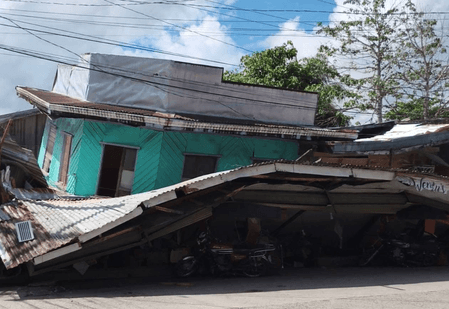
Support teams working within the worst-hit areas of Malapatan and Glan say there’s an pressing want for shelter, meals, and water, however broken roads and bridges proceed to hamper aid operations and delay the supply of help to remoted areas
ALABEL, Sarangani – When the magnitude 7.8 earthquake struck Southern Mindanao, 63-year-old Fe Rotante was attending to a buyer at a public market in Poblacion of Malapatan, the place she has bought greens for years.
The bottom immediately shook.
“I am sorry. We have been crawling on the street (I used to be terrified. We needed to crawl our means alongside the street.),” Rotante recalled.
Fearful {that a} tsunami would strike, Rotante rushed dwelling in Barangay Pananggalon, a coastal village in Malapatan situated about 5 kilometers from the city heart.
Like tons of of different residents in coastal communities, Rotante spent hours anxiously ready for updates whereas aftershocks as robust as magnitude 6.0 continued to shake the city.
However for Rotante, surviving the earthquake was solely the start.
As broken infrastructure and energy interruptions disrupted water techniques in Sarangani, residents discovered themselves lining up for water deliveries, counting on donations, or looking for various sources to satisfy their every day wants.
Two days after the quake, a provide of potable water delivered by way of a volunteer-led aid effort organized by the Sangguniang Kabataan of Poblacion, Alabel grew to become the primary protected consuming water her household had entry to in additional than 12 hours, she mentioned. Alabel city is sort of 40 kilometers from her village.
Queenie Anne Pag-Elion, a Ward councilor (village councilor), mentioned that a minimum of 5 homes of their district (village) have been completely destroyed by the earthquake, together with Rotante’s dwelling.
“After what we went by way of through the earthquake, we’re nonetheless afraid of the aftershocks. That’s why many selected to sleep outdoors on basketball courts and open fields,” Pag-elion mentioned in a mixture of English and Cebuano.
As of Tuesday, June 9, Apparable had recorded 10 deaths, 1,936 partially broken households, and 634 completely broken households. No less than 158 households have been staying in evacuation facilities, based on the native authorities information.
The extended energy outage additionally crippled water refilling stations in Malapatan. Even after energy was restored round midday on Tuesday, June 9, provides have been depleted inside hours.
“Largely to us right here than to the effectively that drinks,” mentioned Pag-elion. (Due to that, most of us right here ended up consuming from hand pumps.)
The local government of Malapatan continues to attraction for help as it really works to supply affected communities with potable and daily-use water, meals packs, and momentary shelter supplies.
However at the same time as support organizations and native officers mobilized sources, getting help into essentially the most affected communities proved tough.
Entry denied
Support teams working within the worst-hit areas of Malapatan and Glan mentioned there was an pressing want for shelter, meals, and particularly water. Nonetheless, they mentioned broken roads and bridges proceed to hamper aid operations and delay the supply of help to remoted areas.
Rodrigo Sosmeña, regional director of the Workplace of Civil Protection, mentioned on Tuesday, June 9, that Glan stays the worst-affected municipality in Sarangani. As of writing, the city has recorded 17 deaths, the best reported fatality depend within the province.
The broken transport community has compelled authorities and humanitarian teams to seek out various routes to ship support.
On Tuesday evening, June 9, the primary wave of aid packages from the Sarangani provincial authorities was transported by sea from GenSan Fish Port Advanced to Glan. Authorities mentioned the route was the most secure choice for reaching the municipality, which stays largely inaccessible by land.
For residents who dwell in far-flung areas, help has been even tougher to entry.
In Barangay Huge Margus Glan, a distant village about 40 kilometers from the city heart, the primary spherical of aid distribution from the native authorities had but to succeed in residents as of Wednesday, June 10, based on resident Charlie de Arce.
Confronted with delay, neighborhood members organized their very own donation drive to help households in essentially the most remoted elements of the barangay. However De Arce mentioned that the initiative faces challenges of its personal, noting that provides are restricted as shops in Glan have already begun operating low on important items.
Throughout Sarangani, related issues persist.
For Rotante, each supply of consuming water gives solely momentary aid. Days after the earthquake, she stays unsure the place her household’s subsequent provide of unpolluted water will come from as they proceed to attend for updates on the restoration of water providers.
As roads stay broken and support struggles to succeed in remoted communities, residents like Rotante proceed to attend for the following cargo of provides from the native authorities and volunteer teams.
The entire province is now under a state of calamityas declared by Sarangani Governor Rogelio Pacquiao right this moment, June 10, with response efforts targeted on the hardest-hit municipalities of Malapatan and Glan. – Rappler.com
Rey Mark Paran is a senior statistics pupil on the College of the Philippines Visayas. An alumnus of the Aries Rufo Journalism Fellowship of Rappler for 2025, he’s additionally the managing editor of sunrises.
https://weblog.passive-income4u.com/create-your-very-own-auto-publish-news-blog-site-and-earn-passive-income-in-just-4-easy-steps/
https://www.rappler.com/philippines/mindanao/sarangani-quake-survivors-struggle-safe-drinking-water/