Current information breaches have exposed private information throughout Philippine authorities businesses and personal corporations, making it extra essential than ever to remain alert to focused scams.
The Nationwide Privateness Fee has advised the general public to stay cautious about doable makes an attempt at phishing, smishing, and different scams which will come up after the wave of cybersecurity incidents within the nation.
In its State of Scams Report, the World Anti-Rip-off Alliance (GASA) discovered that 84% of Filipinos have encountered a rip-off this 12 months. This is a rise from 77% in 2025. The surveywhich had 1,160 Filipino grownup respondents, was performed from March 16 to April 13, 2026.
Understanding what a rip-off seems like is now not sufficient, as scammers have upgraded their strategies to catch you. Right here is how scammers attain you at this time.
E-mail messages
Together with your actual identify or account particulars, scammers can ship convincing faux promotions, receipts, password-reset prompts, and even account-suspension warnings.
Since emails mean you can improve your textual content with kinds, scammers can simply mimic official branding of presidency businesses, banks, and organizations to trick you into opening malicious attachments or clicking hyperlinks.

Your e mail service can usually detect whether or not a message is suspicious or not. However you will need to be careful for mismatched sender domains, uncommon requests, or surprising hyperlinks and attachments.
Social media and messaging apps
As extra telecommunication corporations tighten SMS filters, scammers have migrated to Fb, Instagram, Viber, Telegram, WhatsApp, and different social media platforms.
Once they acquire unauthorized entry to your social media accounts, they aim extra victims by impersonating you and sending suspicious direct messages (DMs) or hyperlinks to your contacts.
Some even casually ask how you might be and proceed to give you job alternatives or paid duties.
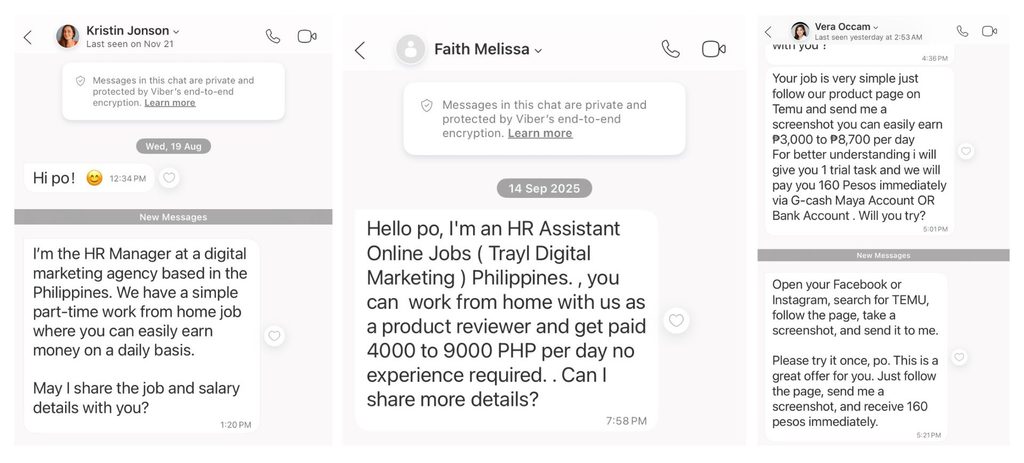
Be aware of participating with messages not solely from unknown contacts, but in addition out of your family members. Should you discover one thing suspicious, chances are you’ll use your on-line messaging app’s report and block choice.
Telephone calls
Scammers don’t solely use unknown numbers to contact you. They will spoof their caller ID to mimic banks, digital wallets, authorities staff, and courier corporations utilizing Voice over Web Protocol (VoIP).
It permits customers to make cellphone calls by way of an web connection as a substitute of an analog cellphone line, in keeping with the Federal Communications Commission.
Fraudsters make the most of VoIP to lure you into sharing delicate info by telling you that you’ve got unauthorized transactions or your account has been compromised. They trigger panic and urgency, to allow them to entry your account info.
Be cautious when answering cellphone calls from unknown numbers. Don’t share delicate account particulars or passwords, as banks and e-wallets won’t ever ask for these particulars, and scammers may also spoof caller IDs.
Grasp up and confirm whether or not a cellphone quantity is related to reputable establishments by checking their official channels or by looking this checklist of hotlines and telemarketing SIM numbers printed by native banks and e-wallets:
SMS and textual content messages
So GASA discovered that Filipinos largely expertise scams performed by means of textual content messages this 12 months.
Scammers used to ship spam texts to you thru an unknown cellphone quantity, which you’ll simply establish as suspicious.

However now they’ve discovered a workaround that doesn’t require your cellphone quantity to succeed in you: Worldwide Cellular Subscriber Id (IMSI) catchers.
These are surveillance units appearing as faux cell towers that may intercept your cell phone, entry your gadget’s location, and manipulate message threads by sending spoofed messages to you.
Such messages slip straight into your reputable message threads as a result of they’re undetected by telco spam filters as they bypass cell towers.

Cybersecurity advocacy group Rip-off Watch Pilipinas documented spoofed messages by means of IMSI catchers as early as 2024, in keeping with an investigative report by The Philippine STAR.
The Central Financial institution of the Philippines already launched Memorandum No. M-2022-015 in 2022, prohibiting banks from sending clickable hyperlinks by means of textual content, e mail, or messaging apps.
Should you obtain a textual content message with a hyperlink to your gadget, don’t click on it, since it might be a smishing rip-off.
The Canadian Centre for Cyber Safety additionally advised turning off the 2G community connection of your gadget, if the choice is offered.
Web sites
Not like texts or calls that interrupt you, faux web sites function the ultimate lure.
Fraudsters draw you in by means of a hyperlink in a spoofed SMS, a phishing e mail, a social media DM, or a sponsored search or social media advert. The purpose is so that you can land on a bogus web site that clones a banking portal, promo web page, or on-line retailer.
Even scanning QR codes can lead you to malicious web site hyperlinks hidden as a picture as a substitute of textual content till the web page masses.
These faux web sites usually spoof banking portals that require you to enter your login credentials, card particulars, or one-time PINs.
Earlier than clicking on any hyperlink, look intently on the internet deal with for unusual domains, misspelled or additional phrases, unfamiliar symbols, and numbers swapped for letters (e.g., 0 for O and 1 for l).
When scanning QR codes, verify first if the printed picture has indicators of tampering. You might also learn the hyperlink preview first earlier than accessing the location after scanning.
Additionally guarantee that you’ve got activated the built-in anti-phishing or malware safety options of your browsers and have turned on multi-factor authentication on your digital accounts.
Scammers can spoof cellphone numbers, clone web sites, or imitate cell towers. However they can not get by means of a consumer who stops to confirm first.
Should you encounter any on-line scams, chances are you’ll report them to the Cybercrime Investigation and Coordinating Middle by dialing 1326. – Rappler.com

https://weblog.passive-income4u.com/create-your-very-own-auto-publish-news-blog-site-and-earn-passive-income-in-just-4-easy-steps/
https://www.rappler.com/expertise/explainer-how-scammers-reach-you-with-or-without-your-data/