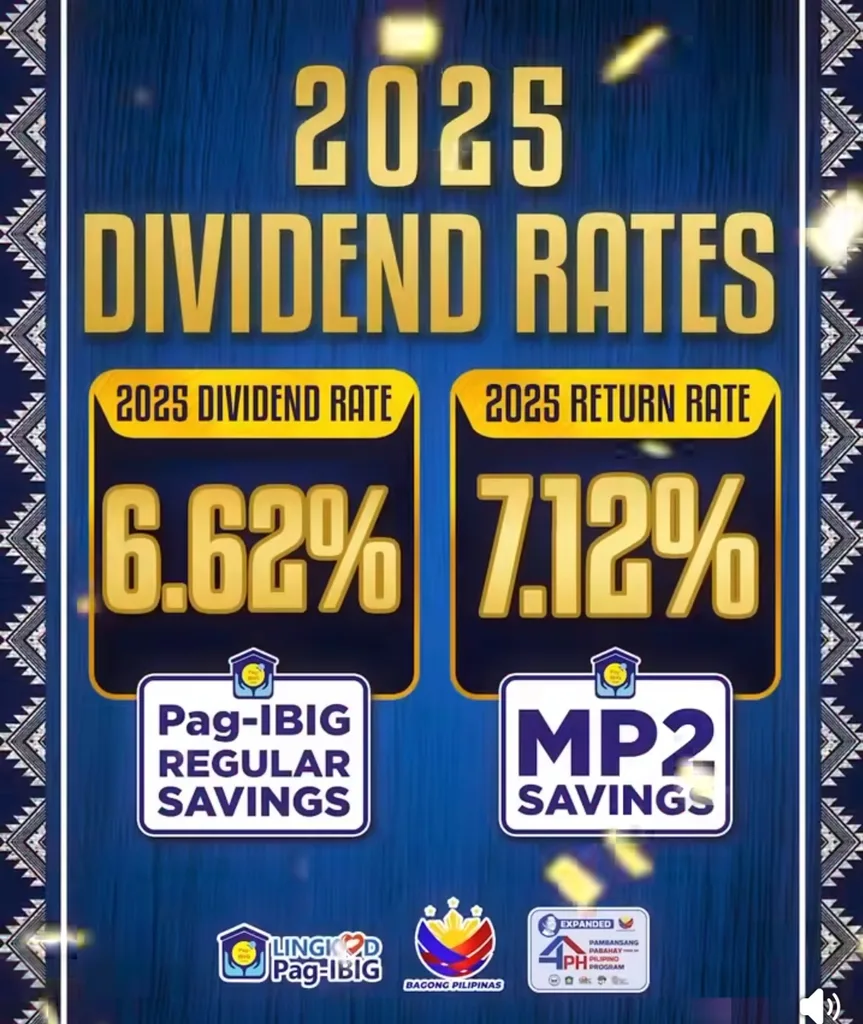
MANILA, Philippines – Pag-IBIG’s MP2 program sounds, at first look, prefer it belongs in the identical psychological drawer as deductions and authorities paperwork. Nevertheless it’s not a compulsory contribution; in reality, this voluntary financial savings product is likely to be among the best locations to park medium-term cash.
For 2025, Pag-IBIG declared an MP2 dividend charge of seven.12%, up from 7.10% the yr earlier than. Pag-IBIG additionally declared P64.34 billion in complete dividends for 2025, which it stated was the very best in its historical past.
If you happen to make investments in any respect, your first response might be that the speed seems superb. However let’s fastidiously unpack what this dividend charge really means and and the way a lot of that 7.12% are you able to really anticipate to maintain.
What the dividend charge really means
MP2 isn’t like a financial institution deposit, so it doesn’t pay curiosity the identical means your financial savings account does. Pag-IBIG calls MP2 earnings a dividend as a result of the speed is said after the yr ends, as soon as the fund’s web earnings has been calculated and authorised by the company’s board of trustees.
This additionally signifies that the dividend charge is versatile, so once you see 7.12%, consider it as solely the most recent declared outcome. It’s not a assured quote you’re locking in for future years. Subsequent yr’s dividend charge may be increased or decrease, relying on how Pag-IBIG performs.
How do you estimate what you may earn? Your dividend is mainly the declared charge multiplied by the cash you had sitting in MP2 through the yr. The sooner your cash is within the account, the extra of the yr it really counts.
Right here’s a pattern computation utilizing the declared 7.12% charge.
Assume you contribute P5,000 each month beginning January. Your end-of-year complete contribution is P60,000, however your steadiness didn’t sit at P60,000 for the entire yr. A easy option to estimate is to make use of your common month-to-month steadiness. Your month-to-month finish balances could be P5,000, P10,000, P15,000, and so forth, as much as P60,000 in December. Add these up (P5,000 x 78 = P390,000) then divide by 12 months to get a median steadiness of P32,500. Apply the dividend charge: P32,500 x 7.12% = about P2,314 in dividends for that yr.
If as an alternative you had positioned a lump sum of P100,000 in January and left it there for the yr, a tough estimate is easier: P100,000 x 7.12% = about P7,120 for the yr. Once more, that is an estimate, but it surely offers you the texture of the mathematics.
How is Pag-IBIG in a position to give a charge that top?
Let’s begin with what Pag-IBIG is. Formally, it’s the House Improvement Mutual Fund, mandated to generate financial savings by means of a nationwide membership system and mobilize members’ funds for housing functions.
The rationale MP2 can really feel unusually beneficiant is that Pag-IBIG will not be making an attempt to behave like a typical industrial financial institution that retains earnings for shareholders. Beneath its constitution, Pag-IBIG returns not less than 70% of its annual web earnings to members as dividends.
For 2025, Pag-IBIG stated it declared P64.34 billion in dividends, equal to a 98.6% payout ratio, on the again of P65.8 billion in web earnings.
The place does Pag-IBIG earn from? Principally, it earns the way in which a housing finance fund is meant to earn — from lending. The majority of Pag-IBIG’s earnings comes from the curiosity and collections on its housing mortgage portfolio, plus short-term loans like money loans to members.
Investing is a supporting income stream, although it’s nonetheless a significant one. On the investing aspect alone, Pag-IBIG reported P9.43 billion in funding earnings in 2025, with a big portion parked in authorities securities and the remainder positioned in time deposits, company bonds, and most well-liked shares.
It’s from this secure move of earnings that the company declares these MP2 dividends. Pag-IBIG is basically an enormous pooled fund that collects financial savings, lends a giant portion out by means of housing and member loans, invests the remainder conservatively, then shares again most of what it earns as dividends.
And sure, 7.12% is excessive relative to many secure benchmarks. For context, the Bureau of the Treasury’s reference charges confirmed the 5-year authorities yield round 5.555% as of February 26, 2026. MP2’s declared charge for 2025 sits noticeably above that, which is a part of why it will get a lot consideration when the dividend is introduced.
And people returns are tax-free
One more reason MP2’s returns hit tougher in actual life is that they’re tax-free. In 2025, the Division of Finance explicitly clarified that financial savings and investments in SSS, GSIS, and Pag-IBIG, together with MP2, remain tax-free.
That tax-free element issues greater than you may assume. Since July 2025, curiosity earnings from financial institution financial savings, bonds, and comparable preparations is mostly topic to a 20% tax. Meaning you successfully preserve simply 80% of the curiosity you earned. A time deposit marketed at 6% gross, for instance, is absolutely about 4.8% web after tax. Even a 5% charge turns into 4% as soon as that 20% tax takes its minimize.
With MP2, the dividend earnings are handled otherwise. The DOF has clarified that Pag-IBIG financial savings and investments stay tax-free, which implies the declared MP2 dividend charge is way nearer to what you really preserve, assuming you comply with the principles and let the account run its correct course.
So. can you actually earn as a lot as 7% in MP2? The trustworthy reply is sure, it occurred for 2025, and the return may be particulary compelling as a result of there’s no tax consuming into the payout. However simply bear in mind this can be a dividend declared after the actual fact, based mostly on Pag-IBIG’s precise efficiency, not a assured charge you possibly can rely on yearly. – Rappler.com
Lance Spencer Yu is a former enterprise journalist for Rappler. He later labored as a non-public capital analyst at MSCI, working immediately with sovereign wealth funds, pension funds, and household workplaces throughout the Asia-Pacific area. He now serves as an funding and technique analyst at Dedale Intelligence, producing in-depth, actionable analysis for personal fairness funds and institutional buyers.
Finterest is Rappler’s collection that demystifies the world of cash and provides sensible recommendation on managing your private funds.

https://weblog.passive-income4u.com/create-your-very-own-auto-publish-news-blog-site-and-earn-passive-income-in-just-4-easy-steps/
https://www.rappler.com/enterprise/finterest-things-to-know-pag-ibig-fund-mp2/