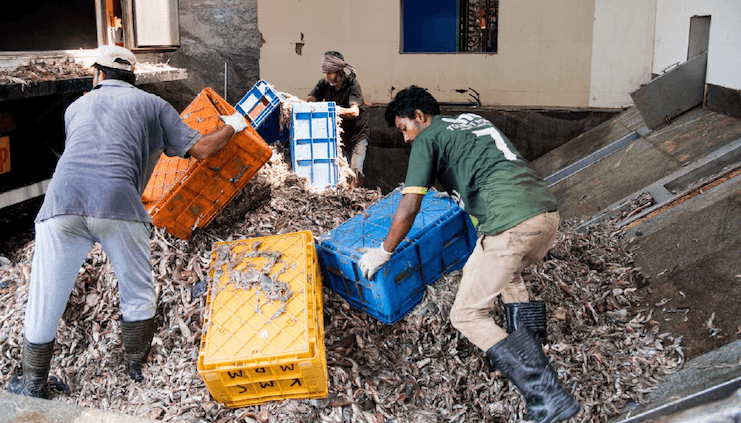
In Could 2025, a regional workplace of the Philippines’ fisheries company in Visayas introduced an initiative that might invite fishers to authorities conferences held to increase fish farming within the area.
Officers would introduce the fishers to ongoing fish breeding, processing, and distribution tasks as a part of a push to remodel the native financial system “from fish looking to fish farming.” They emphasised that this transformation would ease stress on the ecosystem.
“As a substitute of continually taking from the ocean, let’s attempt to domesticate fish and provides the ocean an opportunity to get well,” mentioned group improvement officer Joel Lutao.
However critics worldwide have questioned whether or not the follow of catching and lowering complete, contemporary fish to develop extra seafood can ever be thought of sustainable. The preferred varieties of farmed seafood — milkfish, tilapia, salmon, shrimp, and trout — are fed the varieties of untamed fish that aquaculture claims to be saving, thereby accelerating ocean depletion, not slowing it.
Two-thirds of worldwide aquaculture grows species which might be fed fishmeal and fish oil. Earlier than it reaches market, a farmed salmon, for example, eats at some farms greater than six occasions its weight in wild-caught fish.
The considerations about aquaculture prolong far past the destiny of the oceans. The feed that powers most of this business comes with an enormous number of different hidden prices, in response to a wide-reaching investigation by The Outlaw Ocean Projecta information group based mostly in Washington, DC.
These prices embody the lack of artisanal fishing jobs, continual chemical publicity, avoidable employee deaths, violent protests sometimes spurred by the horrid odor from fishmeal factories, and escalating geopolitical tensions as international locations compete for scarce sources of protein.
‘There’s no fish left right here’
What economists typically name “externalities,” these social and environmental impacts precise a worth primarily paid by the poorer international locations the place the feed ingredient is harvested and processed, removed from the place the ensuing luxurious seafood is eaten.
In The Gambia and Mauritaniathe investigation documented how the business drives meals insecurity, as fish that after sustained native communities are more and more being diverted into fishmeal factories for export.
In distant islands in Russia’s far east and in China’s Xinjiang area, the reporting detailed the usage of compelled labor on ships, at farms, and in factories.
In different international locations, together with India and Peruthis business was tied to a minimum of 80 incidents of civil unrest, a few of them violent, normally within the type of labor strikes and group protests sparked by the water air pollution or stench from factories cooking 1000’s of tons of decomposing fish, in response to Bait to Platean internet instrument that tracks the fishing and seafood industries.
In Senegalfishmeal has put native fishers out of labor, so more and more they’re promoting — or repurposing — their boats to flee to Europe, sometimes taking the roughly 930-mile sea journey to Spain’s Canary Islands, a route that claimed greater than 3,000 lives in 2025.
“We’re fishermen, however there’s no fish left right here, so we left,” mentioned Cheikhou Omar, a 21-year-old fisher, in September 2024 as he sat on a seaside in Senegal, rescued after the fishing boat he took attempting to get to Spain capsized, killing two dozen.
The five-year investigation mapped roughly all the international fishmeal business, together with greater than 1,400 fishmeal factories throughout 64 international locations, tracing provide chains from fishing vessels to processing vegetation, feed mills, fish farms, and seafood retailers. The reporting effort concerned dozens of journalists from as many international locations, visiting factories and farms and boarding fishmeal ships at sea.
Unsustainable fishing
The oceans bear an particularly heavy and largely invisible burden of the fishmeal and fish oil business. Greater than a fifth of wild-caught fish world wide is used for non-human consumption, particularly as feed for fish, but additionally chickens and pigs.
The investigation assessed greater than 2,400 ships tied to fishmeal manufacturing, working within the waters of a minimum of 30 international locations. It discovered that almost all of those ships don’t absolutely adjust to the International Constitution for Fisheries Transparency, a information created by main ocean-focused civil society teams detailing accountability requirements for industrial fishing fleets.
For instance, lower than 30% of the fleet had publicly accessible location info, and underneath 25% had a singular vessel identification quantity, or ship license plate. Such opacity makes the fleet tough to police.
Scientific research categorized a minimum of half of the species landed by the assessed fishmeal vessels as “overexploited” or worse. Many of the ships on this fleet are purse seiners or trawlers, which deploy huge nets to seize dense faculties of fish. Each gear varieties are related to excessive ranges of waste, routinely hauling in giant volumes of bycatch and non-target species.
A minimum of 165 of the ships within the international fishmeal fleet had been backside trawlers, conducting a very harmful type of fishing that makes use of weighted nets that scrape the ocean ground, destroying just about all the pieces of their paths.
The issue of unsustainable fishing is compounded by heavy authorities subsidies that hold too many vessels working, accelerating stress on already confused fisheries.
“Any accounting of the true impression of aquaculture has to start out not with the farm, however with the feed,” mentioned Daniel Pauly, challenge director of the Sea Round Us initiative at College of British Columbia. “And that form of accounting gives a really totally different image than the business gives.”
The issue with fishmeal
As commodities, fishmeal and fish oil promise to develop in worldwide significance.
Beginning in 2022, greater than half of the seafood eaten globally got here from fish farms slightly than wild catch. Aquaculture is a $313-billion business and the fastest-growing phase of worldwide meals manufacturing. Most of those fish farms are powered by fishmeal and fish oil.
Fishmeal processing within the Philippines is concentrated in three cities. The primary is the port metropolis of Navotas, generally known as the nation’s “fishing capital.” Positioned in Metro Manila on the island of Luzon, it has a minimum of one fishmeal plant.
The second is Zamboanga, a metropolis on the island of Mindanao thought to be the Philippines’ “sardine capital,” house to half a dozen fishmeal vegetation. The third is Common Santos. The nationwide “tuna capital,” it lies in Mindanao and hosts 4 fishmeal vegetation.
Many of those vegetation focus totally on processing seafood for human consumption, however additionally they redirect inedible offcuts into fishmeal. This follow is broadly cited as sustainable and socially useful, because it makes use of supplies that might in any other case be thrown away.
Subsequently, fishmeal manufacturing within the Philippines is much less of a driver of meals insecurity than it’s in different international locations that use complete edible fish. Nevertheless, the Philippines suffers from extreme meals insecurity due to normal overfishing and the export of most catch, be it small anchovies or bigger species like tuna.
The far better burden of meals insecurity, social unrest, and air and water air pollution is borne by the poorer international locations that produce the fishmeal or fishmeal-fed seafood the Philippines imports. The nation imported extra seafood than it produced as of 2023.
Half of all seafood globally is farmed, and most of that’s fed fishmeal. The fish farms in a number of of the international locations that export essentially the most seafood to the Philippines — together with China, VietnamPapua New Guinea, Chileand Japan — have ties to extreme issues attributable to fishmeal manufacturing, in response to the investigation.
Hidden prices
The investigation revealed a stunning variety of hidden prices within the international feed business.
In Senegal, fishmeal manufacturing accelerated overfishing, eroding conventional fishing grounds and contributing to 1000’s of younger males making an attempt lethal and determined voyages at sea to Europe.
In Russia, fishmeal employees had been held captive in secluded firm cities in distant components of the nation, or caught on ships removed from shore.
“Individuals have nowhere to go, no cash,” one employee mentioned in a plea to Russian President Vladimir Putin, who participated in an episode of a call-in tv present concerning the fishmeal plant. “Please, assist us,” a second employee mentioned.
In Chile, a number of hundred protesters burned tires and blocked coastal highways and railway tracks, demonstrating in opposition to the early closure of the fishing season, a transfer partly pushed by overfishing tied to fishmeal.
The investigation additionally unveiled the hidden function of compelled labor and land appropriation in China’s rising aquaculture business. (To be continued) – Rappler.com
The reporting for this story was half of a bigger investigation carried out by a world team of journalists based mostly at The Outlaw Ocean Venture.
https://weblog.passive-income4u.com/create-your-very-own-auto-publish-news-blog-site-and-earn-passive-income-in-just-4-easy-steps/
https://www.rappler.com/surroundings/food-for-feed-price-paid-beyond-plate/