DAVAO CITY (MindaNews / 15 March) — To know deeply in regards to the metropolis the place I used to be born, I discovered in regards to the story of creation of each landmark and why they occurred to be constructed on that location, in addition to the modifications they’d undergone by way of the years.
Many people have at the very least questioned in regards to the story of the organising of the primary Spanish discount by the Davao bay, within the space now occupied by the Sangguniang Panlungsod, Davao Metropolis Corridor, and the San Pedro Cathedral. However in contrast to most younger Dabawenyos immediately, I’m extra curious about previous occasions that haven’t been illuminated, or at the very least ones about which nobody has dared to start asking questions.
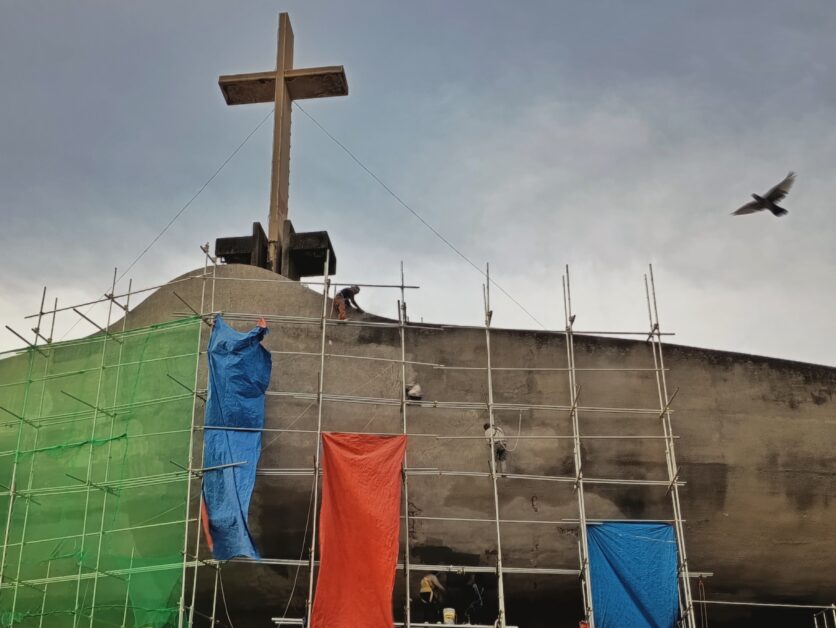
Take, for instance, the San Pedro Cathedral. It’s being repainted grey, or at the very least a lighter shade than the unique. Rev. Msgr. Paul A. Cuison, Rector of the cathedral, has lastly taken the possibility to offer it new life. However what issues now could be that its historical past of building must be revisited.
I’m scripting this essay to current a succinct historical past of San Pedro Church and to make clear inconsistencies relating to its postwar redesign right into a cathedral — particulars which have proliferated in native newspapers for years. I may also focus this essay on the pictures, the articles printed on-line, and the reminiscences of Dabawenyos, all of which concern the 12 months the church was redesigned.
This can be a {photograph} of the laying and blessing of the cornerstone for the San Pedro Cathedral dated June 28, 1968, alongside San Pedro Avenue, Davao Metropolis. On the again is then Metropolis Mayor Elias Lopez, sitting cross-legged. The girl on the desk is Guadalupe Cervantes-Suazo-Castillo, the granddaughter of Pablo Ferrando Suazo, a soldier from the east coast of Mindanao who got here to Davao with Don Jose Oyanguren in 1848.

Oyanguren got here to Davao with Pablo Ferrando Suazo in 1848, together with different pioneer settlers who formed the social and political scene of Davao within the early occasions. On the correct facet of the photograph, a crowd witnessed the unfolding of one other historic second for the Catholic group. As seen within the {photograph}, the postwar construction of the previous San Pedro Church nonetheless stood there in 1968.
You will need to elevate one key query right here. Was the cathedral that changed the previous San Pedro Church accomplished within the early Nineteen Sixties, or, to be exact, 1964, as most printed information articles declare?
The defeat of Datu Bago was pivotal within the consolidation of Spanish affect within the southeastern Philippines. Our pricey historians, Father Paul Pastells SJ, Ernesto Corcino, Dr. Macario Uncle, Dr. Patricia Irene Dacudao, and Antonio Figueroa share the identical narrative in telling the expedition of Oyanguren en path to Davao. After defeating Datu Bago, Oyanguren earned the excellence of being the final conqueror of the Philippines. Davao Gulf was the final unoccupied territory within the nation. He dislodged Datu Bago on June 29, Peter.
Oyanguren established his capital on the positioning of Datu Bago’s settlement, renaming it Nueva Vergara, after his hometown in Vergara, Spain. The province underneath his rule was referred to as Nueva Guipuzcoa, additionally named after his dwelling province within the Basque nation. The city plan was created based mostly on the usual Spanish grid system. The municipal corridor, the tribunal corridor, and the church had been constructed because the face of the plaza.
It was additionally in 1848 that Father Francis Lopez of St. Anthony of Padua, a Recollect, assumed the primary apostolic administrator of Yglesia Mision de Cabezera de Bergara de la Nueva Guipuzcoa. On January 30, 1857, the church was renamed Parish of San Pedro Apostol of Davao with Father Toribio Sanchez, a Recollect, because the parish priest and concurrent pastor of St. Francis Xavier Parish of Pundaguitan. Then, San Pedro Church was named after the parish in Oyanguren’s hometown in Vergara. After the Recollects administered the missionary works within the space, the Jesuit clergymen took care of the church within the 1860s.
The inhabitants modified the title of the city from Nueva Vergara to its former title Davao after the loss of life of Oyanguren in 1858; and in 1867, the entire province was renamed Davao.
In 1938, a ceremony held on the Immaculate Conception School Auditorium marked the transition of San Pedro Church from the Jesuit administration to the PME Fathers. This occasion signaled the eventual turnover of the Davao mission to the diocesan clergy of Mindanao. Reverend Father Clovis Thibault, PME was put in as the primary PME Parish Priest of San Pedro Church. Mayor Santiago Artiaga, Common Paulino Santos, Atty. Jose Palma Gil, Fr. Tomas Puig, SJ, the final Jesuit Parish Priest of San Pedro Church, Bishop Luis del Rosario SJ, DD of Zamboanga, and Councilor Isidro Bastida had been among the many attendees of the occasion.

After the Second World Warfare, plans for rebuilding town acquired underway, particularly for San Pedro Avenue. Architect Ramon Basa had made design modifications on the prewar church within the Forties.
Based on his son, Architect Renato Basa in his essay within the guide The Davao We Knowthe church was constructed “alongside neoclassical strains, with a Filipino contact within the nipa hut-inspired roof of the 2 towers.” After the struggle, the church was rebuilt with minor modifications. It had three home windows on every tower; the spherical element on its entrance was a lot bigger.
The {photograph} dated June 28, 1968 clarifies that redesigning the postwar church would ultimately materialize. If the declare that the church’s redesign was accomplished in 1964 utilizing Manuel Chiew’s constructing plan, would he have been thought of an architect then, on condition that he completed his Structure diploma on the College of Mindanao years later, in 1971? Earlier than that, he was first a Civil Engineer. He earned his diploma from the Mapua Institute of Know-how in Manila.
This led us to query if it was permissible for a civil engineer to create architectural designs within the Nineteen Sixties in the event that they weren’t a licensed architect? What had been the legal guidelines that outlined the scope of observe between an engineer and an architect that point?

It is usually essential to level out which design was favored by the PME fathers throughout this laying and blessing of the cornerstone ceremony. Architect Renato Basa acknowledged that out of many design schemes, “a round cathedral with a domed roof was chosen” by the PME fathers who employed the service of his father, Ramon.
The truth is, “a scale mannequin was even made, for show” throughout a San Pedro fiesta and through fundraising actions previous to the development of the cathedral. As to the particular date and announcement when this occurred, this nonetheless must be verified.
The important thing remaining query is when Manuel Chiew’s design got here into play. Some data present he earned his Structure diploma from the College of Mindanao in 1971. Nonetheless, the laying and blessing of the cornerstone for the cathedral, as depicted within the {photograph}, happened earlier, on June 28, 1968.
One other vital info was the involvement of Architect Apolinar Bundalian within the building of San Pedro Cathedral. The architect managed his personal firm, Metal Fabricators Builders, in 1965. He was additionally concerned in designing a number of church buildings in and outdoors Davao Metropolis.
His son, Paul John Bundalian, remembers even as much as today, the occasions when his father would carry him to examine the undertaking within the mid-Nineteen Seventies. As a result of his father’s experience was in metal buildings, Architect Chiew recruited him to work on the cathedral’s roofing. Under are a few of the images he had stored of the cathedral’s building.


The articles beforehand printed by the Atenews, Edge Davao, Davao In the present day, and SunStar Davao in regards to the cathedral’s building date might have been restricted by the scarce proof and first paperwork obtainable for interpretation.
In scripting this essay, I’ve been enlightened by related articles that challenged me to contribute to the continued historicizing of San Pedro Church. It’s anticipated that extra writings about our pricey San Pedro Cathedral can be printed quickly.
Neil Teves accomplished his bachelor’s diploma in Interdisciplinary Research (Language and Literature), cum laude, on the Ateneo de Davao College. He’s presently a member of the Davao Writers Guild. He writes about his hometown, Davao Metropolis and the area.
==
Sources:
“Constructing Davao” by Renato S. Basa in The Davao We Know, edited by Lolita R. Lacuesta. Printed by Anvil Publishing, Inc. in 2011.
Key Tales of Our San Pedro Cathedral by Leenard R. Baquial. Printed by Davao Catholic Herald on July 2, 2015.
A Sojourner’s View: Davao Gulf, Datu Bago and Davaoeños immediately by Karl M. Gaspar, CSsR. Printed by MindaNews on March 16, 2018.
twenty fifth Yr (1973-1998) Silver Jubilee Yearbook of DCM (Diocesan Clergy of Mindanao).
https://weblog.passive-income4u.com/create-your-very-own-auto-publish-news-blog-site-and-earn-passive-income-in-just-4-easy-steps/
https://mindanews.com/arts-culture/2026/03/from-san-pedro-church-to-san-pedro-cathedral-revisiting-history/