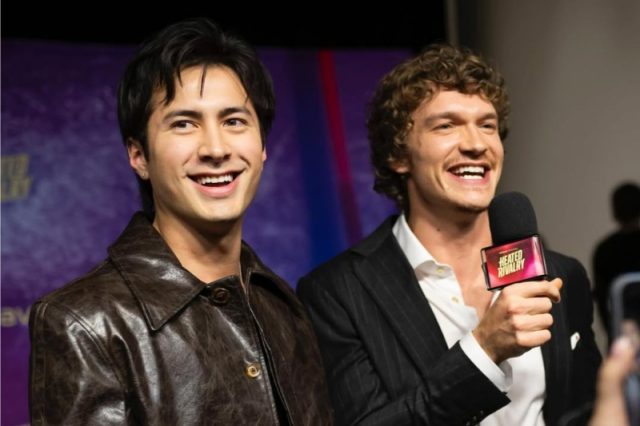

“Heated Rivalry,” the Bell Media-produced Canadian homosexual hockey romance based mostly on the novel by Rachel Reid, has taken the world by storm.
The sequence stars Hudson Williams as Shane Hollander, a Japanese Canadian hockey participant for the Montréal Metros, and Connor Storrie as Ilya Rozanov, a Russian hockey participant for the Boston Raiders.
With a lot of the series was filmed in Guelph, Ontario and other Canadian locationsthe sequence highlights each Canadian hockey and queer illustration and wishes.
Heated Rivalry explores the rising sexual rigidity and eventual romance between Hollander and Rozanov as they navigate the extremely masculinized and heteronormative social pressures of taking part in in an expert hockey league.
Whereas the sequence has develop into a huge audience success and obtained largely positive critical evaluations of its acting, production and characterizationit has gained widespread attention for its representation of queer romancesignificantly homosexual sports activities romance.
The present has additionally obtained media commentary for its large following of women who are fans of the show and its actors. Many have been debating and discussing the show on social media.
Given the current climate of anti-LGBTQ legislation and increased political and social transphobia and homophobia, Heated Rivalry might sign essential queer illustration throughout a politically harmful time.
Hockey’s tradition of masculinity
Hockey is a very heteronormative and masculinized sport and continues to face critical points associated to sexual violence and racism — issues which have been broadly reported on over the previous a number of years.
In 2022, Hockey Canada confronted quite a few public controversies amid reports that it paid $8.9 million for sexual abuse settlements to 21 complainants since 1989.
Analysis has additionally documented persistent racial inequities inside Canadian hockey that gasoline the erasure of Black Canadians’ contributions to the establishment of ice hockey in Canadain addition to historical and ongoing experiences with taunting, harassment and exclusion of racialized hockey players in Canadian hockey leagues.
Towards this backdrop, Heated Rivalry provides a uncommon interruption to hockey’s normative tradition, even because it stays constrained by lots of the sport’s dominant values.
Visibility versus structural change
Whether or not Heated Rivalry will meaningfully affect the willingness or security {of professional} gamers to return out is an open query. Presently, there are no openly queer hockey players in the National Hockey League.
Former Canadian hockey participant Brock McGillis, who is usually famous as one of the first out gay professional hockey playershas expressed skepticism. He has argued the present is “more likely to have an adverse effect on a player coming out.”
McGillis stated that he enjoys the present whereas additionally explaining: “I don’t imagine that many hockey bros are going to look at it. And I don’t assume, if they’re watching it, they’re speaking about it positively.”
In the meantime, the NHL has previously banned rainbow Pride coloured hockey stick tape. Given the recognition of Heated Rivalrythe NHL launched a press release articulating its hope that the sequence will act as a “unique driver for creating new fans.”
Whether or not such symbolic gestures will translate into structural adjustments that deal with the ingrained homophobia inside hockey stays to be seen.
Illustration and intersectionality
Inside my analysis, I analyze points associated to gender and sexualityusually significantly because it pertains to the experiences of gay and queer men.
For a lot of homosexual males, navigating masculinity is complicated in terms of both in-group and out-group discrimination. It isn’t unusual for white, muscular and masculine-presenting gay men to receive the most media attention and be positioned as extremely fascinating inside homosexual males’s communities.
Heated Rivalry gives priceless illustration for homosexual male romance and sexualities, however it additionally raises necessary questions on each its potential and its limitations.
Shane Hollander’s character gestures towards the intersections of race and sexuality by means of his experiences as an Asian hockey participant, although this storyline could have been explored further in the series. Ilya Rozanov’s narrative, in the meantime,
explores family-based and nationalistic homophobia through his background as a Russian-born queer man.
Though each characters profit from monetary and gender-based privileges that many LGBTQ folks don’t share, their experiences navigating identification and homophobia because it intersects with household, state-sanctioned homophobia and race and ethnicity, are significant for viewers.
Nonetheless, a lot of the storyline nonetheless focuses on the experiences of two males who’re historically engaging, match and muscular, and masculine-presenting. This echoes a lot of the mainstream queer illustration, which glorifies match male our bodies and homosexual health club cultures.
The bounds of mainstream illustration
Many mainstream representations of queer identities, such because the 2018 movie Love Simon, fail to represent the nuances and complexities of multifaceted queer experiences and identities outdoors of white, masculine and upper-middle class norms.
Homosexual media platforms reminiscent of Grindr, the well-known homosexual hook-up app, are identified for emphasizing fit bodies, muscular physiques and gym or beach selfies. These norms can result in types of discrimination or prejudice in opposition to app customers who don’t conform, in addition to body dysmorphia and body image issues that disproportionately have an effect on homosexual and queer males.
Gay men’s sexualities, dating and relationships are often shaped through shame and secrecyfuelling tropes that gay men are unable to form healthy and meaningful long-term romantic relationships.
A lot of Heated Rivalry emphasizes secrecy, disgrace and threat as the 2 important characters wrestle with their romantic emotions for one another.
Whereas this may replicate the realities many queer men facepositioning such experiences as normative dangers reinforcing longstanding negative stereotypes.
Queer pleasure — and what’s nonetheless lacking
Heated Rivalry’s creator and author, Jacob Tierney — himself a homosexual author, actor and producer — has emphasised that the tip of the primary season is meant to be extra celebratory than earlier episodes.
“For these final two episodes,” he told journalist Philiana Ng“you’re going to lastly get the enjoyment that we wished from the start – simply queer pleasure, pure happiness and sweetness and love and all that different good things.”
Nonetheless, there has been controversy about the show’s stars’ and creator’s resistance towards publicly identifying the lead actors’ sexual orientations. Given the widespread observe of getting straight and cisgender actors play queer and trans characters in film and mediaquestions concerning authenticity in LGBTQ illustration proceed.
It’s value noting, nonetheless, that Heated Rivalry does function overtly queer performers. François Arnaud, who performs Scott Hunter, is openly bisexualand trans actor Harrison Browne — a former professional hockey player — stars in a minor function.
Tierney has pushed again at questions on the principle actors’ sexual orientations, saying “I don’t think there’s any reason to get into that stuff.” He famous that what issues is an actor’s enthusiasm and willingness to do the work, and questions on actors’ sexuality are legally off-limits in casting.
Advocates for casting queer actors in queer roles acknowledge that whereas respecting actors’ privateness is crucial, choices can be made through the casting and production process to create a extra inclusive business.
Queer romance on the ice
Past questions of illustration, Tierney has been clear concerning the present’s thematic focus. Highlighting the love story between the 2 important characters, he has famous how “a gay love story set in the world of hockey … is an act of rebellion” and that audiences “need to have a homosexual present that’s attractive and sexy and enjoyable.”
Nonetheless, audiences need to have homosexual exhibits which might be attractive, sexy, enjoyable and consultant of quite a lot of lived experiences and our bodies.
With Heated Rivalry renewed for a second seasonwhether or not the present “scores” when it comes to shifting conversations about masculinity, sexuality and sport continues to be up within the air.
Adam DaviesAffiliate Professor, Faculty of Arts, University of Guelph. This text is republished from The Conversation beneath a Artistic Commons license. Learn the original article.
https://weblog.passive-income4u.com/create-your-very-own-auto-publish-news-blog-site-and-earn-passive-income-in-just-4-easy-steps/
https://interaksyon.philstar.com/hobbies-interests/2026/01/21/308059/heated-rivalry-scores-for-queer-visibility-but-also-exposes-the-limits-of-representation/