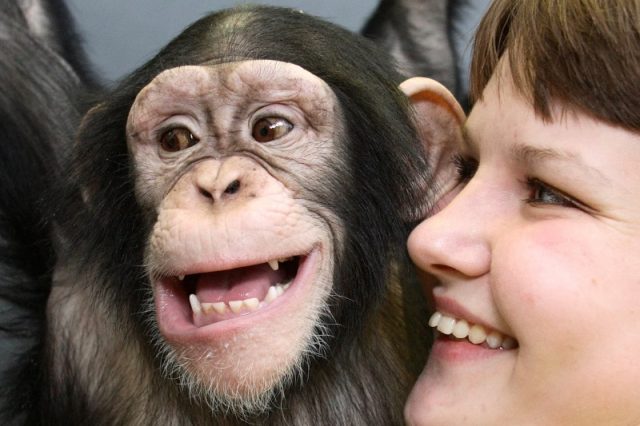

- Laughter in contrast in people and 4 nice ape species
- Research concerned chimps, bonobos, gorillas and orangutans
- Human laughter is quicker and delicate to social context
- Analysis might provide clues into how human speech advanced
WASHINGTON — There are lots of sorts of laughter. Folks might guffaw at a joke. They could giggle nervously in an uncomfortable state of affairs. They could chuckle with delicate amusement. They could snicker to specific contempt — particularly film villains.
However whereas laughing appears uniquely human, it’s not. Our closest evolutionary family members do it too. Researchers now have in contrast laughter in people to laughter within the numerous nice apes — chimpanzees, bonobos, gorillas and orangutans. They recognized similarities among the many species on this vocalization in addition to traits unique to individuals.
Laughter in every of the species studied adhered to a daily rhythmic sample, with evenly spaced intervals between successive sounds. As a result of this laughter sample was shared amongst individuals and the opposite species, the researchers stated, it might have existed of their final frequent ancestor, thought to have lived about 15 million years in the past in East or Central Africa.
“Human laughter shares the identical fundamental evolutionary roots as nice ape laughter, nevertheless it differs in vital methods,” stated Chiara De Gregorio, a primatologist and analysis fellow on the College of Warwick in England and lead writer of the research printed within the journal Communications Biology.
“Human laughter is quicker, extra variable and extra delicate to social context than the laughter of different nice apes. Chimpanzees and bonobos are certainly our closest family members, and their laughter is mostly extra much like ours than that of gorillas or orangutans. Nevertheless, human laughter nonetheless stands out in its diploma of rhythmic complexity and adaptability,” De Gregorio stated.
The human evolutionary lineage diverged from the lineage that led to chimpanzees and bonobos maybe 7 million years in the past.
The researchers analyzed recordings of laughter from 4 chimpanzees, three bonobos, two gorillas, 4 orangutans and 4 individuals, measuring the timing between every burst of sound in a complete of 140 sequences of laughter. The ape recordings had been made of their dwelling environments in zoos in Germany and Malaysia whereas particular person apes had been engaged in play or had been gently tickled by human caretakers acquainted to them.
Folks had been discovered to vary the pace of their laughter relying on the state of affairs.
“Our research exhibits that laughter has modified progressively over the course of nice ape and human evolution,” De Gregorio stated.
“One putting distinction is that people seem capable of modify the temporal construction of laughter based on context. In our research, we discovered little proof that nice apes alter the rhythmic construction of their laughter throughout totally different conditions in the identical method people do, though future analysis might reveal subtler types of variation,” De Gregorio stated.
The researchers stated their findings might have implications for understanding the origins of human speech.
“By finding out laughter in our closest family members, we are able to higher perceive not solely the place language got here from, but in addition the social and emotional foundations that make us human,” De Gregorio stated.
“The evolutionary improve in rhythmic flexibility that we noticed means that our ancestors might have already got possessed extra refined vocal management than fashionable apes, representing an vital stepping stone towards speech and language. We nonetheless have no idea precisely how our ancestors communicated, however we now have a a lot clearer image of how they could have laughed,” De Gregorio stated.
So what precisely is laughter?
“Laughter is a rhythmic vocalization sometimes related to constructive social interactions reminiscent of play, in non-human animals,” De Gregorio stated.
“Laughter is believed to have advanced as a social sign that helps keep constructive interactions and strengthen social bonds. Throughout play, it communicates that actions are pleasant quite than aggressive, serving to people have interaction in rough-and-tumble interactions with out misunderstandings. In people, laughter has taken on many extra social capabilities, however its origins doubtless lie in play,” De Gregorio stated.
Different animals apart from nice apes have behaviors akin to laughter.
“Whether or not different animals really ‘snigger’ will depend on how strictly we outline laughter. Many mammals present play alerts that seem to serve related capabilities. Canines, for instance, show a attribute ‘play face’ and produce a play panting vocalization throughout social play. These alerts assist talk playful intentions and point out that interactions are non-aggressive. Comparable play-associated vocalizations have been described in a number of different mammals,” De Gregorio stated.
—Reporting by Will Dunham; Enhancing by Daniel Wallis
https://weblog.passive-income4u.com/create-your-very-own-auto-publish-news-blog-site-and-earn-passive-income-in-just-4-easy-steps/
https://interaksyon.philstar.com/trends-spotlights/2026/07/29/315740/humans-and-great-apes-show-similar-rhythmic-pattern-in-laughter/