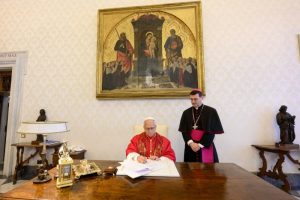
VATICAN— In his encyclical Magnificent Humanityprinted Monday, Pope Leo XIV calls on society and AI builders to implement “shared requirements of social justice” to ensure that synthetic intelligence to respect human dignity and serve the frequent good.
AI shouldn’t be a morally impartial software; It issues not solely how it’s used, however how it’s designed, Leo writes in “Magnifica Humanitas: On Safeguarding the Human Person in the Time of Artificial Intelligence,” printed Might 25. Magnifica Humanitas means “Magnificent Humanity” in Latin.
He additionally warns that “a extra ethical AI shouldn’t be sufficient if that morality is set by a number of … The truth is, as with each main technological shift, AI tends to amplify the facility of those that already possess financial assets, experience and entry to knowledge.”
The primary encyclical letter of Leo XIV covers a variety of social points, focusing closely on the impacts of AI within the areas of schooling, the financial system, unemployment, work, the event of younger individuals, human trafficking and battle.
He proposes the rules of Catholic Social Doctrine — the dignity of the particular person, the frequent good, the common vacation spot of products, subsidiarity, solidarity and justice — as pointers for decision-making and the “standards for judging whether or not applied sciences really serve humanity or are subjugating it.”
Whereas rejecting dichotomous pondering that pits the alternatives of AI towards its dangers, or enthusiasm towards worry, Leo affords a stark evaluation of the technological paradigm the world finds itself in at this time and describes a path of progress that serves individuals “or a progress that topics them to the mentality of energy.”
“The chance extends past the misuse of sure applied sciences. Extra gravely, the pervasive technocratic paradigm during which we’re immersed, and that’s amplified by the digital revolution and AI, threatens to normalize an anti-human imaginative and prescient,” he writes.
Leo borrows the time period, “technocratic paradigm,” from Pope Francis’ 2015 encyclical Laudato Si’, during which, Leo writes, Francis critiqued a paradigm “that seeks to cut back every part to an object to be dominated.”
In that anti-human imaginative and prescient, he continues, “the fullness of life is equated with having extra, lowering weak spot, eliminating uncertainty and exerting whole management. When effectivity turns into the final word measure of worth, human beings are tempted to see themselves as a undertaking to be optimized somewhat than as individuals referred to as to relationship and communion.”
In line with Pope Leo, the central query — safeguarding our humanity — is one thing everybody ought to have a task in answering.
He invokes certainly one of his non secular guides, St. Augustine of Hippo, quoting from “De Civitate Dei” (“The Metropolis of God”): “‘Two loves have constructed two cities: the earthly metropolis, the love of self even to the contempt of God; the heavenly metropolis, the love of God even to the contempt of self.’ As all through historical past, these two loves proceed to contend for dominance in our hearts at this time.”
From Catholic Social Doctrine to the struggle for energy
The encyclical’s 245 paragraphs are damaged down into an introduction and 5 chapters, with the primary two devoted to an evidence of the event of the Church’s Social Doctrine from Pope Leo XIII to at this time, the primary rules of that doctrine, and the way they are often utilized to the present technological age.
Chapter three introduces “the technocratic paradigm” of synthetic intelligence and the imbalance of digital energy.
Chapter 4 turns to the significance of safeguarding reality, democracy, work, schooling, and human freedom within the age of AI, whereas the fifth chapter is devoted to an evaluation of the normalization of battle, the struggle for energy, and the way everybody has a accountability to assist construct a civilization of affection by the cultivation of peace and justice.
All through the encyclical, Leo attracts on the picture of development to ask how humanity will reply to the brand new technological age. Humanity, he says, should select between constructing the Tower of Babel (Genesis 11:1-9) and constructing a metropolis the place God and humanity can dwell collectively, as Nehemiah gathered collectively individuals to rebuild the partitions of Jerusalem after the Babylonian exile (Nehemiah 2-6).
“In mild of those two pictures, the Holy Spirit challenges us at this time concerning our relationship with know-how and the continued digital revolution,” he writes. “Know-how has the facility to heal, join, educate and defend our frequent dwelling; however it may well additionally divide, exclude and generate new types of injustice.”
Pope Leo XIV attracts on quotations from distinguished nineteenth and Twentieth-century thinkers, each Catholic and Jewish, together with St. John Paul II, Victor Frankl, Hannah Arendt, J.R.R. Tolkien, Giorgio La Pira, and Fr. Romano Guardini, to argue that whereas know-how shouldn’t be an answer in itself to humanity’s issues, neither is it inherently evil.
“In observe, nevertheless, know-how isn’t impartial, as a result of it takes on the traits of those that devise it, finance it, regulate it and use it,” he writes.
The selection, he continues, shouldn’t be between a “sure” or “no” to know-how, however “between establishing Babel or rebuilding Jerusalem; between an influence that claims to dominate the heavens and a individuals who work collectively within the presence of God to rebuild the partitions of fraternal coexistence.”
Continuously cited sources for the encyclical letter embrace Pope Benedict XVI’s encyclical Caritas in Veritate and the Compendium of the Social Doctrine of the Church.
Writing that he doesn’t want to give a complete overview of AI, the pope factors readers to earlier writings by the Church on AI, particularly, the 2025 be aware Antiqua et Nova by the Dicastery for the Doctrine of the Religion and the Dicastery for Tradition and Schooling and Quo Vadis, Humanitas? printed earlier this 12 months by the Worldwide Theological Fee — each of that are cited typically within the footnotes of Magnifica Humanitas.
Christian humanism and the technocratic paradigm
The pope writes concerning the mindsets of transhumanism and posthumanism and the way they’re the ideological imaginative and prescient underlying know-how.
He proposes a Christian humanism, the place human beings “will not be confined by the boundaries of their very own nature; somewhat, they’re referred to as to self-transcendence, not by an escape from actuality or a contempt for his or her limitations, however by their success in love.”
In Magnifica Humanitas, the Holy Father additionally expresses concern concerning the “new monopolies of AI.”
“To talk of the frequent good means exposing this new type of epistemic, financial, and political asymmetry,” he writes.
The important thing query, he says, is that posed by Saint John Paul II: Does AI “make human life on earth ‘extra human’ in each facet of that life? Does it make it extra worthy of man?’”
Leo writes that “a decisive take a look at for the moral discernment of AI and digital transformation” is within the struggle towards new types of slavery, similar to human trafficking. The pontiff goes on to “sincerely ask for pardon,” within the identify of the Church, for the “immense struggling and humiliation endured by so many” earlier than slavery was unequivocally condemned within the nineteenth century.
“This improvement affords a transparent instance of the Church’s progress in understanding the perennial truths of Revelation that she safeguards. Though there was not at all times consistency in observe,” he writes, “there was a steady affirmation all through historical past of the dignity of each human being, created within the picture of God, even when it took eighteen centuries for its full incompatibility with slavery to be explicitly acknowledged.”
The reminiscence of previous blindness and complicity concerning the injustice of slavery is “a name to vigilance,” the pope says. “What we’ve got discovered should be translated into discernment and accountability within the current.”
‘A violent tradition of energy’
A big part of the pope’s letter is dedicated to what he writes is, “a troubling revival of battle as an instrument of worldwide politics,” AI use in warfare, a disaster in multilateralism, and the erosion of moral rules that used to restrict battle.
“Humanity is slipping right into a violent tradition of energy,” he warns. “In the present day, greater than ever, with out prejudice to the proper to self-defense within the strictest sense, you will need to reaffirm that the ‘simply battle’ principle which has all too typically been used to justify any sort of battle, is now outdated. Humanity possesses far more practical and succesful instruments for selling human life and resolving conflicts, similar to dialogue, diplomacy and forgiveness.”
“The trendy Babel might be seen not solely within the globalized technocratic paradigm, but additionally within the distant conflict between opposing imperialisms, between powers that want to protect their supremacy, and people who aspire to grab that supremacy, leading to a multiplicity of native conflicts. Furthermore, there appears to be no restrict to the race — pushed by a dehumanizing ambition — to develop evermore highly effective applied sciences or to safe management over them,” Pope Leo writes.
However the pontiff doesn’t conclude on a destructive be aware. He provides that, “regardless of this downward spiral, we are able to additionally glimpse an amazing a part of humanity that’s striving to stay human and dealing to construct the holy metropolis of coexistence and peace.”
Concluding the doc, he expresses the hope that, “Within the humble constancy of every day life, even the period of AI can change into a time during which the Holy Spirit brings concerning the civilization of affection in our lives.”
“Certainly, the Lord continues to make all issues new and affords each period the opportunity of turning into a part of salvation historical past within the mild of the Incarnation.”
https://weblog.passive-income4u.com/create-your-very-own-auto-publish-news-blog-site-and-earn-passive-income-in-just-4-easy-steps/
https://interaksyon.philstar.com/trends-spotlights/2026/05/26/314006/magnifica-humanitas-pope-invokes-justice-to-combat-anti-human-vision-in-ai/