Enterprise house owners in Manila are struggling to maintain up with the sharp enhance within the rubbish charges they’re now required to pay below a brand new metropolis ordinance.
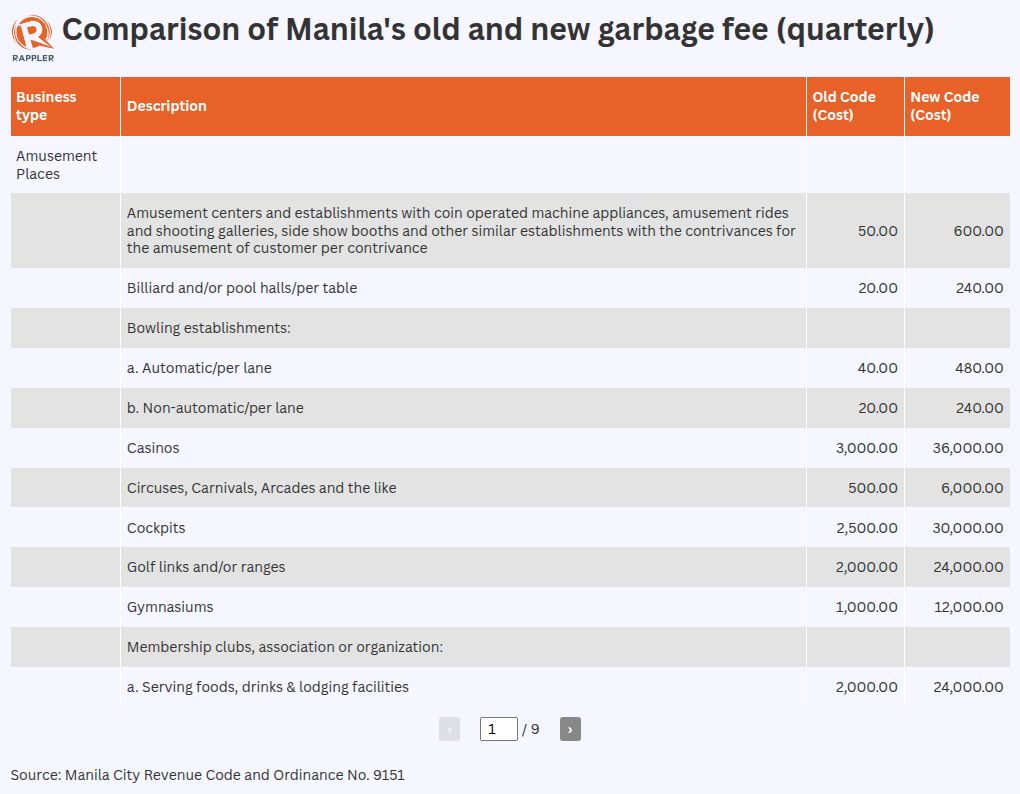
Rubbish charges for some companies have risen by as a lot as 1,200%.
The town authorities, led by Mayor Isko Moreno, mentioned the rise displays the rising price of waste assortment and disposal, arguing that the earlier charges have been primarily based on a income code authorised greater than a decade in the past and now not reflective of present bills.
For a lot of enterprise house owners, nonetheless, the sudden leap got here as a shock. Some companies instructed Rappler that there was an absence of public session when the ordinance revising the town’s income code was handed.
“It’s completely unfair to simply go that on to the common enterprise proprietor. As an illustration, there are months the place I barely made any revenue income — expense was nearly zero. So to pay for this onerous quantity is a giant blow to us,” a small cafe proprietor in Manila instructed Rappler.
Manila Metropolis Vice Mayor Chi Atienza, nonetheless, instructed Rappler that the rubbish charges imposed by the town “don’t require public session” below the Native Authorities Code.
“The executive measure went by the right legislative course of within the metropolis council, together with committee discussions and inside opinions,” Atienza mentioned in a Viber message to Rappler.
Why Manila’s rubbish charge ballooned
Manila’s metropolis council mentioned the upper rubbish assortment charges are the results of a significant shift within the location of the town’s waste disposal website.
Underneath the ordinancethe adjustment follows an order from the Metropolitan Manila Development Authority requiring the capital metropolis to haul its rubbish to the New San Mateo Sanitary Landfill in Rizal, after the everlasting closure of the Navotas Sanitary Landfill, the place Manila and different cities within the area beforehand disposed of their waste.
Metropolis officers mentioned the longer hauling distance has pushed up transportation and operational prices, prompting the necessity to elevate rubbish charges to maintain assortment providers.
Moreno additional justified the hike by pointing to rising gasoline costs. In 2013, gasoline costs ranged from P39 to P43.05 per liter, in contrast with P56.74 to P59.74 per liter as of January 16, 2026, Moreno mentioned. He famous that the upper gasoline prices instantly have an effect on rubbish hauling, fleet operations, and steady assortment.
Within the ordinance, the council mentioned the brand new charges are supposed to “improve the Metropolis’s waste administration capability, enhance service supply, and improve the dwelling situations of Manileños.”
The council additionally mentioned the revised charges are actually aligned with precise waste technology by trade, with companies that produce extra rubbish paying increased assortment charges.
Citing a Waste Evaluation and Characterization Research, Moreno mentioned that in 2015, a single Manila resident generated a median of 0.607 kilograms of waste per day. By 2023, this determine had risen to 0.939 kilograms per particular person day by day.
Primarily based on the examine and Manila’s inhabitants, Moreno estimated that the town now produces about 650,317 metric tons of rubbish every day.
He additionally mentioned there was no enhance in rubbish charges from 2019 to 2022, throughout his time period as mayor, as companies have been struggling amid the COVID-19 pandemic.
In line with Moreno, the town spends about P1.35 billion yearly on rubbish assortment, however from 2013 to 2025, it collected solely round P110 million in rubbish charges. Moreno mentioned that residents should not being charged with rubbish charges, solely companies.
Moreno additionally mentioned that the debt incurred by the earlier administration likewise added to the ballooning price of rubbish assortment.
Manila’s debt
Debt has turn out to be a central and recurring concern in Manila, with metropolis leaders blaming each other’s administrations for the monetary obligations amassed over time.
Moreno accused the administration of his predecessor and former ally, Honey Lacuna, of forsaking unpaid obligations.
He mentioned the town has lengthy been subsidizing the price of rubbish assortment, warning that persevering with to take action may come at the price of social service applications.
Leonel Waste Administration Company, which is chargeable for amassing rubbish within the metropolis, mentioned the Manila metropolis authorities incurred P561 million in unpaid dues throughout Lacuna’s time period.
After Leonel’s contract ended on December 31, 2024, PhilEco and Metro Waste Strong Administration took over rubbish assortment within the metropolis. Nonetheless, each corporations later terminated their contracts, citing unpaid obligations totaling round P400 million.
Moreno then declared a state of health emergency attributable to uncollected waste after which tapped Leonel once more to offer providers in Manila.
In the course of the marketing campaign, Lacuna identified how the earlier administration of Moreno additionally incurred a P17.8-billion debt. From 2019 to 2022, Lacuna served as Moreno’s vice mayor. She mentioned that many of those infrastructure projects have been designed to spice up Moreno’s presidential bid.
Moreno rejected these accusations, saying Manila residents have benefited from the infrastructure tasks. He additionally confused that his administration needed to safe loans in the course of the COVID-19 pandemic, which put extra pressure on the town’s funds.
Highest in comparison with different wealthy cities within the Metro
In comparison with a number of the richest cities within the Nationwide Capital Area, Manila imposes the costliest rubbish charges on companies.
Native governments sometimes cost rubbish charges primarily based on a enterprise’ kind and measurement. To check charges, Rappler compiled how a number of the capital area’s wealthiest cities cost chosen companies.
For a restaurant or café with a flooring space of at the very least 50 sq. meters however lower than 100 sq. meters, Manila costs P48,000 a yr. That is sharply increased than neighboring cities: P7,200 in Pasay Metropolis, P4,000 in Makati, P3,120 in Quezon Metropolis, and P2,000 in Taguig Metropolis.
Though Pasig can also be among the many richest cities within the area, it was excluded from the comparability as a result of it makes use of a unique pricing mannequin. Underneath Pasig Metropolis’s income code, rubbish charges are calculated primarily based on a enterprise’s precise flooring space, relatively than fastened charges tied to measurement brackets, a system utilized by most different cities.
In Caloocan, additionally among the many wealthiest cities within the capital, rubbish charges are primarily based on a hard and fast annual charge, the variety of workers, and the enterprise’ precise flooring space.
Authorized considerations
Manila Anti-Incinerator Alliance (MAIA) additionally questioned the legality of Manila’s transfer to extend rubbish charges. The group cited the Supreme Courtroom ruling on Ferrer Jr. vs Quezon Metropolis, the place the Excessive Courtroom dominated that rubbish charges imposed by LGUs are invalid once they lack a transparent foundation and computation.
The group mentioned that the ordinance growing the rubbish charge lacks particulars and “makes it unattainable for the general public to evaluate whether or not the charges are proportionate, affordable, or justified.”
Whereas the Supreme Courtroom ruling on Quezon Metropolis pertains to rubbish charges for residents and never companies like in Manila, MAIA mentioned that the court docket’s resolution factors out that “what issues just isn’t who pays, however whether or not the charge is instantly tied to a particular regulatory service.”
“Any rubbish charge, whether or not imposed on households or companies, should correspond to an precise service rendered and can’t be used as a disguised tax or revenue-generating measure,” mentioned lawyer Zelda Soriano, founder and government director of the Group Authorized Assist and Public Curiosity Centre, and authorized counsel supporting the MAIA.
The group additionally criticizes the ordinance growing the rubbish charges, saying this “prioritizes charge assortment for hauling and disposal, with out demonstrating the way it will meaningfully scale back waste technology.”
The group mentioned that it “runs counter to the core goal of Republic Act No. 9003, the Ecological Strong Waste Administration Act of 2000, which prioritizes waste discount at supply, reuse, recycling, and composting.”
“A system centered primarily on amassing charges and transferring waste doesn’t tackle the foundation of the issue,” the group mentioned.
Blow on companies
On account of the hike, some companies are actually rethinking whether or not or to not proceed working or increasing in Manila — or whether or not to go on to customers the added prices.
Robby Sylianteng, proprietor of the First United Constructing (FUB) and member of Escolta Industrial Affiliation Integrated (ECAI), mentioned that the rubbish charge hike “disincentivizes folks from renewing their enterprise allow.”
“It’s getting powerful for me to even invite folks to the constructing now to start out their enterprise right here,” Sylianteng mentioned. FUB, one of many oldest buildings in Escolta, is providing workplace areas for creatives.

A small fried hen store that not too long ago opened within the metropolis mentioned it’s uncertain whether or not it could proceed working after being charged P36,000 in rubbish charges for the primary quarter of the yr.
“I simply began my enterprise, and it seems to be like I’ll have to shut it already. It hurts. I by no means thought it could come to this. I’m simply promoting fried hen,” he mentioned in a Fb publish.
One Manila-based enterprise proprietor, who requested anonymity attributable to worry of doable backlash from the town authorities, mentioned they’re contemplating eradicating scholar reductions and revising customer-friendly cost phrases to offset the upper rubbish charges.
The proprietor added that the rise has additionally dampened plans to increase throughout the metropolis.
“Undoubtedly not opening one other enterprise in Manila. In the event you evaluate ease of enterprise, transparency, stage of service, security, lose (It’s a loss). Even accounting providers — in the event you say your online business is in Manila, they cost increased in comparison with different cities as a result of they know the way tedious it’s to work with Manila,” the enterprise proprietor mentioned.
With the rise in rubbish charges, Sylianteng hopes that there will likely be extra transparency within the metropolis authorities, particularly with regards to its bills.
Addressing Manila’s rubbish drawback was a central promise of Moreno’s election marketing campaign. He promised to “make Manila nice once more.” A couple of days into workplace, he declared a state of health emergency over the town’s trash disaster.
Instantly, rubbish vans rolled out throughout the town. Streets have been cleared nearly in a single day, a transfer broadly welcomed by residents.
However just a few months later, companies are feeling the monetary weight of sustaining that cleanup. And in the end, house owners warned, the price of cleaner streets might discover its option to customers’ pockets and even voters’ ballots. – with analysis from Arriane Dela Cruz and Vicensa Nonato/Rappler.com
Arriane Dela Cruz is a Rappler intern. She is an Economics scholar from the Polytechnic College of the Philippines-Manila. Vicensa Nonato can also be a Rappler intern. She is a journalism scholar on the College of the Philippines Diliman.
https://weblog.passive-income4u.com/create-your-very-own-auto-publish-news-blog-site-and-earn-passive-income-in-just-4-easy-steps/
https://www.rappler.com/newsbreak/in-depth/manila-garbage-fee-hike-business-impact-2026/