Manila and Tokyo enter ‘new period’ of relationship
The upcoming state visit of President Ferdinand Marcos Jr. to Japan on Could 26 to 29 is historic in some ways. It’s the first state go to of a Philippine president in 11 years, and it marks a milestone: the 70th yr of diplomatic relations between our international locations.
Marcos’ go to reveals the continuity of robust relations between the 2 international locations. “Our bilateral ties are strong and transcend the person initiative of single politicians, no matter (Prime Minister Sanae) Takaichi or Marcos,” Yusuke Takagi, a Southeast Asia knowledgeable on the Nationwide Graduate Institute for Coverage Research in Tokyo, advised me in an e-mail interview. “It’ll develop into one other good image to reconfirm good bilateral ties.”
Takagi traces our international locations’ strong ties to the Fifties when people-to-people alternate began, with college students learning in Japan. Later, business-to-business relationships had been bolstered after the Japan-Philippines Treaty of Amity and Commerce went into pressure in 1974.
Shaking off pacifist moorings
Right this moment, there’s a wider context. Marcos can be in Tokyo at a time when a tectonic shift is going down: it’s shaking off its pacifist moorings, having simply despatched its combat troops to the Philippines to take part within the Balikatan navy workout routines, a primary for the reason that Japanese got here as invaders in World Struggle II.
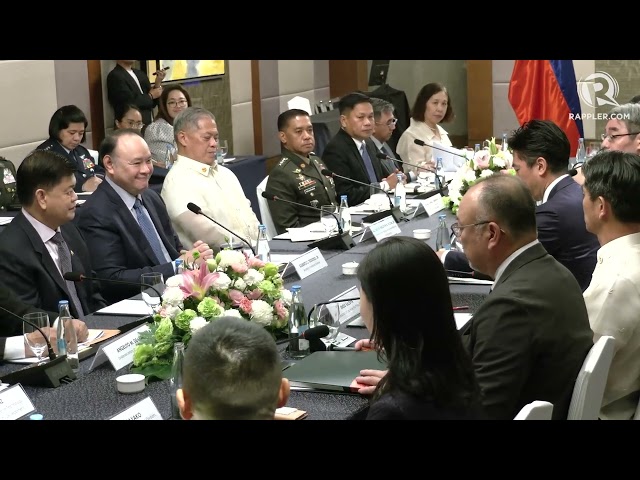
Protection Minister Shinjiro Koizumi visited Manila final week to look at the Balikatan, the place 1,400 members of the Japanese Floor Self Protection Forces took half.
Equally consequential is the lifting of Japan’s previous arms-export guidelines, the primary time since World Struggle II. It permits the export of deadly protection tools reminiscent of missiles and destroyers. Koizumi stated that Tokyo and Manila are engaged on an early switch of used destroyers and plane to the Philippine navy.
This seismic shift is a boost to defense companies like Mitsubishi Heavy Industries and IHI, which manufacture primarily for home use. They’re now investing to develop manufacturing for abroad markets like Australia, Philippines, New Zealand, and Indonesia.
Protection Secretary Gilberto Teodoro welcomed this transfer saying it “will permit the Philippines to entry protection articles of the very best high quality and supportability, which won’t solely allow us to strengthen home resilience but additionally to contribute to regional stability by deterrence in a significant manner… Our protection partnership with (the) Japanese has entered a brand new period of working collectively.”
Previously, Japan restricted its export of protection tools for noncombat makes use of: rescue, transport, warning, surveillance, and minesweeping.
This new zeitgeist is a part of Japan’s strategic shift below Sanae Takaichi, the nation’s first feminine prime minister. She received by a landslide in February along with her celebration, the Liberal Democratic Celebration, gaining a supermajority within the highly effective decrease home.
Her approval rankings stay excessive due to her “clear messaging on constitutional reform, stronger protection, and financial safety,” Naoya Yoshino, information editor of Nikkei Asia, stated in a webinars. She can be seen as a successor to the late prime minister Shinzo Abe, who pioneered the idea of a free and open Indo-Pacific.
The truth that she is Japan’s first feminine prime minister is a plus issue.
Abe’s legacy
Japan and the Philippines began to construct deeper protection relations throughout the time of Abewhen he remodeled safety ties from humanitarian cooperation to a strategic partnership. The geopolitical panorama within the area was altering as China was asserting itself within the South China Sea and Taiwan Strait, elevating tensions.
It was in 2011 when Manila and Tokyo solid a strategic partnership, which included constructing the maritime capability of the Philippine Coast Guard. Japan supplied loans for greater than a dozen patrol vessels.
A couple of years later, Japan lifted the ban on the export of used protection tools, permitting it to switch second-hand {hardware} and spare elements for helicopters to the Philippine navy. Momentum grew in 2022, when Japan exported model new air surveillance radar systems to the Philippine Air Power.
Then talks started for a visiting-forces-type of settlement in 2023 which was ultimately known as the Reciprocal Entry Settlement or RAA and was signed in 2024. A milestone in bilateral relations, it allowed troops of each international locations to interact in navy workout routines right here and in Japan.
The signing of ACSA or the Acquisition and Cross Servicing Settlement adopted in January 2026. It supplied the framework for the reciprocal provision of provides and providers—reminiscent of meals, gas, and medical care—between the Philippine navy and the Japan Self-Protection Forces.
Final yr, the Japanese press reported that Japan plans to export to the Philippines a command and control system that can be used for air protection operations and sharing of knowledge, aimed toward “strengthening their capabilities for coping with China within the East and South China Seas.” If it pushes by, it will likely be the primary time for Japan to export a command and management system for navy functions.
The altering safety atmosphere is pushing Japan and the Philippines nearer to one another. Marcos and Takaichi are the leaders presiding over this new period.
Let me know what you assume. You’ll be able to e mail me at marites.vitug@rappler.com.
Until subsequent e-newsletter!
ICYMI Associated articles:
https://weblog.passive-income4u.com/create-your-very-own-auto-publish-news-blog-site-and-earn-passive-income-in-just-4-easy-steps/
https://www.rappler.com/plus-membership-program/exclusive-content/sui-generis-marcos-state-visit-japan-historic-strategic-shift-may-2026/