DAVAO CITY (MindaNews / 22 Might) — Questions of reminiscence, disinformation, impartial publishing, and the way forward for Mindanawon storytelling took heart stage on Thursday, Might 21, as writers, students, publishers, journalists, and readers gathered for the opening day of the Third Mindanao Ebook Pageant on the Ateneo de Davao College.
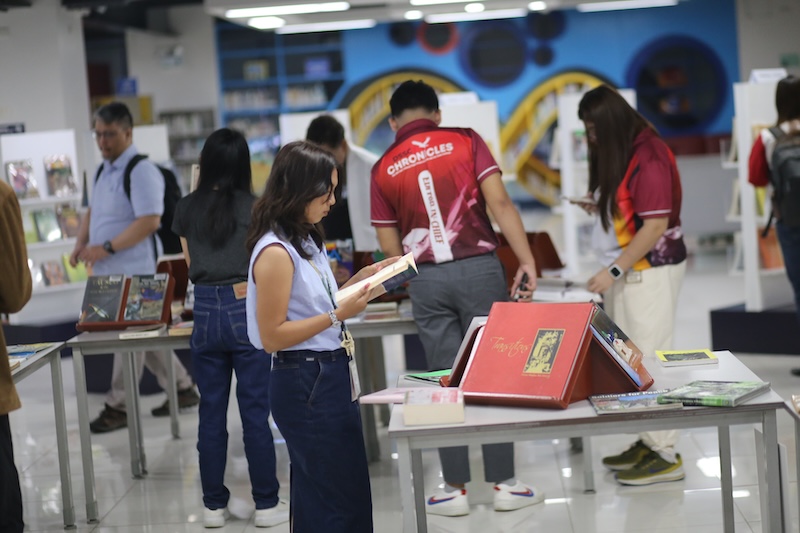
Within the Miguel Professional Studying Commons, conversations amongst college students, writers, journalists, archivists, and readers drifted between cabinets and tables displaying regional histories, literary journals, and self-published titles. Close by, archival images tracing Mindanao tales throughout the a long time lined the exhibit area, because the ambient sounds of page-turning and casual discussions blended into the competition’s opening environment.
Held below the theme “Writing Mindanao, Righting Mindanao,” the competition’s opening day introduced collectively writers, publishers, journalists, students, and cultural staff from throughout the area for conversations on historical past, synthetic intelligence, archives, impartial publishing, and regional illustration.
Carolyn Arguillas, Particular Stories Editor of MindaNews and head of its Publications, Archives and Library, framed the competition as an area for reclaiming narratives about Mindanao amid historic distortion that the area has fallen sufferer to lengthy earlier than at the moment’s age of rising disinformation. Explaining why the competition retained the theme “Writing Mindanao, Righting Mindanao” from the 1stbookfest in 2013 to the twond in 2022 and the Third in 2026, Arguillas mentioned there stays “a have to proceed” asserting “our proper to jot down” tales concerning the area “from the lenses of Mindanao.”
MindaNews itself was based in 2001 after Mindanao-based journalists who wrote for a nationwide newspaper grew pissed off with how tales from the area, particularly throughout instances of armed battle, had been dealt with by “the Central Desk” in Manila.
“Lengthy earlier than the age of disinformation and misinformation,” she added, “Mindanao has been a sufferer of each. Now we have all the time been misunderstood… Within the nationwide narrative, Mindanao equals violence.”
You might be being lied to
The competition’s first session, titled “You Are Being Lied To,” centered on disinformation and the rising challenges posed by AI-generated and manipulated media. The discussion board featured audio system Yas Ocampo, head of MindaNews Truth Verify, Carlos “Naz” Nazareno of Democracy.Web.PH, and Janina “Jan” Santos of Doublethink Lab.
Ocampo gave an outline of MindaNews’ fact-checking work utilizing methods and instruments resembling reverse picture search, verification of viral AI-generated content material, and map-checking to establish the capability of an open venue, amongst others. Santos spoke on election safety and knowledge operations in Mindanao, and Nazareno mentioned the “Evolving Panorama of GenAI, Artificial, and AI-Manipulated Media.”

Throughout the open discussion board, Santos described how disinformation and misinformation are additionally formed by energy imbalances, arguing that “the voice of Mindanao is being drowned out by people who find themselves not even from Mindanao.” She additionally warned towards treating info integrity points as merely technical issues, emphasizing that, finally, “all these info integrity points are human rights points as effectively.”
Exterior the formal panels and lectures, festivalgoers drifted between cubicles showcasing impartial and regional publishing initiatives from throughout Mindanao. Amongst these featured had been Pawikan Press, Aletheia Publishing, Tridax Zines, ElziStyle eBookShop, Aklat Alamid, Darussalam Bookshop, Mindanao Institute of Journalism, Maven Media Asia. College students browsed by way of pages and spoke with publishers and writers between periods.

Elsewhere, archival and photographic shows traced the historical past of MindaNews since its founding in 2001, with one {photograph} marking annually of the information group’s presence. The exhibit sat alongside the shows of Mindanao books and historic supplies, underscoring lots of the competition’s themes: reminiscence, documentation, regional identification, the persevering with battle over how Mindanao is represented and remembered.
In his welcome remarks within the afternoon session, Jeremy ‘Bong’ Eliab, Vice President for Administration of the Ateneo de Davao College (ADDU), framed the competition’s theme, ‘Writing Mindanao, Righting Mindanao,’ as each a literary and civic problem.
“To write down Mindanao,” Eliab mentioned, “is to insist that Mindanao must not be reduced to someone else’s summary.” He famous how the area is commonly described “from a distance,” flattened into narratives of “battle,” “poverty,” “hazard,” or “unique,” as a substitute of being understood by itself phrases.

“Mindanao is residence,” Eliab mentioned. “It’s not a footnote. It’s not merely a setting.” As an alternative, he described Mindanao as “reminiscence,” “battle,” “ache,” “magnificence,” “grief and braveness,” and “many peoples, many languages, many wounds, and plenty of hopes.” He added that the competition’s emphasis on “righting” Mindanao was equally necessary as a result of “some tales should be corrected,” “some silences should be damaged,” and “some lies should be confronted,” particularly for these pushed to the margins.
The discussions on info and narrative continued into the afternoon by way of a lecture by historian and scholar Dr. Patricio N. Abinales titled “Mindanao as Historic Middle,” which challenged Manila-centric understandings of Philippine historical past and argued that Mindanao ought to as a substitute be seen as a historic and financial heart in its personal proper. Drawing from maritime Southeast Asian historical past, Abinales described Mindanao as a part of the broader “Nusantara” world, with longstanding commerce connections to China, Indonesia, Singapore, and past.

“Mindanao was the middle of commerce earlier than the Spanish,” Abinales mentioned, pointing to the Sultanates of Sulu and Maguindanao as examples of political and financial facilities that maintained in depth worldwide commerce relations even throughout the colonial interval. He additionally questioned dominant narratives portraying Moro areas as “beleaguered,” arguing that many histories overlook how Spanish forts in Luzon and the Visayas had been themselves defensive buildings constructed towards Moro resistance.
Turning to Davao, Abinales famous that “early on, Davao was uncovered to the world,” tracing how town’s hemp business linked it economically to Japan, the USA, and Europe as early because the early twentieth century. He urged contributors to rethink how Mindanao is taught and remembered in Philippine historical past, arguing that recovering these histories can be a manner of reclaiming regional identification and historic company.
A separate discussion board on impartial publishing gathered poets, editors, translators, and publishers working outdoors conventional Manila-based literary buildings. Panelists included poet and former UP Mindanao chancellor Ricardo M. de Ungria, creator and translator Dr. Mansoor Limba, Pawikan Press publishing director Yasmin Arquiza, and Sophia Escarza of Tridax Zines.
The panel emphasised how impartial publishing in Mindanao has develop into each a inventive observe and a response to structural exclusion within the Philippine literary business. Escarza described Tridax Zines as a venture dedicated to “break(ing) by way of the cement the place mainstream literature constructed its wall” by nurturing marginalized voices and hybrid regional languages.

De Ungria, in the meantime, criticized the “gatekeeping by padrinos” that always shapes Manila-centered literary circles, contrasting it with impartial publishing areas in Mindanao that he describes as extra experimental, collaborative, and community-driven.
Limba additionally shared how digital platforms, self-publishing, and on-line distribution allowed him to flow into translations, books on Mindanao research, and works on Islamic spirituality internationally, with readers from each the Philippines and overseas.
Arquiza likewise harassed that impartial publishing is pushed much less by business objectives than by the need to protect and flow into underrepresented tales and voices, significantly from Mindanao and Palawan. All through the dialogue, panelists returned to the significance of constructing literary communities able to sustaining regional voices, languages, and histories outdoors Manila-based publishing establishments.
Across the venue, festivalgoers moved between cubicles that includes native publishers, zines, group archives, and independently produced books.
Day one of many competition ended with presentation of Mindanao books revealed between July 2022 and Might 2026 (the 2nd bookfest honored Mindanao books written between 2020 and June 2022).
“To Mine or To not Mine: Tampakan’s Copper-Gold Deposit,” written by MindaNews veteran reporter Bong Sarmiento was launched together with the Davao Metropolis launch of Fr. Reynaldo Raluto’s Integral Ecology Ministry | Doing Ecological Theology and Advocacy in Gentle of Laudato Si’.

Raluto’s ebook, revealed in September final 12 months, was first launched in Libona, Bukidnon in September final 12 months.
Raluto described his ebook because the end result of a decade of theological, ecological, and pastoral work following the discharge of Pope Francis’ Laudato si’ in 2015, whereas Sarmiento referred to as his ebook “virtually 25 years within the making,” documenting what he described as his “single longest journalistic protection of a problem in Mindanao.”
Sarmiento mentioned his ebook seeks to function a “data repository for the current and future generations” by analyzing each the guarantees and controversies surrounding the Tampakan mining venture, together with its environmental, financial, and social implications.
The books of Sarmiento and Raluto had been revealed by the Mindanao Institute of Journalism, the writer of MIndaNews.

As Arguillas mentioned, “lengthy earlier than the age of disinformation and misinformation, Mindanao has been a sufferer of each.”
And as Eliab reminded, “Some tales should be corrected, some silences should be damaged, some recollections should be recovered.”
Greater than a celebration of books, the competition turned a wider dialog about reminiscence, reality, and — amid political noise, historic revisionism, and quickly altering disinformation applied sciences — Mindanao’s proper to relate itself.
The Third Mindanao Ebook Pageant continues till Might 23, with the ultimate day that includes periods on the Marawi siege 9 years later, Bangsamoro politics past the transition interval, and fact-checking workshops for senior residents centered on Fb, algorithms, and on-line “peyknews.”
The Third Mindanao Ebook Pageant was initiated by MindaNews in partnership with the Ateneo de Davao College Libraries. Its otherpartners are the Davao Historic Society, College Archives, College Neighborhood Engagement and Advocacy Council, Division of Anthropology, Davao Metropolis Media-Citizen Council, Worldwide Truth-Checking Community and fyt. (Bea Gatmaytan / MindaNews)
https://weblog.passive-income4u.com/create-your-very-own-auto-publish-news-blog-site-and-earn-passive-income-in-just-4-easy-steps/
https://mindanews.com/arts-culture/2026/05/memory-disinformation-history-and-regional-storytelling-at-the-Third-mindanao-book-festival/