WHEN your entire editorial board of Primum, the scholar publication of the College of Mindanao in Davao Metropolis, resigned en masse in early March, it was each a dramatic act of protest and a sadly acquainted story.
The difficulty had been constructing for weeks. In February, Primum revealed an article about Sen. Robin Padilla’s remarks calling in the present day’s youth weak. Then, on Feb. 20, a author utilizing the pseudonym Silakbo posted “Alegorya ng Mananakbo” — Allegory of a Runner — a political allegory written from the perspective of Vice President Sara Duterte. It imagined her outrunning even the late Asian “dash queen” Lydia de Vega whereas fleeing the issues and allegations trailing her. That very same day, hours after it went up, two college officers known as the editors in and ordered them to take the piece down for being “too political.”
From that time, the stress mounted. Screenshots circulating on-line confirmed an alleged alternate between college officers directing the scholar workers to “be apolitical,” with warnings that scholarships could possibly be revoked and the publication shuttered if they didn’t comply. On March 6, the editors and workers of Primum resigned. The Fb web page was deactivated, then reopened days later with an announcement in search of a brand new workers; its remark part was turned off.
The College of Mindanao has not issued a proper assertion.
This was not an remoted incident. It was the newest in a protracted sample, one which the Campus Journalism Act of 1991 – the very regulation supposed to stop it – has confirmed powerless to cease.
Three A long time of Damaged Guarantees
Republic Act 7079 was signed on July 5, 1991, by President Corazon Aquino, who understood firsthand what a captive press regarded like. Campus journalists had been among the many most fearless voices through the Marcos dictatorship. The regulation was a tribute to that braveness, a declaration that pupil publications deserved the identical press freedom protections because the mainstream press.

In observe, it handed college directors a roadmap to do the alternative.
Take into account what occurred on the College of Santo Tomas in February 2024. The College’s Workplace of Pupil Affairs ordered TomasinoWeb, the college’s digital media group, to delete a photograph of scholars in uniform getting into a comfort retailer, on the grounds that it brought on “public ridicule.” The publication’s adviser, journalist Leo Laparan II, resigned in protest, calling the order a blatant act of censorship. As soon as Laparan stepped down, UST’s Workplace of Pupil Affairs positioned the publication’s social media operations on maintain, citing its rule that a corporation can’t function with out an adviser.
That episode uncovered one of many regulation’s most harmful structural flaws: the undefined “technical steering” position assigned to college advisers. The CJA limits advisers to offering “technical steering” — however by no means defines what which means. Critics say this has led some directors and college advisers to define the term based mostly on their very own “understanding or misunderstanding of the journalism occupation,” compromising editorial independence within the course of. An overreaching adviser — or a college prepared to make use of one as a proxy — can kill or alter tales, and the regulation, as written, doesn’t cease them.

A yr earlier, in late 2023, the scholar publication An Lantawan of Leyte Regular College was subjected to what the Faculty Editors Guild of the Philippines described as “repressive” university policies that successfully paralyzed its operations — one other case the place the CJA provided no significant safety.
Press Freedom Underneath Hearth in Davao
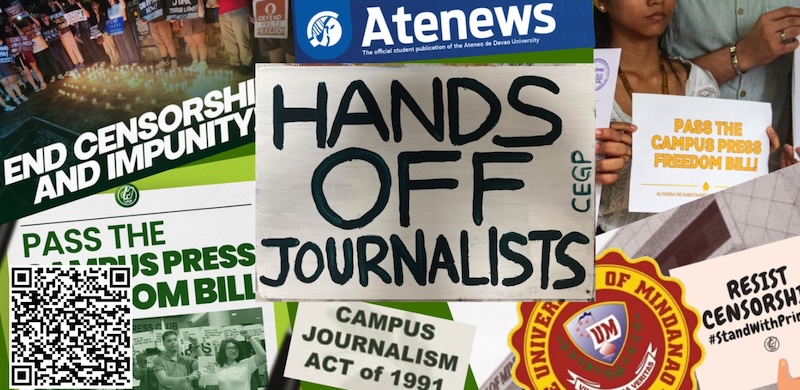
The Primum case was not the one one placing Davao campus journalism underneath a highlight. Not far-off, the Atenews of Ateneo de Davao College confronted a unique type of assault, one which got here not from its personal administration, however from outdoors the campus partitions.
Following the arrest of former President Rodrigo Duterte by the Worldwide Felony Court docket in March 2025, Atenews revealed a joint assertion of the Ateneo Publications Alliance calling for justice and a sober reckoning with the Duterte legacy. What adopted was a flood of hate feedback and “red-tagging” – the observe of accusing critics of being communists – a few of it from the college’s personal alumni neighborhood. The assaults had been traced to pro-Duterte blogger Tio Moreno, whose actual title is Alex Destor, who revealed a now-deleted put up claiming the Atenews assertion didn’t replicate the broader Ateneo neighborhood’s place. Destor went additional, doxxing the publication’s workers by posting the names of its editors.
The Atenews editor-in-chief instructed Rappler the one measure she might consider as a response to the harassment was to instruct her workers to lock their Fb profiles. Not like Primum, nevertheless, the Atenews was not alone. The college president and the scholar council condemned the net assaults and known as on their neighborhood to method the ICC problem with restraint — a reminder that institutional assist, when it exists, makes a important distinction.
The College Editors Guild of the Philippines‘ Davao chapter stated the 2 incidents replicate what pupil journalists within the area face always: “censorship, administrative stress, and restrictions that undermine their capacity to report freely inside their very own establishments.” Because the UM Debate Society put it in an announcement after the Primum resignations: “A censored press weakens scrutiny, shields establishments from accountability, and denies the general public entry to data needed for knowledgeable judgment.”
The Legislation’s Structural Failures
The issues with the CJA should not beauty. They’re baked into its textual content.

Essentially the most consequential flaw is funding. The regulation says pupil publications “might” obtain cash from college financial savings, subscriptions, and different sources, however it doesn’t require faculties to gather publication charges. Critics say this offers directors an influence of the purse over campus journalists, permitting them to withhold funds as a method of silencing important reporting, in the identical approach Congress makes use of budgets to stress businesses. CEGP has recorded greater than 800 campus press freedom violations since 2010; 322 of them concerned inconsistencies and suppression of funds.
The regulation additionally has no penalty provisions. A college can censor, shut down, or starve a pupil paper of assets, and the CJA provides no mechanism to punish the offenders. It doesn’t require all tertiary establishments to have a faculty paper. It doesn’t require closed publications to be reinstated. And it supplies no penal sanctions towards administrations that repeatedly violate campus press freedom.
Then there’s the digital hole. The regulation was written in 1991, properly earlier than the web. It by no means anticipated digital media, leaving on-line campus publications with out clear authorized safety — a niche the UST case made not possible to disregard. And because the Atenews expertise reveals, the menace to digital publications now comes not simply from college officers, however from coordinated on-line harassment campaigns the CJA has no instruments to handle.

At the highschool degree, the structural downside is even starker. On the elementary and secondary ranges, the editorial board consists of a school adviser, the certified pupil editor, and a PTA consultant — and together they determine editorial policies. Meaning directors have a built-in seat on the editorial desk in primary training, the place pupil journalists are youngest and most weak. With the CJA’s implementing guidelines and rules permitting moderators to find out editorial insurance policies and making them answerable for a publication’s contents, publication advisers are likely to go properly past their mandate of offering technical help.
From 2023 to 2024, the CEGP recorded 206 campus press freedom violations nationwide, practically double the 100 instances tallied the yr earlier than.
The Invoice That Retains Dying
The proposed substitute for the Campus Journalism Act has a historical past virtually as dispiriting because the regulation it’s making an attempt to repair.

The primary model, House Bill 4287, was filed Feb. 28, 2011, by then-Kabataan Social gathering-list Rep. Raymond Palatino and Bayan Muna Rep. Teodoro Casiño. Their explanatory word was blunt: whereas the CJA had robust provisions on paper, it was “inadequate and missing in materials points to totally keep the existence of the campus press.” It cited the non-mandatory assortment of publication charges, the absence of penalty clauses for violators, and broad loopholes that left pupil papers on the mercy of their college administrations.
That invoice went to committee and died there. So did a refiled model in 2013 underneath then-Rep. Terry Ridon, and one other in 2016 underneath then-Rep. Sarah Elago. A Senate model filed by then-Sen. Leila de Lima in 2018 — impressed partly by San Beda College’s decision to ban the distribution of 1,700 copies of its senior highschool pupil paper over content material it deemed too important — made it solely to a primary studying.
Elago filed but once more in 2019; a technical working group was shaped in 2020, then shelved when Congress redirected its consideration to COVID-19 laws. In 2022, Rep. Raoul Manuel filed the Home model as HB 1155 whereas Sen. Ramon “Bong” Revilla filed a Senate counterpart. A joint committee listening to was held in early 2023 however no progress adopted.
The invoice was refiled on Aug. 28, 2025 — two days earlier than Nationwide Campus Press Freedom Day — this time as Home Invoice 4172, once more carried by the Kabataan Social gathering-list and supported by the ACT Academics Social gathering-list underneath the Makabayan bloc. It now sits within the twentieth Congress, the place it faces the identical unsure destiny as all its predecessors. As of this writing, no committee listening to has been scheduled.
What the invoice would do, if handed, is significant. It might require all academic establishments to ascertain a pupil publication, mandate the gathering of subscription charges throughout enrollment, and permit campus publications to say real editorial independence.
It might additionally impose penalties for campus press freedom violations — a high-quality of as much as P200,000 and imprisonment of 1 to 5 years upon conviction. Critically, it might outline “technical steering” clearly sufficient to stop directors from utilizing the time period as cowl for editorial interference, and it might prolong authorized safety explicitly to on-line and digital publications.
The invoice has no organized opposition on the report — no bloc of lawmakers has argued publicly towards it. However its repeated failure to advance via 14 years and a number of congresses tells its personal story. Inertia, competing legislative priorities, and the political value of taking over college administrations — a lot of them deeply embedded in native communities and politics — have been sufficient to maintain it bottled up.
There are additionally actual tensions inside the invoice’s numerous variations which have slowed consensus.
The Senate version features a provision permitting college authorities to dam supplies they contemplate libelous, oppressive, or opposite to moral journalism requirements. Pupil press freedom advocates have pushed again arduous towards this, arguing it merely recreates the censorship loophole they’re making an attempt to shut — this time written instantly into the substitute regulation. If directors retain the discretion to determine what qualifies as “oppressive” content material, critics say, the invoice won’t be meaningfully higher than what it replaces.
The CEGP, which has been calling for the repeal of the Campus Journalism Act since 1996, put it plainly ready paper: the CJA “is normally used towards campus journalists as a substitute of defending their rights.” The guild has documented greater than 1,000 campus press freedom violations since 2010. Not a single college administrator has confronted prison expenses underneath the present regulation — as a result of the present regulation imposes none.
Why Campus Journalism Issues
The stakes go properly past pupil newspapers. The Philippines has one of the vital harmful and politically pressured media environments in Asia. Mainstream information organizations face red-tagging, defamation fits, and possession pressures. On this panorama, campus publications usually fill gaps that industrial media can’t or won’t — masking native governance, army operations, land rights conflicts, and the day-to-day abuses that by no means make it to nationwide broadcasts.

Campus journalism can be the place the following technology of journalists is skilled. The reporters who doc extrajudicial killings, labor abuses, and official corruption in the present day realized their craft in class papers. Letting directors silence these papers doesn’t simply hurt pupil journalists — it depletes your entire press freedom ecosystem.
Past the native image, the Philippines has worldwide authorized obligations it ignores each time it permits a pupil publication to be shuttered with out consequence. Article 19 of the Worldwide Covenant on Civil and Political Rights, which the Philippines has ratified, ensures the suitable to freedom of expression — together with the liberty to hunt, obtain, and impart data. The U.N. Convention on the Rights of the Child, additionally ratified by the Philippines, enshrines youngsters’s rights to freedom of expression and entry to data underneath Articles 13 and 17.
When college directors threaten pupil journalists with scholarship revocation, order content material taken down, or padlock a publication’s workplace, they don’t seem to be simply violating a home statute — they’re breaching treaty obligations the Philippine authorities freely accepted.

The Campus Journalism Act was meant to be a protect. What it turned out to be, in too many instances, is a set of loopholes — one for the administrator who claims an adviser overstepped, one other for the college that by no means bothered to gather publication charges, one other for the official who by no means imagined the web existed. The scholars at Primum, at TomasinoWeb, at An Lantawan, at Atenews, and at tons of of different publications throughout the nation didn’t want a regulation with good intentions. They wanted one with enamel.
The scholars who walked away from Primum — and the tons of earlier than them who confronted censorship, fund withholding, red-tagging, and threats — have been ready for Congress to behave for the higher a part of twenty years. They’re nonetheless ready. (Rights Report Philippines with a report from Tyrone Velez)
When you’ve got skilled censorship as a campus journalist, let us know about it.
https://weblog.passive-income4u.com/create-your-very-own-auto-publish-news-blog-site-and-earn-passive-income-in-just-4-easy-steps/
https://mindanews.com/top-stories/2026/03/the-shield-that-became-a-weapon-press-freedom-law-is-being-used-to-suppress-campus-journalists/