DAVAO CITY (MindaNews / 21 November 2026) – Interspersed among the many newest developments in worldwide vitality analysis and cutting-edge applied sciences on the fifteenth Worldwide Discussion board on Power for Sustainable Improvement was a grassroots innovation conceptualized after a lady from the Agusan Marsh stated her dream in life is to “drink water every single day.”
Co-designed by youth-led social and local weather enterprise O1nnovations with the floating communities of Agusan del Sur, the ensuing off-grid rainwater catcher system was the one Filipino undertaking featured among the many varied poster shows on the discussion board, held final November 3-6 on the Xi’an Worldwide Conference Centre in Xi’an, China.
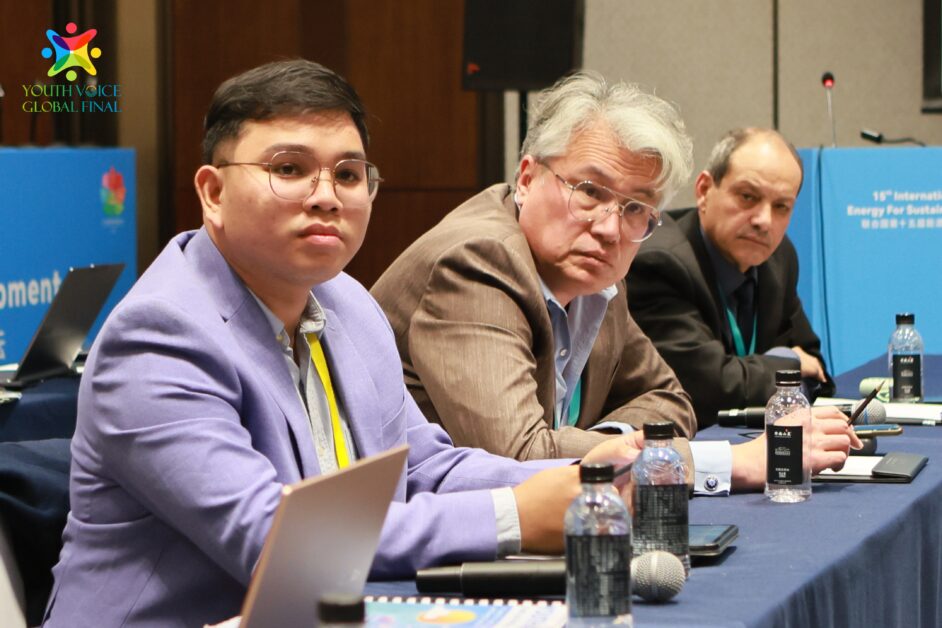
Augustus Nicko Bas, co-founder and CEO of O1nnovations (pronounced “uwan-novations”), underscored the significance of illustration in these avenues in on-line interviews with MindaNews. “In Xi’an, nobody knew there are households residing on water who don’t have water,” he stated. “Insurance policies and developments begin from boards like this; when the grassroots aren’t represented, the (ensuing) suggestions don’t match us,” he pressured. Based on Bas, he was the only Filipino delegate on the discussion board.
An annual international collaboration by 5 United Nations Regional Commissions, this 12 months’s discussion board “addressed vitality safety, financial progress, and resilience, with discussions protecting the entire vitality worth chain,” in accordance with a press launch posted on the web site of the United Nations Financial Fee for Europe (UNECE) dated November 6.
For Bas, these discussions have been vital alternatives to spotlight grassroots realities. The O1nnovations raincatcher system he mentioned throughout networking breaks with discussion board attendees — who included representatives from governments, worldwide organizations, business, academia, and different stakeholders — is a gravity-powered full unit that harnesses rainwater for normal use or converts it into potable water, relying on the precise system. It additionally comes with a tank, a gutter, a pipe, a filter, and a faucet, designed to allow entry to consuming water or water used for broader functions like washing and cleansing for the floating communities of the marsh, in addition to faculties and business properties in water-scarce areas.

At the moment, their rainwater catchers have harvested over 200,000 liters of rainwater from the assorted programs they’ve put in all through their province. This features a floating sanitary facility with a rainwater harvesting system in Sabang Adgawan, La Paz, serving not less than 60 kids and 5 daycare lecturers.
The identical off-grid expertise was additionally piloted throughout two extra floating communities in Maharlika and Sabang Gibong, in addition to not less than three completely different elementary faculties. In earlier interviews with this reporter, Bas stated that together with faculties of their goal communities turned a necessity as a result of in faculties that aren’t related to water utilities, college students come to class bringing not solely their luggage but additionally buckets of water.
These neighborhood nuances have been likewise a spotlight in Bas’ participation as a panelist in a dialogue on “Resourcing the Future: Important Minerals and Intergenerational Fairness,” which was uploaded on YouTube by moderator Maximilian Ang Jian Zhi, First Deputy Govt Director of the Uncover Mannequin United Nations Basis, and whose transcripts have been captured in a doc shared with MindaNews.
Requested concerning the significance of youth and indigenous communities in sustainable growth, Bas foregrounded the dialogue on vital minerals by stating:
“The floating neighborhood lives on water, but lacks entry to wash water. Why is that this? As a result of the water round them is contaminated with heavy metals from close by mining operations. They will’t drink it. And only recently, they’ve been instructed to not fish in it.
“I don’t deny the financial worth of mining, however the place I reside, the social indicators aren’t counted. If counted, they have been clearly taken without any consideration. So (some) issues have to vary.”
Chief amongst these is making certain entry to fundamental commodities. Based on Bas, defending the surroundings and the individuals who shield it can’t occur with out the supply of water, vitality, and training. “Solely then can they consider their very own options and search alternatives as an alternative of simply surviving every day,” he stated.
One other necessary issue for significant participation is offering capability growth for indigenous youth to make sure that they don’t solely declare a seat, however know the best way to use it. Indigenous leaders and elders ought to equally be concerned in decision-making at each step of the method, not solely consulted ultimately, he stated.
“Let’s bear in mind this: the surroundings the youth will inherit sooner or later is being determined now… If we require younger individuals to current a totally developed answer earlier than giving them help, after all, younger individuals and indigenous communities can’t beat the newest applied sciences that we at the moment have,” he pressured.
Lastly, applications should deliberately measure social indicators and maintain corporations accountable via frameworks just like the United Nations Framework Classification for Assets and the United Nations Useful resource Administration System, which already declare that social viability counts as a lot as geology. What’s lacking, Bas stated, is the measurement that checks whether or not the rules are being adopted.
“So earlier than exploration begins, set up a social baseline for the neighborhood’s training, hygiene, water entry, vitality entry, well being, and different social indicators,” he stated. “Maintain (corporations) accountable towards that baseline for the lifetime of the undertaking and after closure. If the indications go down, the undertaking shouldn’t be viable, irrespective of how wealthy the deposit is,” he added.
Pathways to participation
Except for contributing his insights as a panelist, Bas was additionally appointed Youth Ambassador for the Worldwide Society for Power Transition Research (ISETS). Delivering the youth message on the closing day, he underscored the significance of trusting the youth to form the choices that can usher sooner or later, notably via the vitality transition, as “the technology that can reside longest with the vitality selections made in the present day.”
Easing entry to participation is essential to that, Bas stated. On the discussion board, he stated his participation was funded by the UN and ISETS via the UN Financial and Social Fee for Asia and the Pacific, after O1nnovations received the first World Prize within the Youth Voice on Power Transition competitors final 12 months, and engaged with UN officers about vitality transition, renewable vitality, and the position of the youth in these conversations.
With out this, international locations and even small organizations like his can nonetheless ship delegates, together with youth delegates, if they’ve the price range. However Bas stated extra work must be finished to make participation equitable. “We want extra applications that attain youth who need to serve, not solely those that pays,” he stated.
The discussion board ended with the adoption of the Xi’an Declaration on Power Transition in an Unsure World: Driving Safety, Progress, and Resilience, which requires “stronger regional electrical energy connectivity, sooner renewable vitality deployment, improved vitality effectivity, and accountable administration of vital minerals as priorities… (whereas emphasizing) funding and the participation of native communities in vitality decision-making,” in accordance with the UNECE press assertion.
Coming again dwelling to Agusan del Sur, Bas will likely be carrying the teachings that he discovered from the discussion board, whereas additionally scaling their present efforts via authorities help and after successful native awards. These embrace nabbing 1st place on the 2026 Caraga Startup Fest Pitching Competitors (Round Economic system Resolution class) by the Division of Science and Know-how Caraga, in addition to the Kabataang Resilient Award (Youth Group class) on the KLIMALIKASAN: Local weather and Catastrophe Resiliency Recognition Awards 2026 from the Division of Setting and Pure Assets and UNICEF.
Networking with different attendees, he has moreover realized how useful it is going to be to make use of photo voltaic applied sciences to make sure the ability points within the floating communities may also be addressed. “(Our considering) is to ‘fall in love with the issue, not together with your answer’; (so) even when O1nnovations has its personal RainCatcher programs, we don’t assume and faux that this alone can remedy the issue of the neighborhood,” he stated.
He additionally intends to construct a youth community that particularly focuses on off-grid, distant, and geographically remoted and deprived areas, hoping to spur change from advocacy and into influencing and lobbying for insurance policies. This solidarity, he stated, will likely be very important to attaining real and equitable illustration, harnessing the ability that comes from that, and utilizing it to drive and notice social change.
“We’re only a small youth group. Can we do all of it? Absolutely not. Can we do it with extra youth lively in altering their communities? Sure,” he closed. (Kat Petines-Rabino / MindaNews)
https://weblog.passive-income4u.com/create-your-very-own-auto-publish-news-blog-site-and-earn-passive-income-in-just-4-easy-steps/
https://mindanews.com/top-stories/2026/11/rainwater-harvesting-system-in-agusan-del-sur-featured-at-un-energy-forum/