Bea Gatmaytan of MindaNews and David Ezra Francisquete of SunStar Davao
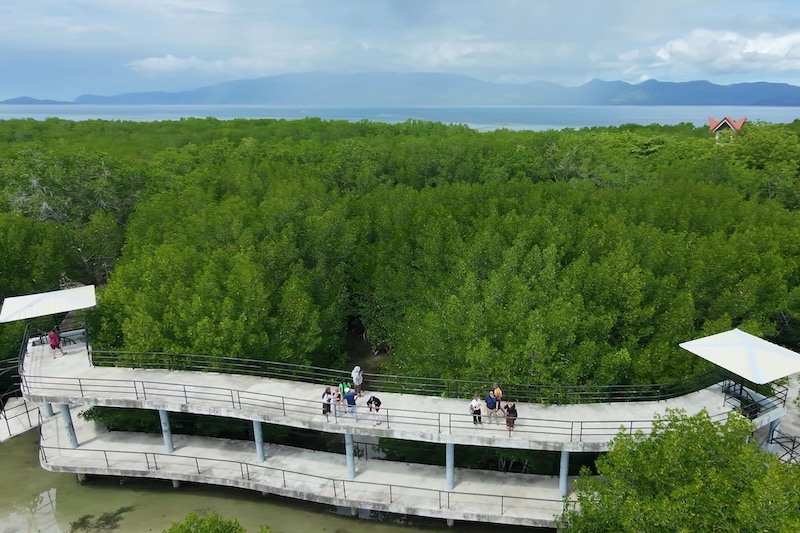
MATI CITY (MindaNews / 01 Could) — Rows of mangrove seedlings line components of Guang-Guang Mangrove Park and Nursery — a protected panorama and seascape space in Pujada Bay. However not all of them take root: some wither beneath the warmth and different local weather issues, whereas others fail to develop in any respect regardless of repeated mass planting efforts.
Within the coastal group of Sitio Guang-Guang, Barangay Dahican, an estimated 20 hectares of mangroves (Rhizophora mangle) are seen as a frontline protection againstclimate change.
But throughout many coastal areas, survival charges have raised questions on how these efforts are being carried out.
Amid storm surges and typhoons, the failure of those planting efforts exhibits that planting mangroves alone just isn’t sufficient.
Throughout the park, mangrove rehabilitation has been ongoing for years with thousands and thousands of seedlings launched by numerous packages. Since 2020, Mama Earth Basis — a non-government group (NGO) devoted to restoring mangroves in Mati — has planted 5 million seedlings, with an estimated survival charge of 70 to 80 p.c, in keeping with Amy Ponce, Director of the Regional Built-in Coastal Useful resource Administration Heart of Davao Oriental State College (DOrSU).
This leaves a 20 to 30 p.c portion that doesn’t survive.
Consultants underscore the basic difficulty that not all mangroves can develop all over the place.
“Particularly if you end up not in science, the idea of, ‘after we plant a tree (if we plant bushes) is at all times good,’ but it surely’s not really, (as a result of) whenever you introduce sure species on a sure space, there are alteration ‘yan (there shall be alterations in ecology) … you really want to formulate with consultants earlier than you do this,” she stated.
As Ponce underscores, mangrove ecosystems depend upon exact environmental situations: soil type, tidal patterns, and wave exposure all decide which species can survive in a given space. Guang-Guang alone incorporates a number of ecological zones — from mudflats to sand flats — every suited to completely different mangrove species.
Environmental research present how mangrove forests are structured by clear zonation patterns pushed by tidal elevation, salinity, and flooding frequency, the place every species occupies a slim ecological band formed by its tolerance to environmental stress. The examine exhibits that even slight modifications in floor elevation or hydroperiod can decide whether or not a mangrove species thrives, survives marginally, or fails fully — reinforcing the concept that mangrove distribution is tightly managed by coastal bodily situations.
Pricey mistake
Improper planting additionally impacts extra than simply the mangroves themselves. In accordance with Wetlands Worldwide, planting mangroves in mudflats can disrupt all the ecosystem: open mudflat areas function feeding and roosting grounds for migrating fowl species, and as key actors in sustaining a coastal sediment stability. Masking these areas with mangroves would deprive these birds of their pure feeding grounds, and alter hydrodynamics — resulting in elevated erosion elsewhere.
“Seagrass meadows and mudflats have their very own ecosystems,” Annabel Cabanban, Nation Supervisor of Wetlands Worldwide Philippines, stated in an October 2025 article on why planting mangroves in mudflats is a costly mistake. “Once you plant mangroves on non-mangrove areas, the mangroves will both die or destroy all the ecosystem,” she stated.

Regardless of this, nevertheless, large-scale planting efforts proceed, typically pushed by campaigns or occasions with little to no ecological planning. In some circumstances, in keeping with Ponce, mangroves had been planted in the course of the pandemic with out correct website matching, resulting in broken or destroyed development.
The result’s a repeated cycle of planting and replanting that doesn’t tackle the underlying mismatch between species and website.
However, when science does information intervention, indicators of restoration turn out to be clear. In areas the place mangrove development has been correctly managed, water high quality has improved and juvenile fish populations have elevated, in keeping with Ponce.
Consultants emphasize that, greater than planting a goal variety of seedlings, profitable restoration additionally requires website assessments, species matching, and long-term monitoring — approaches aligned with ecological mangrove restoration practices. Ponce reiterated that establishing baseline information grounded in sound scientific proof is important.
Excessive warmth, restricted water provide
Excessive warmth and restricted water provide have dealt a serious blow to mangrove rehabilitation efforts in Mati Metropolis, leaving most seedlings unfit for planting, Jeomar Senagan, head of the Fisheries Division of the Bureau of Fisheries and Aquatic Sources (BFAR-Mati) stated.
Senagan cited extended publicity to excessive temperatures as a key issue.
He recalled that in the course of the first quarter of 2025, only about 10% of the 5,000 Bakhaw (purple mangrove) seedlings — equal to roughly 500 — survived.
“We’ve got shares of diria seedlings, about 5,000. We’re sustaining it diligently after which they had been discovered hole within the straight warmth, they died (We’ve got a inventory of about 5,000 seedlings right here. We preserve them watered (however) when uncovered to direct warmth, they die),” Senagan stated.
The seedlings had been grown for coastal planting, significantly in Guang-Guang Mangrove Park. The remaining inventory was set for planting in June.
Improper planting practices additionally have an effect on coastal communities. As a result of mangrove forests function nurseries for fish, crustaceans, and different marine life, additionally they help coastal livelihoods — displaying how environmental points are additionally human points.

Genieve Monares, 52, of Purok Dapila in Brgy. Dahican started fishing in Pujada Bay in 1993, when fish catch was plentiful and mangrove ecosystems had been nonetheless wholesome and secure. She recalled that, previous human actions — significantly the “culturization” of coastal sources, akin to unlawful mangrove reducing and shrimp aquaculture enlargement — contributed to environmental disturbance.
Monares famous that mangrove areas are generally transformed into shrimp ponds, which may undermine conservation efforts.
“Maybe it’s inevitable that the product shall be culturalized, the identical as a tree,” she stated.
In accordance with Ponce, unlawful logging was as soon as a serious difficulty within the space attributable to plans to arrange shrimp farms.
“Now the difficulty has been resolved,” stated Ponce. “The shrimp farm did not cease however they solely stopped reducing — (clearing) the mangroves.” Whereas the shrimp farm plan was carried out, it was accomplished in a manner that didn’t have an effect on the mangroves within the coastal ecosystem.
“A number of the areas, which isn’t actually doable shrimp farm they constructed, we planted them mangroves,” Ponce continued, explaining how areas off-limits to the shrimp farm had been since lined with mangroves — correctly, and with acceptable scientific assessments.
Rising temperatures and growing environmental pressures proceed to point out how mangroves turn out to be a crucial line of protection for coastal communities. Nonetheless, their effectiveness will depend on how their restoration is carried out.
In tree planting efforts, the belief of “the extra, the merrier” might result in unintended impacts on the very ecosystems meant to be protected. (Bea Gatmaytan of MindaNews and David Ezra Francisquete of SunStar Davao)
(This story was produced in the course of the Local weather Impression and Atmosphere Reporting Workshop for Journalists in Mindanao on April 24 to 27 in Mati Metropolis, Davao Oriental. It was organized by the Mindanao Institute of Journalism, writer of MindaNews, beneath the Media Impression Philippines venture. Media Impression is supported by Worldwide Media Assist (IMS) and co-funded by the European Union and the Danish Worldwide Growth Company (DANIDA))
https://weblog.passive-income4u.com/create-your-very-own-auto-publish-news-blog-site-and-earn-passive-income-in-just-4-easy-steps/
https://mindanews.com/top-stories/2026/05/right-species-right-place-why-science-matters-in-mangrove-restoration/